

For nearly five decades, USS Midway traveled the world.
Midway crossed oceans, operated in the waters off Vietnam, became the first U.S. aircraft carrier permanently homeported overseas, helped evacuate thousands during Operation Frequent Wind, and served as flagship of naval air forces in the Persian Gulf during Operation Desert Storm.
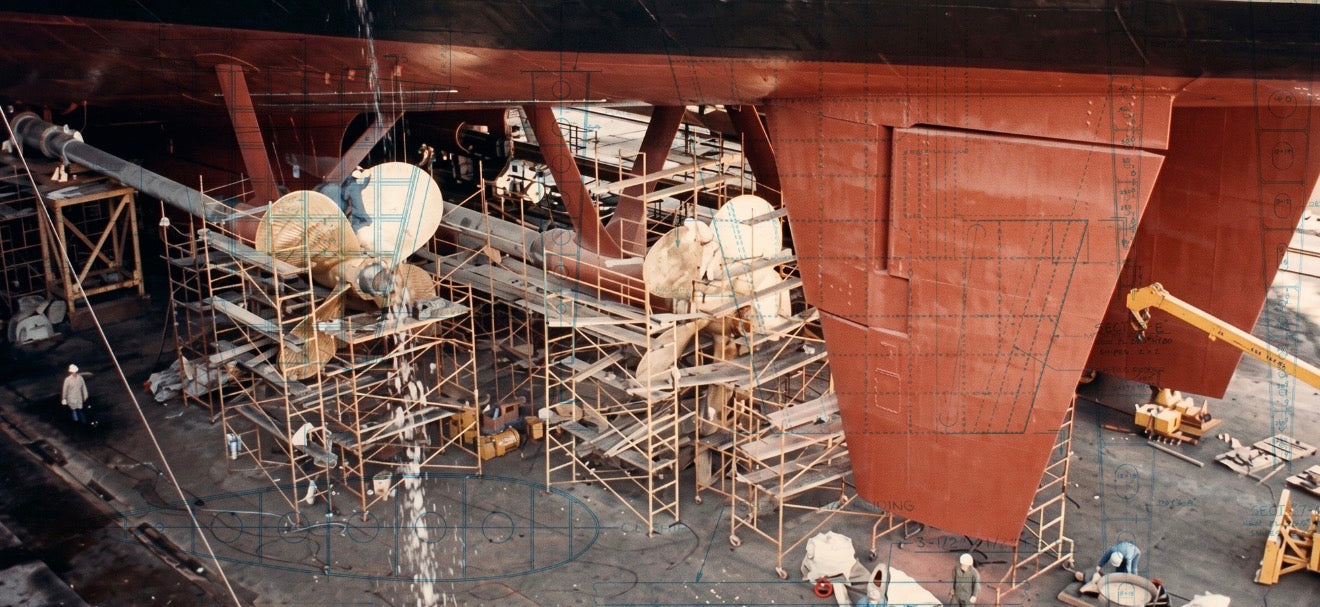
Through all those miles, much of the machinery that kept the massive carrier moving remained hidden beneath the waterline. Among the most important were the rudders.
Today, USS Midway rests along Navy Pier in San Diego as one of America's most visited historic naval ships. But even at rest, preserving a nearly 1,000-foot aircraft carrier presents challenges few museums ever encounter.
In 2023, one of those challenges led to an extraordinary operation beneath the waters of San Diego Bay and, eventually, to the material behind the newest USS Midway PlaneTags.
Steering USS Midway
An aircraft carrier may be defined by its flight deck, but below the waterline was an equally impressive system responsible for moving and maneuvering the ship. USS Midway was equipped with four enormous propellers, or screws, that provided the thrust needed to move the carrier through the water.

Behind them were two massive rudders, each measuring approximately 32 feet long. As water moved past the rudders, changing their angle redirected the flow of water and allowed Midway to change course.
For the sailors responsible for navigating the ship, those rudders were an essential connection between an order given aboard the carrier and the movement of tens of thousands of tons of ship through the sea.
They were there through Midway's Cold War deployments, combat operations in Vietnam, humanitarian missions, decades of service in Japan, and the ship's final combat deployment during Operation Desert Storm. Most sailors and passengers aboard Midway would never see them. But for nearly 47 years, they helped determine where the ship went next.
A New Challenge Beneath Midway
USS Midway was decommissioned on April 11, 1992, bringing nearly 47 years of naval service to an end. In 2004, a new chapter began when the carrier opened to the public as the USS Midway Museum in San Diego.

By PH1 GALEN WALKER - DoDMedia, Public Domain, Link
Midway's engines would no longer propel the ship across the world's oceans, but preserving a vessel of this size created an entirely different set of engineering challenges. Although permanently berthed at Navy Pier, Midway still floats. Beneath the stern, the waters of San Diego Bay are relatively shallow.
Over time, tidal action caused silt to accumulate beneath the ship. During particularly low tides, Midway's enormous rudders and propeller blades began making contact with the muddy floor of the bay. The problem was more serious than simply having the ship touch bottom. The upward forces created when these massive components contacted the bay floor placed abnormal stresses on Midway's rudders, propeller shafts and surrounding structure. Museum engineers needed a long-term solution.
Midway's Underwater Surgery
Dredging beneath the carrier was considered, but removing the accumulated silt would provide only a temporary solution. Following extensive analysis by naval architects and engineers, another approach was chosen: reduce the portions of Midway's propulsion and steering equipment extending deepest beneath the waterline.
Normally, work of this magnitude would be performed with a ship sitting in dry dock, however that wasn't an option for Midway. Instead, the work would have to happen underwater while the nearly 1,000-foot carrier remained at Navy Pier.

Phoenix International, along with Bluegrass Company and Pacific Maritime Group, developed a specialized plan for the project. Divers had to work around changing tides, limited clearance beneath the carrier and the immense weight of the material being removed. Custom-built diamond-wire rail saws were used underwater to make the cuts.
Ultimately, seven and a half feet were removed from the bottom of each of Midway's two 32-foot rudders. Seven of the ship's 14 propeller blades were also partially removed. It was an extraordinary engineering operation performed not to dismantle Midway, but to help preserve the historic carrier. Read more here: Midway's Underwater Surgery
Preserving What Was Removed
Removing historic material from a museum ship presents another question: What happens to it next?

For USS Midway Museum, the material removed during the underwater project represented something much more significant than scrap metal. These were pieces of the carrier that had been part of Midway throughout decades of service.

MotoArt has partnered with USS Midway Museum to preserve portions of this historic material in a different form. Our previous USS Midway PlaneTags releases have given collectors the opportunity to own material connected directly to the ship while helping support the museum's continuing preservation efforts.
Now, another part of Midway's story is being preserved. The rudder.
From Aircraft Carrier to PlaneTags
The material used to create these PlaneTags came from sections of USS Midway's rudder removed during the 2023 underwater preservation project. After coming to MotoArt, the material began another transformation.

Sections were prepared and cut into the familiar PlaneTags shape, preserving the original material, surface characteristics and variations created during decades aboard the carrier.


Each finished tag carries something that photographs alone cannot fully convey: actual material from the steering system of USS Midway.
Material that spent decades beneath the waterline. Material that helped guide Midway through nearly half a century of naval history. And material that was ultimately removed so that the ship itself could continue to be preserved.
USS Midway Rudder PlaneTags
The newest release in our partnership with USS Midway Museum preserves another remarkable piece of the legendary aircraft carrier. Each USS Midway Rudder PlaneTag is made from authentic material removed from Midway during the museum's underwater preservation project and is individually numbered.
USS Midway Rudder PlaneTags will be available beginning Thursday, August 20, 2026 at 12 PM Pacific.
A portion of proceeds from the project supports USS Midway Museum and its continuing mission to preserve the ship and share the stories of the men and women who served aboard Midway.
For decades, these rudders helped determine where Midway went next. Now, a piece of that history can continue its journey in your collection.
Explore More USS Midway Stories
Every piece of USS Midway material has a story behind it. From the massive propellers below the waterline to the watertight doors within the ship, each offers a different look at nearly 47 years of service.
Explore more of our USS Midway stories and discover the history behind the material that has become part of the PlaneTags collection.
USS Midway: A Legendary Aircraft Carrier and Its Lasting Legacy
USS Midway History: Preserving the Materials of a Legendary Carrier


Share:
The Gulfstream That Helped Preserve Walt Disney's Airplane