

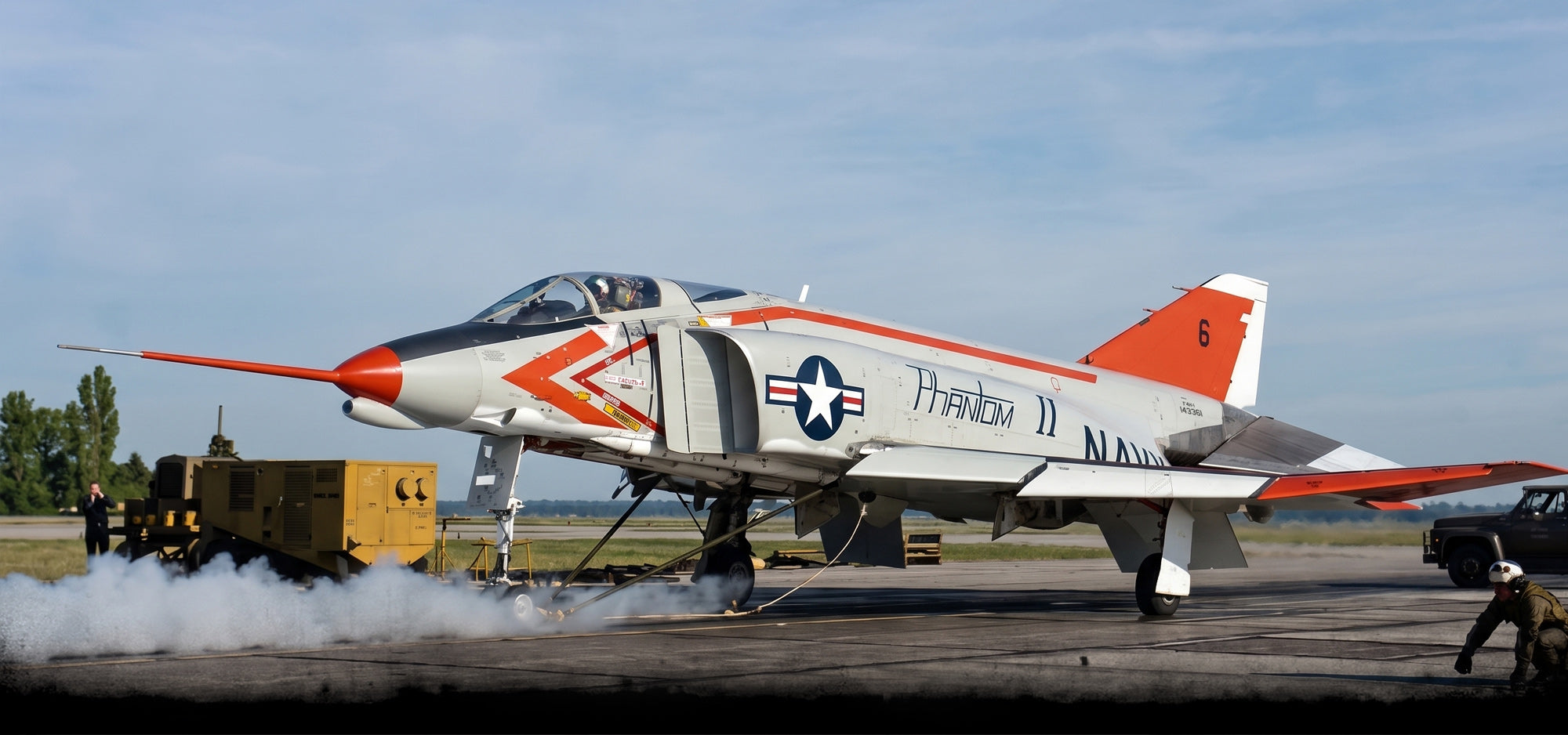
On February 15, 1960, an F4H-1F Phantom arrived aboard USS Independence with a fundamental question to answer: Could the Navy’s powerful new fighter truly operate at sea?
Every legendary aircraft has a beginning.
Long before the McDonnell Douglas F-4 Phantom II became one of the world's most recognizable military aircraft, it was simply an ambitious new design with something to prove. The U.S. Navy envisioned a supersonic, twin-engine fighter capable of defending carrier battle groups in the rapidly changing Cold War environment. On paper, it was impressive. The question was whether it could successfully operate from an aircraft carrier. One aircraft would help answer that question.
BuNo 143391, built as F4H-1F and later redesignated the F-4A Phantom II, became the sixth production Phantom ever built. While later Phantoms would earn their reputation in combat around the world, BuNo 143391 helped establish that reputation before the aircraft ever entered fleet service. Add a Phantom II to your collection.
The Navy Needed Something Revolutionary
By the late 1950s, naval aviation was evolving quickly. Aircraft were becoming faster, heavier, and more capable than ever before. The Navy needed a new fleet defense fighter that could intercept high-speed bombers in all weather conditions while operating safely from aircraft carriers. McDonnell Aircraft answered with the F4H Phantom II.
Designed around two General Electric J79 turbojet engines, advanced radar, and missile armament, the Phantom represented a significant leap forward in performance. But impressive specifications alone weren't enough. Carrier operations remained one of aviation's greatest challenges, and every new naval aircraft had to prove it could withstand repeated catapult launches and arrested landings at sea.
That's where BuNo 143391 entered the story.
Meet BuNo 143391
BuNo 143391 was built as one of the earliest production F4H-1F aircraft, a designation used before the Department of Defense adopted the unified aircraft naming system in 1962. Under that system, the aircraft became known as the F-4A Phantom II.

U.S. Navy photo, public domain
Unlike later operational Phantoms assigned to fleet squadrons, BuNo 143391 served as a developmental aircraft. Its purpose wasn't combat, but testing. Engineers and Navy pilots used aircraft like 143391 to evaluate handling characteristics, carrier suitability, and overall performance before the Phantom entered operational service. As one of the earliest production aircraft, every flight helped refine the Phantom program and move it one step closer to becoming the Navy's next frontline fighter.
An Early Phantom Unlike the Rest
As one of the earliest production Phantoms, BuNo 143391 differed in several ways from the F-4s that would later serve around the world. During the Phantom's development, engineers continuously refined the design as flight testing revealed opportunities for improvement. As a result, BuNo 143391 incorporated several features unique to the Phantom's earliest days, many of which would evolve before full-rate production.
Among its most recognizable characteristics were a smaller radome, differently shaped engine air intakes, and a lower-profile rear cockpit canopy, giving the aircraft a noticeably different appearance from later Phantom variants. These features provide a fascinating glimpse into the Phantom's evolution as McDonnell engineers refined the design for fleet service.
Perhaps most significant was BuNo 143391's blown-flap boundary layer control system. By directing high-pressure engine bleed air over the wing flaps during takeoff and landing, the system increased lift and improved low-speed handling, essential qualities for carrier operations. Its successful evaluation during carrier trials demonstrated the system's effectiveness, and it was adopted on subsequent production Phantoms, becoming one of the innovations that contributed to the aircraft's exceptional performance aboard aircraft carriers.
F4H-1F Phantom II At A Glance

F4H-1F SPECIFICATIONS
Manufacturer: McDonnell Aircraft Corporation
Model: F4H-1F Phantom II
S/N: BuNo 143391
Crew: 2 (pilot and radar intercept officer)
Mission: Carrier-based all-weather interception and carrier suitability testing
Sensors: AN/APQ-50 Modified/APQ-72 radar and AN/AAA-4 infrared search-and-track system
Wing Span: 38 ft 5 in
Length: 56 ft 0 in
Height: 16 ft 3 in
F4H-1F PERFORMANCE
Range: 2,300 mi with external fuel
Max Speed: 1,485 mph
Ceiling: 62,000 ft
Empty Weight: 28,000 lb
Maximum Takeoff Weight: 54,600 lb
Rate of Climb: 28,000 ft per minute
Engine: 2x General Electric J79-GE-2 afterburning turbojets
The Test That Changed Everything

By USN - U.S. Navy Naval Aviation News May 1960 [1], Public Domain, Link
On February 15, 1960, BuNo 143391 arrived aboard USS Independence (CVA-62) for one of the most important milestones in the Phantom's development.
Carrier qualification is demanding for any aircraft. Pilots must repeatedly launch from steam catapults, recover using arresting gear, and demonstrate consistent handling under a wide range of conditions. Success means an aircraft is ready for fleet service. Failure can send engineers back to the drawing board.
Flying BuNo 143391, Lieutenant Commander Paul Spencer completed 17 arrested landings, including one at a sink rate of 21.8 Feet Per Second, and 18 catapult launches, demonstrating that the Phantom possessed the stability, power, and handling qualities required for carrier operations.
The successful trials marked the first time a Phantom had completed carrier suitability testing, providing the Navy with the confidence to move the aircraft toward operational service.

By USN - U.S. Navy Naval Aviation News May 1960, Public Domain, Link
Flight Test Milestone
February 15, 1960
USS Independence (CVA-62)
-
First Phantom to successfully complete carrier suitability trials
-
17 arrested landings, including one at a sink rate of 21.8 Feet Per Second
-
18 catapult launches
-
Helped qualify the Phantom for U.S. Navy service

By U.S. Navy - National Museum of the U.S. Navy photo 428-GX-USN 710625, Public Domain, Link
The Birth of a Legend
The Phantom quickly proved itself to be one of the most capable military aircraft of its generation.
Over the following decades, the F-4 served with the U.S. Navy, Marine Corps, and Air Force, as well as the armed forces of numerous allied nations. More than 5,000 aircraft were built, serving as interceptors, fighters, reconnaissance platforms, and attack aircraft. The Phantom established speed and altitude records, flew combat missions around the world, and remained in military service for decades.
Check out "The F4H Navy Fighter", a 1960 promo film.
Its accomplishments are well known. Less well known are the aircraft that helped make those accomplishments possible.
Before fleet squadrons, before combat deployments, and before the Phantom earned its legendary reputation, early aircraft like BuNo 143391 demonstrated that the design was ready for operational service. Read about another F-4, BuNo 148369, on our blog: F-4 Phantom: An Enduring Frontline Fighter
A Second Life
Following its successful carrier suitability trials, BuNo 143391 continued serving in the Navy's flight test program. The aircraft later transferred to the Naval Air Test Center at Patuxent River, Maryland, where it supported additional evaluation work as the Phantom entered fleet service. Naval records indicate the aircraft was Struck Off Charge on August 17, 1962, ending its relatively brief but historically significant career.
After its testing career ended, BuNo 143391's future became uncertain. Retired U.S. Air Force Colonel Jack G. Wilson acquired the aircraft with hopes of restoring it. Initially believed to be another historically significant early Phantom, further research, including surviving paint markings, photographs, and historical documentation, confirmed the aircraft's true identity as BuNo 143391, the sixth production Phantom and the aircraft that completed the Phantom's first successful carrier suitability trials.
Although time had taken its toll and restoration was no longer practical, its historical importance remained unchanged.

Rather than disappear into history, portions of this pioneering aircraft have now been preserved through PlaneTags, allowing collectors to own an authentic piece of one of the Phantom program's most significant early aircraft.
From Aircraft to PlaneTags
Every PlaneTag begins with authentic aircraft material, but preserving that history takes careful planning and craftsmanship.


After acquiring McDonnell Douglas F4H-1F Phantom II BuNo 143391, the MotoArt team carefully removed sections of the aircraft's aluminum skin for preservation. The material was then transported to MotoArt Studios in Torrance, California, where it was prepared for its next chapter as authentic PlaneTags.
Each piece retains the unique character of the aircraft itself, allowing collectors to own a tangible connection to one of the earliest and most historically significant Phantoms ever built.
"Our goal is always to preserve the history of the aircraft while giving collectors a genuine connection to it. Every piece we cut has a story, and it's our responsibility to honor that story."
– Dave Hall, Founder, MotoArt & PlaneTags


A Legacy Preserved
Not every historic aircraft becomes famous because of where it flew or what missions it completed. Some become important because they helped prove what future generations of aircraft could achieve.
BuNo 143391 occupies a unique place in Phantom history. As one of the earliest production aircraft and the first to successfully complete carrier suitability trials, it helped demonstrate that the Navy's newest fighter was ready for service. Every operational Phantom that followed owes something to the work completed by aircraft like 143391.
Today, that history continues through authentic PlaneTags crafted from the original aircraft material. Each individually numbered tag preserves a tangible connection to the Phantom's earliest days and the moment one aircraft helped launch one of the most successful fighter programs in aviation history. Get your F4H-1F PlaneTags now.


Continue Your Naval Aviation Collection
The story of BuNo 143391 is one chapter in the long history of U.S. naval aviation.
Explore our Naval Aviation Collection, featuring authentic PlaneTags crafted from legendary Navy and Marine Corps aircraft, including historic trainers, helicopters, carrier aircraft, and artifacts from the USS Midway. Each preserves a unique piece of naval aviation history while helping tell the stories behind the aircraft that served at sea.

Share:
The Prototype That Changed Regional Aviation: The Story of Embraer's First E190
The Gulfstream That Helped Preserve Walt Disney's Airplane