

The Bell UH-1V Huey, the crews who answered the call, and a piece of aviation history preserved by PlaneTags.
Few helicopters are as instantly recognizable as the Bell UH-1 Iroquois. Better known as the "Huey," its distinctive rotor beat became the soundtrack of an era. From transporting troops and supplies to evacuating wounded soldiers, the Huey earned its place as one of the most iconic helicopters in military aviation history. For those waiting for help on the battlefield, the sound of an approaching Huey meant something more. Hope.
For the pilots, crew chiefs, and medics who answered the call of "DUSTOFF," every mission was a race against time. Their job was to reach the wounded, provide lifesaving care, and bring them to safety, sometimes under enemy fire.
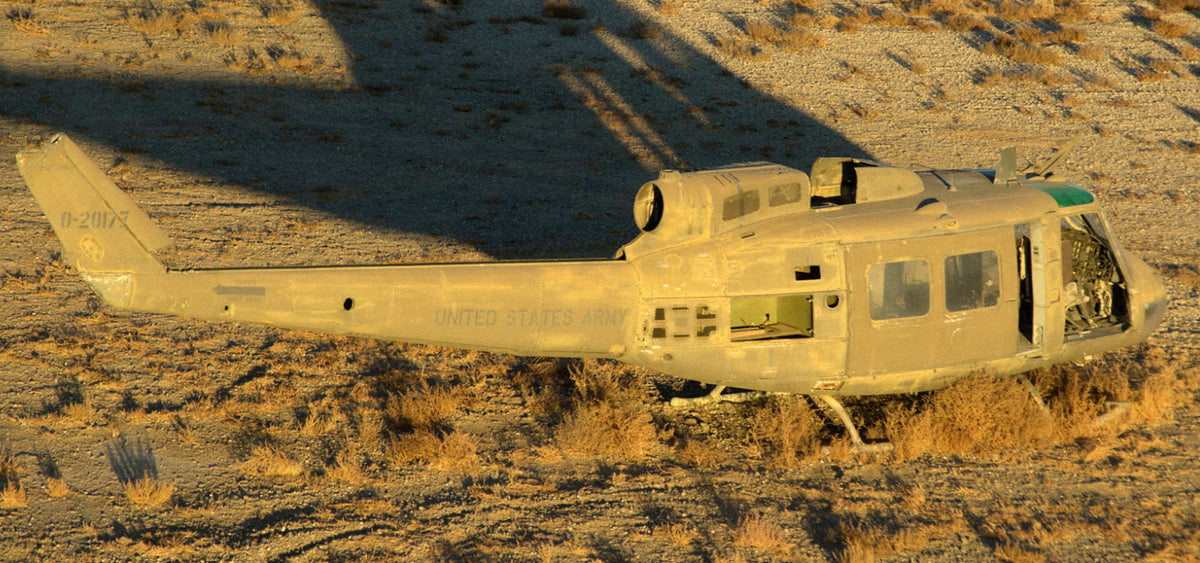
One helicopter that would eventually take on this lifesaving role was Bell UH-1V Iroquois 71-20177. Originally built as a UH-1H utility helicopter, it was later converted for dedicated aeromedical evacuation duties. Now, a piece of its history lives on through PlaneTags.
The Huey: An American Aviation Icon
The Bell UH-1 Iroquois first flew in 1956, developed to meet the U.S. Army's need for a turbine-powered utility and medical evacuation helicopter. Its nickname, "Huey," came from its original HU-1 designation and remained long after the aircraft was redesignated UH-1.

uh-1 flickr photo by Judge Rock shared under a Creative Commons (BY-NC 2.0) license
The helicopter became inseparable from the Vietnam War, where its versatility made it indispensable. Hueys carried troops into landing zones, delivered supplies to remote positions, supported combat operations, and transported casualties to medical facilities.
The UH-1H, one of the most widely used versions, featured a more powerful engine and improved performance compared with earlier models. Its spacious cabin and ability to operate in challenging conditions made it particularly valuable for medical evacuation. The Huey was more than a workhorse. It became a symbol of the soldiers and aircrews who depended on it, and of the lives it helped save.
DUSTOFF: A Mission to Save Lives
During the Vietnam War, helicopter medical evacuation became one of the most important developments in battlefield medicine. The call sign "DUSTOFF" was adopted by the U.S. Army's 57th Medical Detachment in 1963. The name was fitting. When helicopters landed in the dry fields of Vietnam, their powerful rotor wash sent clouds of dust and debris swirling into the air.

By Australian War Memorial - https://www.awm.gov.au/collection/C290044, CC0, Link
DUSTOFF crews often flew unarmed helicopters marked with red crosses, entering dangerous areas to retrieve wounded personnel. Their missions demanded extraordinary coordination between pilots, crew chiefs, and medical personnel. Every moment counted.
One of the most influential figures in this history was Major Charles L. Kelly, commander of the 57th Medical Detachment. Kelly became known for his unwavering commitment to reaching wounded soldiers, even in the face of enemy fire.

Major Charles L. Kelly, Medical Service Corps, United States Army. Photo from the United States Army - National Archives II at College Park, Maryland, Record Group 319, Entry UD 1134, Box 1, Folder 1, "Pictures, Related Letters.", Public Domain, Link
On July 1, 1964, while attempting to retrieve casualties under fire, Kelly was killed in action. His final response when urged to withdraw became a defining expression of the DUSTOFF mission: "When I have your wounded."
Those words became a lasting symbol of the dedication shown by generations of aeromedical evacuation crews. For the wounded waiting below, the arrival of a DUSTOFF helicopter could mean the difference between life and death.
From UH-1H to UH-1V: A New Mission

By Jones, Michael John - https://www.awm.gov.au/collection/C331639, CC0, Link
The Huey had already proven its value as an air ambulance during the Vietnam War, but its lifesaving mission continued long after the conflict ended. Beginning in 1976 and throughout the 1980s, approximately 220 UH-1H helicopters were converted to the UH-1V configuration, specifically designed for aeromedical evacuation. These upgraded aircraft featured improved avionics, rescue hoists, and specialized medical equipment, allowing crews to transport patients and conduct rescues in challenging conditions.
The UH-1V could accommodate up to six litter patients or, in another configuration, three litter patients and four ambulatory patients. A typical four-person crew included two pilots, a crew chief, and an emergency medical technician. Unlike armed variants of the Huey, these dedicated medical evacuation helicopters carried no external weapons.

By SP4 Richard Rogers - Image, Public Domain, Link
The UH-1V continued serving with U.S. Army and Army National Guard units for decades, supporting military medical missions, civilian emergencies, and disaster relief operations. In 2006, a New York Army National Guard UH-1V used its rescue hoist to save civilians stranded in a flooded home, demonstrating how the DUSTOFF mission had evolved beyond the battlefield.
As newer helicopters entered service, the UH-1V gradually gave way to the UH-60 Black Hawk. In April 2009, the New York Army National Guard's 249th Medical Company retired its final four UH-1Vs, marking the end of an era for a helicopter that had spent decades answering the call for help. For aircraft like Bell UH-1V 71-20177, the conversion represented a remarkable second chapter, transforming a versatile utility helicopter into a dedicated lifesaving aircraft.
Bell UH-1V Iroquois At A Glance

Bell UH-1V Iroquois Characteristics:
- Manufacturer: Bell Helicopter
- Type: Uh-1V Iroquois
- Serial #: 71-20177
- Construction #: 13001
- Crew: 4 (Pilot, Co-Pilot, Crew Chief, Medic)
- Main Rotor Diameter: 48 Ft 0 In W/2 Blades
- Tail Rotor Diameter: 8 Ft 6 In W/2 Blades
- Length: 41 Ft 11 In (Fuselage)
- Height: 14 Ft 5 In
- Equipment: Dme, Radar Altimeter, Medical Evacuation System, Litter Support
- Patient Capacity: Up To 6 Litter Or 9 Ambulatory Patients
Bell UH-1V Iroquois Performance:
- Range: 318 Mi
- Cruise Speed: 127 Mph
- Service Ceiling: 12,600 Ft
- Empty Weight: 5,132 Lbs
- Max Takeoff Weight: 9,500 Lbs
- Rate Of Climb: 1,600 Ft / Minute
- Engine: 1x Lycoming T53-L-13b Turboshaft

Photo by Ken Meegan, used with permission.
The Story of 71-20177
71-20177 began its military career as a UH-1H-BF Iroquois, construction number 13001. Originally configured as a utility helicopter, it was later selected for conversion to the UH-1V aeromedical evacuation standard, most likely during the 1980s.
The conversion gave 71-20177 a new purpose, reflecting the continuing need for dedicated helicopters capable of transporting wounded and injured personnel to medical care. As the Army increasingly transitioned to newer helicopters, including the UH-60 Black Hawk, the UH-1 fleet was gradually phased out of many of its longstanding roles.

Bell UH-1V 71-20177 in storage at Victorville, California. Photo by eLaReF, used with permission.
Following its military career, 71-20177 was retired and eventually stored at Victorville, California. But the story didn't end there.


Back at MotoArt's workshop in Torrance, California, the recovered aircraft material was transformed into PlaneTags. Sections of metal were cut, shaped, finished, and engraved to create individual collectibles, each carrying a tangible connection to the historic helicopter.


Own a Piece of the DUSTOFF Legacy
The Bell UH-1V PlaneTags preserve an authentic piece of a helicopter built for service and later adapted to help save lives. Each PlaneTag is crafted from original aircraft material and features identifying details connecting it to 71-20177.
Whether you're a helicopter enthusiast, military aviation collector, veteran, or someone with a personal connection to the Huey, this release offers a tangible connection to an aircraft type that helped shape modern aeromedical evacuation.
Explore More Helicopter PlaneTags
The Huey's story is just one chapter in the remarkable history of rotary-wing aviation. Explore more helicopters preserved through PlaneTags.
Sikorsky EH-60A Black Hawk 87-24659 - Developed from the helicopter family that succeeded the Huey, the EH-60A Black Hawk took Army aviation into the era of electronic warfare. Built in 1987, 87-24659 served during the Gulf War, equipped with specialized systems designed to intercept and disrupt enemy communications.
Bell AH-1W SuperCobra 163941 - From the company that gave us the legendary Huey came another military aviation icon. Bell AH-1W SuperCobra 163941 served with the U.S. Marine Corps during Operations Iraqi Freedom and Enduring Freedom before finishing its career with HML/A-369, the "Gunfighters." Built for attack and close air support, this combat veteran lives on through PlaneTags crafted from its original aircraft skin.
Boeing MH-47G Chinook 05-03761 - Three identities. Nearly six decades of Army aviation history. Beginning life as a Vietnam-era CH-47A, 05-03761 was rebuilt as a CH-47D before becoming an MH-47G serving with the elite 160th Special Operations Aviation Regiment, the "Night Stalkers."
A Legacy Worth Preserving

By SSG Howard C. Breedlove - Image, Public Domain, Link
For generations of soldiers, the unmistakable sound of a Huey approaching meant help was on the way. The DUSTOFF mission demanded courage, compassion, and a willingness to put others first. Its legacy belongs to the pilots who flew into danger, the crew chiefs who kept their helicopters flying, and the medics who worked tirelessly to bring the wounded home.
71-20177 represents a chapter in that continuing history. From its beginnings as a utility helicopter to its conversion for medical evacuation, and finally to its preservation by PlaneTags, its story reflects the extraordinary versatility of the Huey. Today, pieces of this retired helicopter carry that history forward.
To the DUSTOFF crews who answered the call, and to all who served aboard the Huey, we honor your legacy.
Share:
TagFest 2026: Aviation History, Collectors, and an Unforgettable Reunion