

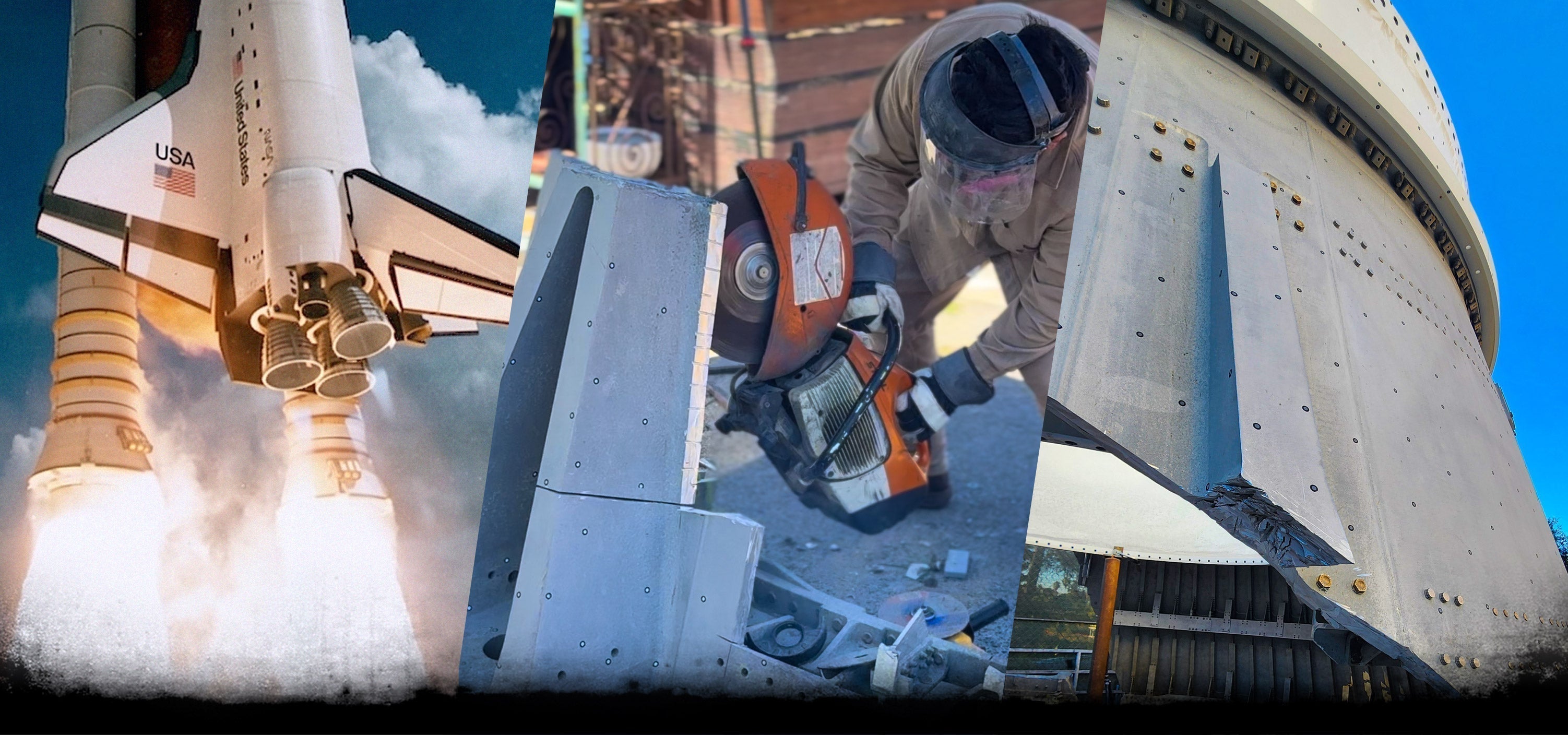
Every PlaneTags project has its own story.
Sometimes Dave Hall and the MotoArt team spend months searching aircraft boneyards for a forgotten piece of aviation history. Other times, we're invited to help preserve an aircraft before it begins a new chapter. No two projects are ever quite the same.
Our Space Shuttle Solid Rocket Booster project began with a Boeing 747.

In 2024, MotoArt traveled to Pinal Air Park in Marana, Arizona to help process HL7489, a Korean Air Boeing 747-400. The aircraft had been donated to the California Science Center by Korean Air and will become the centerpiece of the new Korean Air Aviation Gallery inside the future Samuel Oschin Air and Space Center, scheduled to open in November 2026.
After completing that work, we packed up our tools and headed home, thinking the project was finished.
A few months later, the phone rang.
A Call We Didn't Expect
While preparing Solid Rocket Booster Aft Skirt Serial Number 13 for its new home in the Science Center's Solid Rocket Booster Walk-Through Experience, the California Science Center faced an unexpected challenge.
The aft skirt needed to be cut with exceptional precision. Several contractors working on the project had decided not to take on the work because of the complexity and liability involved.
The team from the California Science Center remembered the work MotoArt had completed on the Korean Air 747 and reached out to see if we would be willing to look at the project.

It wasn't a job anyone could guarantee. We prepared an agreement that reflected that uncertainty. We would carefully evaluate the project and do everything possible to complete the work safely and accurately. If we determined it couldn't be done without risking damage to the artifact, we would walk away. If the work was successful, the preserved material would become future PlaneTags.
We were honored to accept the challenge.
More Difficult Than Anyone Expected
At first glance, the work seemed straightforward. Once the project began, we discovered it wasn't. Some portions of the aft skirt, including the hold-down post, were much thicker than expected. In some areas, the material measured nearly six inches thick.
"When we first looked at the aft skirt, we knew it wasn't going to be easy. Once we realized parts of the hold down post were much thicker than expected, it became clear this would take time. We just focused on making every cut as accurately as possible."
— Kevin White, Project Manager


What was expected to be a relatively simple cutting project became several days of careful planning, specialized equipment, and patient work.
Every cut had to be made accurately while protecting an artifact that had already supported 11 Space Shuttle missions and was destined for permanent display at the California Science Center.


Eventually, the team successfully completed the work and separated the material without compromising the artifact.
It remains one of the most technically challenging projects MotoArt has completed.

Helping Preserve History
The completed aft skirt is now part of the Solid Rocket Booster Walk-Through Experience, one of the signature exhibits planned for the future Samuel Oschin Air and Space Center.
Visitors will be able to walk inside an authentic Space Shuttle-era Solid Rocket Booster and experience a piece of the engineering that helped launch astronauts, satellites, scientific missions, and components of the International Space Station.
Knowing that MotoArt played a small part in helping prepare that experience is something we're proud of.
"We've worked with hundreds of aircraft over the years, but opportunities like this don't come along very often. Being trusted by the California Science Center to help prepare such an important artifact was an honor for our entire team. We're proud that visitors will experience the aft skirt in the museum, and that collectors can preserve a small part of its story through PlaneTags."
— Dave Hall, Founder, MotoArt & PlaneTags
Continuing the Story
As part of the agreement with the California Science Center, the material removed during the cutting process was preserved by MotoArt. Rather than becoming scrap, it became an opportunity to continue telling the story of Aft Skirt Serial Number 13.


That material now lives on as two limited PlaneTags collections.

The SRB Aft Skirt collectors edition is crafted from the aft skirt itself and preserves the material at its original thickness. Limited to just 2,000 individually numbered pieces, each includes a premium collector box, brushed metal display card, and story insert.


The SRB Hold-Down Post edition is crafted from another critical piece of Shuttle launch hardware. Each tag is precision water jet cut into the classic PlaneTags profile and limited to 4,000 individually numbered pieces.


Together, they preserve two different parts of the same launch story.
SRB PlaneTags will be available to the general public on July 9, 2026 at 12 PM Pacific on planetags.com. For early access, sign up now.
Why This Project Meant So Much to Us
MotoArt has spent more than 25 years preserving aviation history. Over that time, we've worked with military aircraft, commercial airliners, NASA research aircraft, and museum artifacts. Every project is important because every aircraft has a story. This one was different.

Growing up in Southern California during the Space Race, Dave Hall watched NASA push the boundaries of what was possible. To help preserve a genuine piece of the Space Shuttle program alongside the California Science Center is something our entire team will remember for a long time. Projects like this remind us why we started PlaneTags in the first place.
The Next Chapter
According to California Science Center records, Aft Skirt Serial Number 13 supported 11 Space Shuttle missions between 1982 and 2002, including flights involving Columbia, Challenger, Atlantis, Discovery, and Endeavour. Its role in the Shuttle program is complete, but its story continues.
Visitors to the California Science Center will experience it as part of the Solid Rocket Booster Walk-Through Experience, where it will help explain one of the most important launch systems in aerospace history.
Through PlaneTags, a carefully preserved portion of that same artifact will continue inspiring collectors, aviation enthusiasts, engineers, and future explorers around the world. At MotoArt, we believe every aircraft and every artifact has a story worth preserving. We're honored that Aft Skirt Serial Number 13 is now part of that story.
Keep Reading
Don't miss the rest of the NASA SRB story.
From Liftoff to Legacy: The Story of the Space Shuttle’s Solid Rocket Boosters
11 Missions, 5 Orbiters, One Remarkable Flight History: The Missions of Aft Skirt 13
Continue Exploring NASA History
If this story sparked your interest, take a look at the rest of our NASA Collection, featuring authentic artifacts from the aircraft, spacecraft, and launch equipment that helped shape America's journey into space.

- Mobile Launcher Platform 2 (MLP-2) - Before every Space Shuttle launch, MLP-2 supported the Shuttle stack on the launch pad at Kennedy Space Center. Today, it continues its legacy as part of NASA's Artemis program, helping prepare the next generation of lunar missions.
- NASA T-38N Talon N910NA - For decades, NASA astronauts have trained in the T-38 Talon to maintain the precision, decision-making, and teamwork required for spaceflight. N910NA continues that tradition as part of NASA's active astronaut training fleet.
- NASA AT-38B Talon N864NA - Originally built for advanced pilot training, N864NA later served NASA as a chase aircraft supporting research and flight testing. It represents the aircraft that helped prepare pilots and astronauts for the challenges of flight.
- NASA C-121G Super Constellation N420NA - Known as one of the most elegant airliners ever built, this Super Constellation later served NASA supporting research, logistics, and program operations during the early years of America's space program.
- Lockheed L-300 Starlifter N714NA - The L-300 Starlifter transported oversized cargo, spacecraft components, and critical equipment in support of NASA's missions. Few aircraft played a larger role behind the scenes of the American space program.
- NASA NF-101A Voodoo 53-2422 - This modified F-101 Voodoo served NASA as a high-performance research aircraft, contributing valuable data that advanced aeronautics and flight safety during the agency's experimental flight programs.
- NASA Learjet 24A N805NA - Small but versatile, NASA's Learjet 24A supported atmospheric research, instrument testing, and engineering projects, demonstrating that groundbreaking science often comes from unexpected aircraft.
- Lockheed SR-71A 61-7971 SOLD OUT - After its legendary career with the U.S. Air Force, SR-71A 61-7971 continued pushing the boundaries of flight as a NASA research aircraft, supporting high-speed aeronautical testing and technology development.
- L-300 Starlifter Coaster Set - Crafted from authentic Lockheed L-300 Starlifter aluminum, these coasters preserve the legacy of one of NASA's most important cargo aircraft while adding aerospace history to your home or office.


Share:
11 Missions, 5 Orbiters, One Remarkable Flight History: The Missions of Aft Skirt 13
The Prototype That Changed Regional Aviation: The Story of Embraer's First E190