

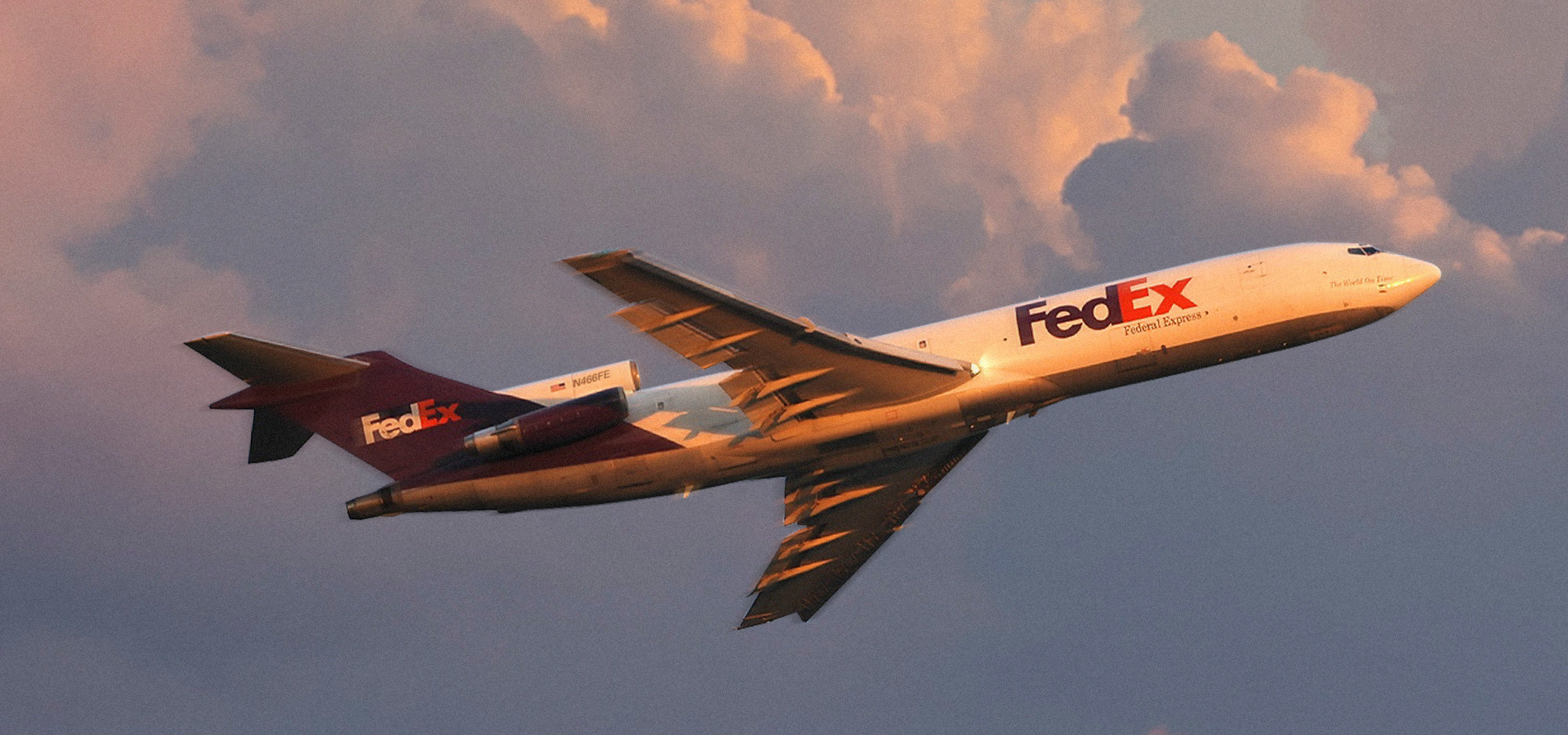
A Cargo Icon That Helped Build the Modern World
Before overnight shipping was expected, before tracking numbers were standard, and before global logistics ran on tight timelines, aircraft like the Boeing 727 quietly did the hard work. Among them was FedEx Boeing 727 N466FE, a jet that spent decades flying through the night, moving packages that connected businesses, families, and communities.
Today, that aircraft lives on in a new form. It is preserved through PlaneTags made from its authentic skin, allowing its story to be shared long after its final flight. Get your Fed Ex 727 PlaneTags.
The Boeing 727
The Trijet That Changed Short- and Medium-Haul Aviation
First flown in 1963, the Boeing 727 was developed to meet a very specific challenge facing airlines in the early jet age. While aircraft like the Boeing 707 excelled on long, high-density routes, many airports lacked long runways, modern terminals, or extensive ground support. Airlines needed a jet that could bring the speed and comfort of jet travel to smaller and regional airports.

First production 727. By Dmitry Avdeev - Gallery page Photo http://cdn-www.airliners.net/aviation-photos/photos/5/8/2/0224285.jpg, CC BY-SA 3.0, Link
Boeing’s answer was the 727. Its three rear-mounted engines provided the power needed for shorter runway performance, while keeping the wings clean and efficient. The aircraft’s distinctive T-tail helped maintain stable airflow over the horizontal stabilizer, especially during takeoff and landing. One of its most innovative features was the built-in rear airstair, which allowed the 727 to operate independently at airports without jet bridges or ground stairs.
The 727 quickly proved itself to be both capable and versatile. It could fly into airports that other jets could not, handle high passenger loads, and operate reliably in a wide range of conditions. Airlines embraced the design, and the aircraft became a familiar sight at airports around the world throughout the 1960s, 1970s, and 1980s.
Over time, the Boeing 727 also earned a reputation for durability. Its robust airframe and systems were designed for frequent cycles, making it well suited for high-utilization service. That strength would later become one of its greatest advantages as many 727s transitioned from passenger service into cargo operations.

By Boeing Dreamscape - C8X [dead link], CC BY 2.0, Link
More than 1,800 Boeing 727s were built, and many of them flew for decades. Even as newer aircraft entered service, the 727 continued to prove its value, adapting to new roles and new operators. Few commercial jets can claim such a long and varied career.
Boeing 727 At A Glance

Boeing 727 Specifications:
Type: 727-225F (Freighter)
Tail #: N466FE
Operator: FedEx Express
Crew: 3 (2 Pilots, 1 Flight Engineer)
Max Payload: 53,000 lb
Wingspan: 108 ft 0 in
Length: 153 ft 2 in
Height: 34 ft 0 in
Main Deck Cargo Door: 140 in × 88 in w/Reinforced cargo floor and roller system
Boeing 727 Performance:
Cruise Speed: Mach 0.78–0.80
Service Ceiling: 42,000 ft
Empty Weight: 100,000 lb
Max Takeoff Weight: 209,500 lb
Rate of Climb: 2,000–2,500 ft/min
Fuel Capacity: 10,585 US gallons
Takeoff Distance: ~8,000 ft
Landing Distance: ~6,000 ft
Engines: 3x Pratt & Whitney JT8D-15 turbofan engines
A Second Life as a Freighter
Why the Boeing 727 Became a Cargo Favorite
As newer aircraft entered airline fleets, many Boeing 727s began transitioning out of passenger service. What could have been the end of their careers instead became a new beginning. The same qualities that made the 727 successful with airlines made it exceptionally well suited for cargo operations.
The Boeing 727 was built to handle frequent takeoffs and landings, often several per day. Its strong airframe, reliable systems, and proven performance allowed it to thrive in high-cycle environments. For cargo operators, this meant an aircraft that could be counted on to fly night after night with minimal downtime.
Cargo conversions transformed the 727 into a highly capable freighter. Passenger interiors were removed, floors were reinforced, and large cargo doors were installed, allowing the aircraft to efficiently carry palletized freight. The aircraft’s size was ideal for regional and domestic routes, bridging the gap between smaller turboprops and larger widebody freighters.
The 727 also retained the operational flexibility that defined its original design. It could serve a wide range of airports, operate from runways that were not built for larger jets, and function reliably with limited ground infrastructure. These traits were especially important during the rapid growth of overnight shipping, when speed, dependability, and consistency mattered more than comfort or aesthetics.
For many cargo carriers, the Boeing 727 became more than a stopgap solution. It became a cornerstone of their fleets. Few aircraft have demonstrated such an ability to adapt to changing roles while remaining relevant for decades.
It was in this second life, as a hardworking freighter, that the Boeing 727 would make its greatest and most lasting impact.
FedEx and the Boeing 727
Building the Overnight Delivery Network
When FedEx began operations in 1971, its goal was ambitious. The company set out to create a reliable overnight delivery network at a time when such a system did not yet exist. Achieving that vision required aircraft that were fast, dependable, and capable of operating on tight schedules, often during overnight hours.
As FedEx expanded beyond its earliest turboprop aircraft, the Boeing 727 emerged as an ideal solution. Its speed allowed packages to move quickly between cities, while its durability supported the frequent cycles required by overnight shipping. The aircraft’s size made it well suited for regional routes that connected smaller markets to major hubs.
The Boeing 727 became a familiar sight in FedEx colors, operating as part of a carefully coordinated hub-and-spoke system. Night after night, these aircraft departed from cities across the country, converged at central hubs, and then returned before morning with outbound freight. Reliability mattered more than anything, and the 727 consistently delivered.

FED EX 727 flickr photo by "Fast" Eddie Maloney shared under a Creative Commons (BY-SA 2.0) license
For FedEx, the 727 was not simply a transitional aircraft. It was a foundational tool during a period of rapid growth. Long before larger and more modern freighters entered service, the 727 helped prove that overnight delivery could be dependable, repeatable, and scalable.
By the time FedEx began modernizing its fleet, the Boeing 727 had already secured its place in aviation history. It had helped shape the company’s operations and played a critical role in building the global logistics network that exists today.
For every aircraft type that helped shape FedEx’s growth, there were individual airplanes that carried that responsibility night after night. Each one had its own history, routes, crews, and years of service. Among them was Boeing 727 N466FE, an aircraft that embodied everything the 727 represented to FedEx. Reliable, adaptable, and built to work.
Aircraft Spotlight: Boeing 727 N466FE
The Story of a Working Freighter

10-3-88 N8874Z Miami flickr photo by P.Macklin shared under a Creative Commons (BY 2.0) license
Built in December 1976, this aircraft began life as a Boeing 727-225, originally delivered into passenger service under the registration N8874Z. During its early years, it flew for Eastern Air Lines, an airline that helped define jet travel in the United States during the golden age of commercial aviation.
Like many aircraft of its era, the 727 later found international service. While registered as N8874Z, it also spent time operating with Avianca, reflecting the global reach and adaptability of the Boeing 727 platform. In these early chapters of its life, the aircraft carried passengers rather than packages, connecting cities and countries long before it entered cargo service.

Boeing 727-225(F) ‘N466FE’ “Gideon” flickr photo by HawkeyeUK shared under a Creative Commons (BY-SA 2.0) license
In October 1992, the aircraft entered a new phase when it joined the FedEx Express fleet. Converted into a dedicated freighter and re-registered as N466FE, it transitioned from passenger operations into the demanding world of overnight cargo. From that point forward, it became part of FedEx’s nighttime rhythm, departing after sunset, arriving before dawn, and repeating the cycle thousands of times over its career.
Like many FedEx aircraft, N466FE was not flashy or ceremonial. It was a workhorse. Its value came from quiet dependability and the ability to perform the same mission night after night, moving packages that helped build the modern logistics network.
After retirement from active flight service, the aircraft took on a new public role. FedEx donated the Boeing 727 known as Gideon to Sacramento City College, and it was later displayed as a centerpiece in the Aerospace Museum of California’s airpark near McClellan Park. For more than a decade, the aircraft served as a popular and recognizable exhibit, allowing visitors to learn about a jet that once flew nightly cargo missions across the country.
Unfortunately, years of outdoor exposure took their toll. Severe water damage and corrosion made long-term preservation of the full aircraft impossible. In late 2025, the difficult decision was made to disassemble the 727. During the process, the nose and cockpit section were carefully preserved and moved indoors, where they can be restored and displayed for future generations. Other portions of the aircraft were responsibly scrapped or repurposed, ensuring that its material continued to be preserved rather than lost.


Working alongside museum partners, MotoArt helped salvage portions of the aircraft skin, transforming them into commemorative PlaneTags that allow the story of this aircraft to continue beyond its physical lifespan.


Photo of Brian and Larry, courtesy of Brian Uretsky, used with permission.

Photo by Brian Uretsky, used with permission

Photo by Brian Uretsky, used with permission
Today, while the full aircraft no longer stands in the airpark, parts of Gideon remain preserved, both through the museum’s saved nose section and through PlaneTags made from its original aluminum. The aircraft’s journey, from passenger jet to cargo workhorse to museum exhibit, reflects a full and meaningful aviation life.
Why It Was Called “Gideon”
A Personal Name on a Working Aircraft
During its time with FedEx, N466FE carried the name Gideon on its fuselage. It is a small detail that reveals something deeply human about cargo aviation.

FedEx has a tradition of naming aircraft after the children of company employees. In this case, it was the name of a FedEx flight crew member Kurt Baum's son Gideon Baum, chosen to personalize an aircraft that would otherwise be known only by a registration number. Thank you Kurt Baum for sharing this photograph.

It is a reminder that behind every freighter are people. Pilots, mechanics, loaders, and dispatchers all have lives and families connected to the aircraft they operate. Gideon was not just a jet. It was someone’s airplane.
From Aircraft Skin to PlaneTags
Preserving a FedEx Workhorse

After retirement, portions of N466FE’s original aircraft skin were preserved by MotoArt and transformed into PlaneTags. Each tag is cut from authentic aluminum that once flew aboard this very aircraft, carrying with it decades of history, wear, and character.
Every PlaneTag from N466FE is a tangible connection to the era when the Boeing 727 helped define overnight air cargo and when FedEx was building the system that still keeps the world moving.
Other Boeing 727 Aircraft Preserved by MotoArt
The FedEx Boeing 727 N466FE is not the only 727 MotoArt has preserved through PlaneTags. Over the years, additional Boeing 727 aircraft have been saved and transformed, each representing a different chapter in aviation history.
Other Boeing 727 aircraft preserved by MotoArt include:
-
Northwest Airlines Boeing 727
A classic example of the 727’s role in U.S. passenger aviation during the jet age, representing one of the airline’s most recognizable narrowbody aircraft. -
Pan Am Boeing 727
An aircraft tied to one of the most iconic names in commercial aviation, reflecting the global reach and prestige of Pan American World Airways. -
United Airlines Boeing 727
A workhorse of United’s domestic network, highlighting the 727’s importance in connecting cities across the United States. -
Delta Air Lines Boeing 727
A key part of Delta’s fleet during a period of rapid growth, representing the airline’s use of the 727 to connect major hubs and regional markets across its expanding network.
Each of these aircraft tells a different story, but together they illustrate the lasting impact of the Boeing 727 and MotoArt’s ongoing commitment to preserving aviation history through authentic aircraft materials. See the rest of the 727 PlaneTags collection.
A Legacy Worth Saving
The Boeing 727 may no longer fly for FedEx, but its impact is everywhere. Aircraft like N466FE Gideon helped make overnight delivery possible and reshaped how goods move around the globe.
Through PlaneTags, that legacy continues. Not as nostalgia, but as preservation.
A special thank you to Brian Uretsky for sharing his photos and videos of N466FE.


Share:
From Warbird to Water Bomber: The Epic Life of the Hawaii Mars
F-84 Thunderjet: A Frontline Jet Preserved for History