

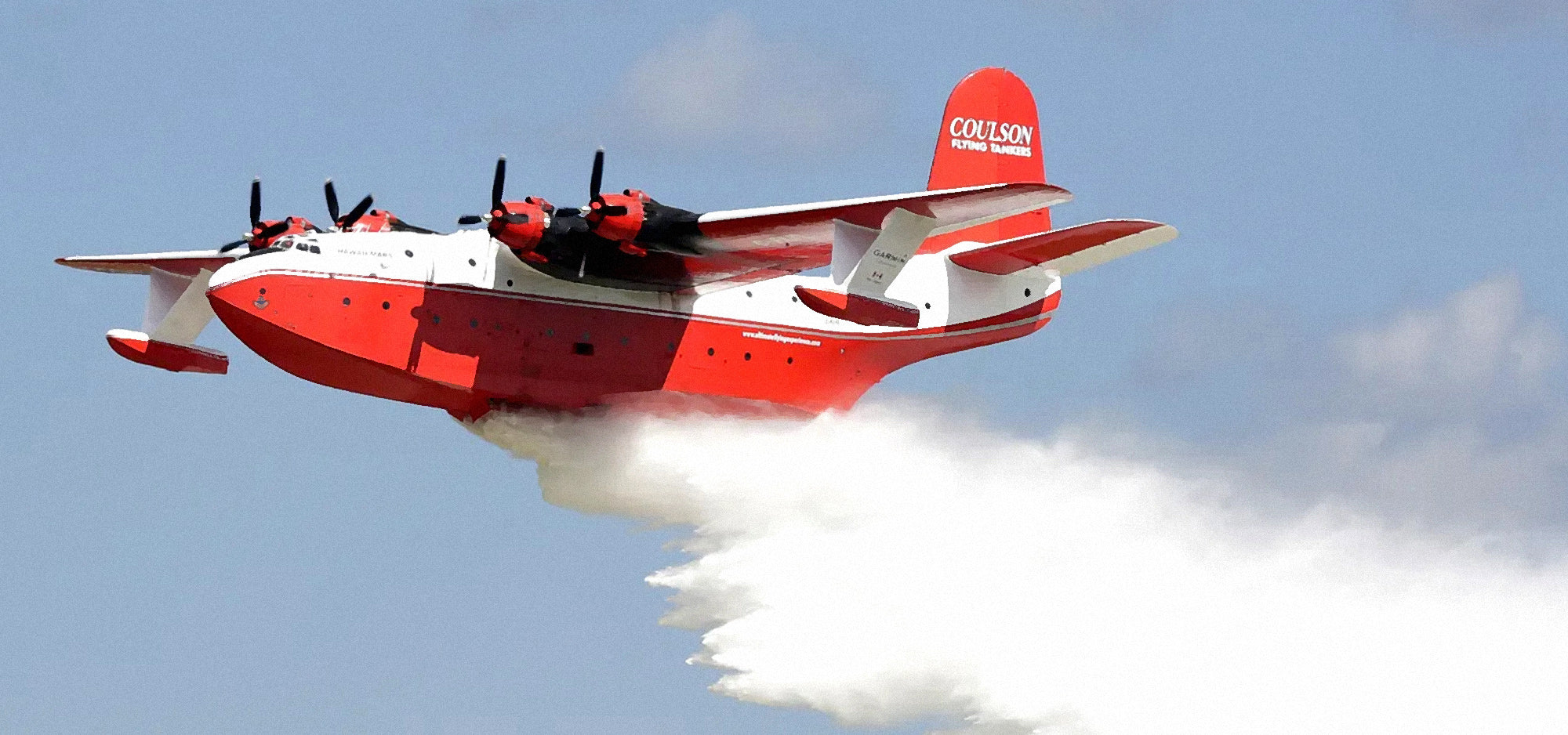
In the world of aviation, few aircraft have lived a life as large, or as long, as the Hawaii Mars. Towering over most of its contemporaries with a wingspan of 200 feet, this mighty flying boat was born in the final days of World War II, then quietly transformed into one of the most iconic aerial firefighting aircraft the world has ever seen. From military transport to firefighting titan, the Hawaii Mars represents one of aviation’s most extraordinary second acts.
In 2025, MotoArt obtained an original wing of this aircraft and created special PlaneTags, made exclusively for the Martin family members and Mars workers. On December 11, 2025, Hawaii Mars PlaneTags will be available to the general public for the first time.
Origins of the Martin Mars

Hawaii Mars flickr photo by arewethereyet? shared under a Creative Commons (BY) license
The Martin JRM Mars began its life as a U.S. Navy project during World War II. Developed by the Glenn L. Martin Company, the Mars was initially envisioned as a long-range patrol bomber capable of crossing vast stretches of the Pacific. But as war priorities shifted, so did the Mars’ mission. Instead of bombing runs, the Mars was converted into a transport aircraft, valued for its massive size and unmatched range.

First XPB2M-1 Mars flying boat, early 1942. Photo courtesy of Lockheed Martin (flickr)
Only seven aircraft were built in total, making the Mars one of the rarest military flying boats ever produced. With its cavernous fuselage and enormous wing, the Mars became a vital lifeline for carrying cargo, personnel, and supplies across the Pacific Theater during and after the war.
Martin Mars Aircraft

Mars AC flickr photo by cpo57 shared under a Creative Commons (BY 2.0) license
Each of the Mars aircraft had its own story. Here are the seven aircraft that were produced:
-
XPB2M-1 Mars (BuNo 1520): The prototype, first flown in 1942. Later converted to a transport aircraft and redesignated XPB2M-1R. Lost in a crash in 1945.
-
JRM-1 Mars (BuNo 76819 – Hawaii Mars I): The first production aircraft, which crashed in Chesapeake Bay during testing in 1945.
-
JRM-1 Mars (BuNo 76820 – Philippine Mars): Served with the Navy and later converted to a water bomber by Coulson Aviation.
-
JRM-1 Mars (BuNo 76821 – Marianas Mars): Destroyed in a hangar fire in 1961.
-
JRM-1 Mars (BuNo 76822 – Marshall Mars): Lost due to an engine fire and crash in 1950.
-
JRM-3 Mars (BuNo 76823 – Hawaii Mars II): The subject of this story, converted to a water bomber and flown until 2016.
-
JRM-3 Mars (BuNo 76824 – Caroline Mars): Also served as a transport and was destroyed in the 1961 hangar fire with Marianas Mars.
- Ship 8 - the unfinished nose section of the eighth Martin Mars aircraft, recovered by Coulson Aviation and now on display at the Sproat Lake Bomber Base. Its name derived from factory markings reading “SHIP8.”

Today, only the Hawaii Mars II and Philippine Mars survive. In August 2024, Hawaii Mars II took its final flight to its new home near Sydney, British Columbia, to the British Columbia Air Museum. As of Feb 2025, the Philippine Mars was relocated from British Columbia to its new home at the Pima Air & Space Museum in Tucson, Arizona, where it is now being reassembled for public display.
The Glenn L. Martin Company

Founded in 1912 by aviation pioneer Glenn L. Martin, the Glenn L. Martin Company played a vital role in early American aviation. Known for its innovation and engineering, the company produced a wide array of aircraft for both civilian and military use. Some of its most significant developments included the B-10 bomber, the PBM Mariner patrol flying boat, and the iconic Martin B-26 Marauder of World War II. The company's focus on large, long-range aircraft made it a natural choice for developing a maritime patrol bomber like the Mars.
Enter the JRM-3 Hawaii Mars
The Hawaii Mars II (Bureau Number 76823) was one of the last Mars aircraft built, completed in 1945 as a JRM-3 variant. This model featured several upgrades over the earlier JRM-1 design, including more powerful Wright R-3350-24WA radial engines and structural enhancements to accommodate heavier payloads.

Hawaii Mars C-FLYL, Sproat Lake, B.C. 11Aug89 flickr photo by Peter M Garwood shared under a Creative Commons (CC BY 4.0) license
Designed for long-range logistics missions, it flew for the U.S. Navy in a post-war era that demanded flexibility and efficiency. The aircraft’s enormous payload capacity, capable of carrying over 30,000 pounds, made it invaluable for supporting Navy operations across island bases in the Pacific. It could carry troops, vehicles, or bulk supplies across thousands of miles with remarkable efficiency.
Despite its strengths, the Hawaii Mars and its siblings entered service just as the military was transitioning to newer transport methods. As runways and airfields became more common across the Pacific and around the world, large seaplanes like the Mars became less essential. Land-based aircraft such as the Douglas C-54 and later the Lockheed C-130 offered greater logistical flexibility without the need for water landings.
Its post-war service was relatively brief, but the Hawaii Mars had already proven itself as one of the largest and most capable flying boats of its time, setting the stage for an unexpected second career.
Martin JRM-3 Mars At A Glance

Martin JRM-3 Mars Specifications:
- Manufacturer: Glenn L. Martin Company
- Model: JRM-3 Hawaii Mars II
- BuNo: 76823
- Tail #: C-FLYL
- Crew: 4 (Pilot, Co-Pilot, Navigator/Radio Operator, and Flight Engineer; w/accomodations for relief crew)
- Wing Span: 200 ft 0 in
- Length: 117 ft 3 in
- Height: 38 ft 5 in (afloat), 48 ft 0 in (beached)
- Firefighting Capability: 4x Internal Tanks Capable of Scooping 7,200 U.S. Gallons of Water in 32 seconds, and 600 U.S. Gallons of Foam
Martin JRM-3 Mars Performance:
- Max Range: 4,900 mi
- Max Speed: 243 mph
- Cruise Speed: 187 mph
- Service Ceiling: 17,050 ft
- Empty Weight: 75,619 lb
- Max Takeoff Weight: 162,000 lb
- Engines: 4x Wright R-3350 Duplex-Cyclone Radial Piston Engines
Retirement from Military Service
After its Navy service came to a close in the 1950s, the Hawaii Mars, along with several of its sister ships, faced an uncertain future. The massive seaplanes were retired and put into storage, too big and outdated for modern military needs, but still structurally sound and brimming with potential.
By the end of the decade, a consortium of British Columbia forest companies formed Forest Industries Flying Tankers (FIFT) and stepped in to acquire four of the remaining aircraft, along with a large stockpile of spare parts. Their aim was to transform the towering flying boats into a new kind of emergency response vehicle, capable of helping combat the region’s increasingly destructive wildfires.
In December 1959, the purchase was finalized, and the aircraft were flown to Fairey Aviation in Victoria, British Columbia, for conversion. Engineers installed a 7,200-gallon plywood water tank in the cargo bay, as well as retractable water pickup scoops beneath the hull. These scoops allowed the Mars to scoop a full load of water while taxiing across a lake - an operation that took just 22 seconds. Some fuel tanks were later converted into additional water tanks, increasing the aircraft’s effectiveness.

By Michael Maclean - Own work, CC BY-SA 3.0, Link
In 2007, Coulson Aviation acquired the Hawaii Mars and Philippine Mars from FIFT. This marked the beginning of Coulson’s fixed-wing aerial firefighting operations. Coulson invested in preserving and modernizing the aircraft, ensuring it remained a reliable and iconic asset in the company’s expanding global firefighting fleet.

Martin Mars flickr photo by → Andrew shared under a Creative Commons (BY-NC-ND 2.0) license
For years, the Hawaii Mars flew seasonal missions across British Columbia and the western United States, often flying multiple sorties per day in demanding conditions. Pilots, ground crews, and local communities held a deep respect for the aircraft, not only for its sheer power and performance, but also for the sense of awe it inspired every time it skimmed across a lake or thundered low over a fireline.
Rebirth as a Firefighting Aircraft
With its new role, the Hawaii Mars became more than a flying boat; it became a symbol of resilience, ingenuity, and dedication to public safety. Refitted with advanced firefighting systems and a reinforced hull, the aircraft was capable of scooping up 7,200 gallons of water in a single pass and delivering it with pinpoint accuracy over wildfires.

Hawaii Mars 065 flickr photo by nix-pix shared under a Creative Commons (BY-ND) license
Its operations often took it into rugged and remote terrain where traditional ground-based firefighting was ineffective. The Hawaii Mars would skim across lakes or reservoirs, refill its tanks in just over 20 seconds, then soar back into the smoke-filled sky to protect forests, communities, and infrastructure below. The aircraft’s immense size and impressive performance made it not only a critical firefighting asset but also a morale booster for fire crews on the ground.
Throughout its civilian firefighting career, the Hawaii Mars responded to countless fires across British Columbia and the western United States, often becoming a featured part of regional firefighting plans. Its presence was both strategic and symbolic, an airborne reminder of the ongoing battle against increasingly severe wildfire seasons.

The Hawaii Mars Flying Water Tanker flickr photo by R J Ruppenthal shared under a Creative Commons (BY-NC-SA) license
The Mars aircraft also drew attention at airshows and public events. Spectators marveled at its graceful water landings, thundering takeoffs, and massive silhouette. Aviation media and YouTube videos turned the Hawaii Mars into a viral icon, known far beyond the firefighting world and beloved by aviation enthusiasts across the globe. Spectators marveled at its graceful water landings, thundering takeoffs, and massive silhouette. Aviation media and YouTube videos turned the Hawaii Mars into a viral icon, known far beyond the firefighting world and beloved by aviation enthusiasts across the globe.
Iconic Status and Final Flights
As newer, more versatile aircraft entered service, the days of the Hawaii Mars drew to a close. By 2016, the aircraft was retired from active firefighting after decades of service and thousands of flight hours. Despite its retirement, the Hawaii Mars continued to captivate aviation enthusiasts and the general public alike.
In its final years, the aircraft was prominently featured at aviation events such as EAA AirVenture Oshkosh, where it performed dramatic water drops and opened its cavernous cargo bay to fascinated attendees. These appearances helped preserve the legacy of the aircraft and introduced it to a new generation of aviation fans.
The Mars also became a symbol of pride for those who maintained and flew her, pilots, engineers, and mechanics who regarded the aircraft not just as a tool, but as a living piece of history. Its presence at airshows, in documentaries, and across social media cemented its reputation as one of the most beloved firefighting aircraft ever built.
In 2024, Coulson Aviation announced that the Hawaii Mars would be donated to the BC Aviation Museum in Sidney, British Columbia, ensuring its preservation as a historic artifact and educational exhibit for future generations. This generous donation marked the final chapter in the aircraft's storied operational life and guaranteed its legacy would be shared with aviation fans and the public alike.
Hawaii Mars II took to the skies for the last time on August 14, 2024, escorted by the Royal Canadian Air Force's Snowbirds. Efforts had long been underway to preserve the Hawaii Mars as a museum piece or display aircraft, in recognition of its rarity and cultural value. Now, with a permanent home secured, the Hawaii Mars endures as a larger-than-life reminder of aviation's power to serve, inspire, and endure.
Legacy of the Hawaii Mars
The Hawaii Mars stands as a testament to innovation, durability, and the ability to adapt across generations. From a post-war Navy transport to an aerial firefighting marvel, its journey tells a larger story about the role of aviation in both conflict and conservation.
As one of the last flying boats of its size, the Mars has inspired filmmakers, historians, and everyday fans alike. For Coulson Aviation, it was more than an asset, it was a flagship of their values: innovation, preservation, and service.

MotoArt was honored to become part of this legacy. The journey began when aviation enthusiast and longtime PlaneTags collector Landon Cain brought the Hawaii Mars to the attention of MotoArt's historian Rob Schneider. CEO Dave Hall reached out to Scott Marchand at the Pima Air & Space Museum, who then connected the team with Coulson Aviation.
From there, our team obtained a piece of the aircraft’s original wing and created a special, limited run of Hawaii Mars PlaneTags. These exclusive tags were first gifted to members of the Martin Mars family, including individuals who worked on the aircraft and supported its long service life. In 2025, a limited edition public release was introduced, giving collectors and aviation enthusiasts the opportunity to own a small piece of this big aircraft.
"It’s an incredible honor to memorialize such an icon through PlaneTags," said MotoArt PlaneTags founder Dave Hall. "The Hawaii Mars has touched countless lives over its decades of service, from the people who built and flew it to those who watched it fight fires from the ground. Now, aviation enthusiasts everywhere can carry a small but meaningful piece of that legacy in their hands."

Before this legendary aircraft was permanently grounded, MotoArt's team had the rare opportunity to go on site and carefully recover original material from the Hawaii Mars. These components, once integral to one of the most iconic flying boats in history, were brought back to MotoArt's workshop, where they were transformed into a limited edition run of PlaneTags.


Hawaii Mars II PlaneTags
Each tag is a handcrafted tribute to the aircraft's dual life as a wartime transport and firefighting hero, offering collectors and enthusiasts a tangible connection to the legacy of the Hawaii Mars. Hawaii Mars II PlaneTags, made with the authentic skin of BuNo 76823 (C-FLYL).


The Hawaii Mars may no longer patrol the skies, but its legend is far from grounded. Its size, service, and symbolism ensure it will be remembered as one of the most extraordinary aircraft to ever take flight.
If you ever stood on the shore and watched it rise from the water, you saw a piece of living history in motion, proof that even the biggest aircraft can have even bigger stories. Get your Hawaii Mars II PlaneTags beginning Thursday, December 11, 2025.

Giants of the Sky Collection
Our Giants of the Sky collection brings together some of the most awe‑inspiring aircraft ever built, from the cockpit‑shaking roar of a Lockheed C-5 Galaxy, to the sweeping wings of a Boeing 747 flaring in for landing. Each PlaneTag is cut from the actual skin or components of a retired giant, salvaged and upcycled so history lives on in your hands. Whether it’s a Cold‑War cargo hauler, a trans‑ocean passenger liner, or a legendary seaplane turned water‑bomber, these planes once carried people, cargo, or hope across continents. Now they carry memories, yours to collect, display, and share.

Share:
F-14 Tomcat Coasters: A Legendary Fighter Reimagined for Your Home
N466FE “Gideon”: The FedEx Boeing 727 That Kept the World Moving