

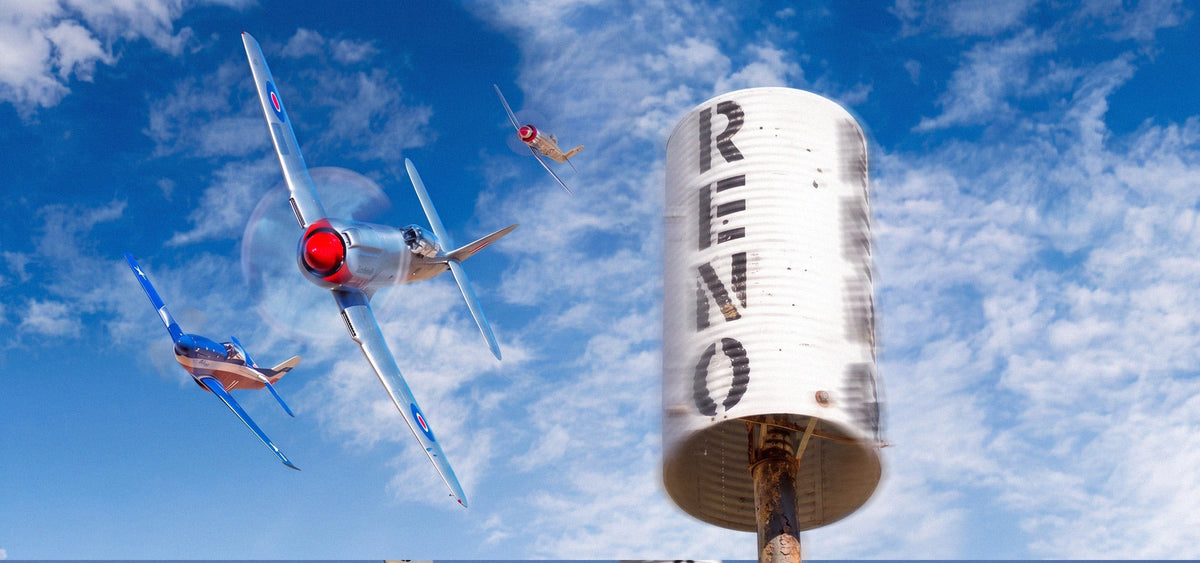
For MotoArt, the Reno National Championship Air Races go back a long way.
More than two decades after our first trips to Reno, that connection led to an unusual new preservation project. Following the final National Championship Air Races in Reno, MotoArt was contacted about some of the material left from the historic racecourse: the pylons themselves.
The Pylons of Reno
The Reno National Championship Air Races began in 1964 and became an annual September tradition for aviation enthusiasts from around the world. After nearly six decades in northern Nevada, the event began a new chapter in Roswell, New Mexico.

North American T-6 Texan “Midnight Miss III,” Race #43, rounds a pylon at the Reno National Championship Air Races. Photo: Charlene Aro, courtesy of Reno Air Racing Association
The courses at Reno weren’t marked by pavement or painted lines. They were defined by pylons. The markers consisted of poles approximately 50 feet tall, known as “sticks,” topped with highly visible sections of corrugated drainage pipe, commonly used for culverts. These marked sections were known around the course as “cans.” Pilots had to remain outside each pylon as they made their way around the course.

Jet Class racers round a pylon at the Reno National Championship Air Races. Photo: Jim Peterson, courtesy of National Championship Air Races
And the judging was precise. Pylon judges positioned at the base looked upward through the can. If any part of an aircraft appeared inside it, the judges could call a pylon cut and report the aircraft, pylon and lap to race scoring.
At racing speeds, the shortest legal line mattered. Flying wider meant covering more distance, while cutting inside a pylon meant a penalty. The pylons were simple structures, but they were an essential part of how the race was flown.
When the Air Races offered MotoArt the opportunity to preserve them, Dave said yes.
Bringing the Pylons to MotoArt
Earlier in 2026, MotoArt Project Manager Kevin traveled to Reno to pick them up. The photos from that trip give a good sense of their scale. Large sections of corrugated metal, many still carrying the familiar RENO markings, had to be stacked and strapped onto a trailer for the trip back to MotoArt.


They were unlike most of the material that comes through our shop. They weren’t pieces of an aircraft that had raced at Reno. They were pieces of the course those aircraft raced around.
Chet later described the project as a kind of “passing of the baton.” With the races moving on from Reno after such a long history there, MotoArt now had an opportunity to help preserve part of the original course. That connection was particularly fitting for a company whose own early history included those trips to Reno.
In a recent podcast, Chet and Rob joined PlaneTags collector Paul Davies to talk about the Reno pylon project, MotoArt’s early days at the races, and what it means to preserve a piece of the course today.
MotoArt + Reno: A History That Goes Back to the Beginning
There was another reason bringing the Reno pylons back to MotoArt felt especially meaningful: Reno is part of where MotoArt got its start.

More than 25 years ago, Dave Hall brought some of MotoArt’s earliest aircraft furniture to the Reno Air Races. In those early days, the pieces were small enough to load into a car and take to the races, where Dave could introduce aviation enthusiasts to the idea of giving retired aircraft material a second life.


As MotoArt grew, we kept coming back. Reno became a place to display new creations, spend time with friends throughout the aviation community and, of course, watch some incredible racing.

When PlaneTags came along, we came back to Reno again, this time with a PlaneTags booth. Over the years, members of our team met collectors at the races, watched aircraft we had preserved as PlaneTags compete around the pylons, and made plenty of Reno memories of our own.


So when the call came asking if MotoArt could do something with the pylons left behind after Reno’s final races, this wasn't just another unusual piece of material arriving at the shop.
It was a piece of a place that had been part of our story almost from the beginning.
Meet Outer #4
The first Reno Pylon PlaneTags are being created from Outer #4 Official Pylon.
Outer #4 was part of Reno’s outer racing course, shared by the Unlimited and Jet classes along with the fastest Sport Gold racers. Modified WWII fighters, jets and high-performance homebuilts all competed along portions of this same racing line.
And Reno was fast. Its racing history includes an Unlimited race average of 507.105 mph by Dago Red, a Jet qualifying record of 543.568 mph by Curt Brown and a Sport qualifying record of 412.554 mph by Jon Sharp in Nemesis NXT.
Outer #4 was one of the markers racers rounded as they made their way around the course.
For this release, its location is highlighted on the metal display card that accompanies each PlaneTag, allowing collectors to see where their piece of pylon once stood on the Reno racing line.
Turning a Pylon Into a PlaneTag
After working with hundreds of aircraft, we’ve learned that every material presents its own challenges. The Reno pylons were no exception.
Unlike relatively flat aircraft skin, the pylon cans are deeply corrugated. Chet went out with a measuring tape to study the curves and spacing of the material so the PlaneTag design could work with the shape of the original pylon. Jaewon then developed the artwork around those measurements and proportions.
Then there was the paint. During early forming tests, the painted surface began pulling apart. The team tried different approaches and considered ways to stabilize the original finish.
Christian, who handles stamping at MotoArt, eventually tried cutting a strip from the corrugated material in the opposite direction. That changed how the metal behaved during stamping. Instead of expanding the material and pulling the painted surface apart, the process compressed it, helping the original finish remain intact.
It also allowed the team to continue stamping the tags rather than turning to water-jet cutting, where the high-pressure process could potentially remove more of the fragile original paint. For Chet, even after overseeing the production of every PlaneTag we’ve made, the Reno pylons presented something new to figure out.
About the Material

The Reno pylon cans were constructed from corrugated metal approximately .100 inch thick, with layers of paint measuring up to .030 inch thick in some areas. The pronounced ridges and curves are very different from the relatively flat aircraft skin our team typically works with, making this an unusual material to transform into PlaneTags.


That substantial painted surface also presented its own challenge. Preserving as much of the original finish and markings as possible while forming the corrugated material required some experimentation from the MotoArt team. The result retains the distinctive texture, finish and character of the original Outer #4 pylon material.
The Racers Behind the Pylons
“Reno and PlaneTags go hand in hand” - Paul Davies
PlaneTags and Reno already share quite a bit of history.

Yakovlev Yak-3UA “Full Noise,” rounds a pylon at the Reno National Championship Air Races. Photo: Doug Fisher, courtesy of Reno Air Racing Association
Over the years, PlaneTags has preserved material from several aircraft with their own histories around the Reno pylons. Dreadnought became one of Reno’s great Unlimited racers, earning six Gold championships, while Pete Zaccagnino’s Vampire captured the 2015 Jet Gold Championship. Argonaut and the Yak-3UA Full Noise also competed on the Reno course.

Hawker Sea Fury “Dreadnought,” at the Reno National Championship Air Races. Photo: Doug Fisher, courtesy of Reno Air Racing Association
In the past, we’ve preserved pieces of the aircraft that raced around Reno’s pylons. This time, we’re preserving a piece of the course they raced around.
For this release, we wanted the presentation to connect the pylon material back to that racing history. Each Outer #4 PlaneTag is presented on a metal card identifying the pylon and showing its position on the Reno course.
We’ve also created a special Gold Champions insert documenting the winning aircraft and years from Reno’s Unlimited, Jet and Sport classes. The information was reviewed with the Air Races, who helped us make final adjustments to the racing history before the insert was completed.
Together, the PlaneTag, metal card and insert provide context for what otherwise might look like a simple piece of corrugated metal: where it stood, what raced around it and why it mattered.
Preserving a Piece of Reno
The National Championship Air Races began near Reno in 1964, and the final races at Reno-Stead were held in 2023. Today, the National Championship Air Races continue in Roswell, carrying that air racing tradition into a new location.

Aero Vodochody L-39 Albatros, Race #8, rounds a pylon at the Reno National Championship Air Races. Photo: Kevin Murray, courtesy of Reno Air Racing Association
In 2026, material from the pylons that once marked the Reno course made its way to MotoArt. Outer #4 is the first of those pylons to become PlaneTags, preserving another part of Reno’s air racing history, this time not from one of the aircraft, but from the course itself.
For MotoArt, there’s a nice connection in that. Some of our earliest years included trips to Reno to share what we were making with the aviation community. Now, all these years later, we’re helping preserve a piece of Reno for that same community.
Own a Piece of the Reno Racing Line
The first Reno Pylon PlaneTags, made from authentic material from Outer #4 Official Pylon, were released Thursday, September 10, 2026.

Each PlaneTag is presented on a custom metal card highlighting Outer #4’s location on the Reno racecourse, along with the special Gold Champions insert documenting the aircraft that helped make Reno racing history.

The story isn’t stopping in Torrance, California. Our team will be bringing the Reno Pylon PlaneTags with us to the National Championship Air Races in Roswell, New Mexico, September 16–20, giving race fans a chance to see a piece of the original Reno course preserved in a new form. The 2026 races will also see all seven racing classes together in Roswell, including the return of the Unlimited and Sport classes.
From the racing line at Reno to the next chapter of the National Championship Air Races, we’re proud to help carry a little of that history forward.





Share:
Boeing 787 Dreamliner ZA004: The Airplane That Helped Certify a Dream
Boeing 737, 747 & 777: Three Chapters in Boeing Aviation History