

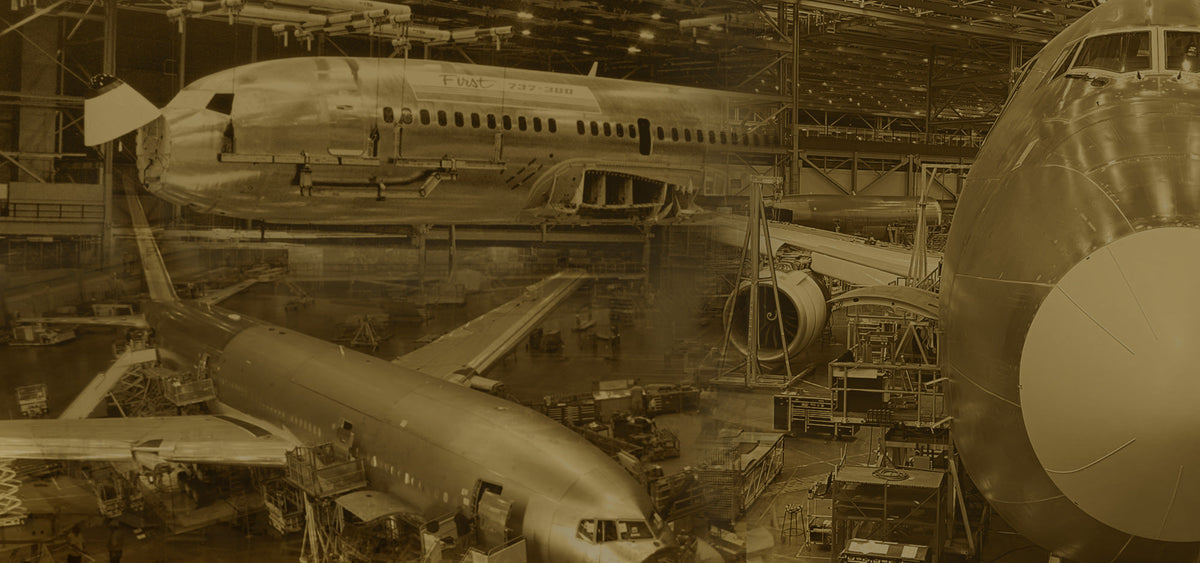
Three Aircraft. Three Chapters in Boeing History.
Meet the 737, 747 and 777 joining the PlaneTags x Boeing Collection.
737. 747. 777. Three numbers recognized around the world, each representing a different chapter in the evolution of Boeing commercial aviation.
The 737 brought Boeing jet technology to shorter routes and smaller airports. The 747 dramatically changed the scale of commercial aviation as the world's first twin-aisle airplane. And decades later, the 777 introduced a new generation of long-range twin-engine aircraft while changing the way Boeing designed airplanes themselves.
On Thursday, September 24, authentic material from Boeing 737 Line #365, Boeing 747 Line #604 and Boeing 777 Line #278 joins the PlaneTags x Boeing Collection.
Before the tags arrive, we're looking back at the ideas, innovations and history behind the aircraft themselves.
Boeing 737: Bringing the Jet Age to More Routes
By the mid-1960s, Boeing was already firmly established in the jet age with the 707 and 727. But there was growing demand for a smaller aircraft designed for shorter routes. The answer was the Boeing 737.

Photo credit: Boeing
When Boeing announced the new twinjet in 1965, its smaller size even earned it the nickname "Baby Boeing." The 737 was designed as a logical complement to the larger 707 and 727, bringing Boeing jet transportation to a different part of the market.
Boeing also drew on what it had already learned. To speed development and production, the 737 shared the same upper fuselage section as the 707 and 727. Its six-abreast cabin offered more seating across than competing five-abreast designs, while engines mounted beneath the wings helped make them easier to service at ground level.
Another important part of the 737's design was its ability to operate at smaller and less-developed airports. Like the 727, it could operate with a high degree of self-sufficiency, helping bring jet service to places beyond the major airports typically associated with the early jet age.

First Boeing 737-100 flickr photo by Gordon Werner shared under a Creative Commons (BY-SA 2.0) license
The first 737 was introduced to the world in January 1967 and made its first flight on April 9, 1967. What began as Boeing's smaller short-range jet would grow into an aircraft family spanning generations.
Boeing 747: Thinking Bigger
If the 737 was about bringing jet travel to shorter routes, the 747 was about imagining air travel on an entirely different scale. Development began in the 1960s as air travel was growing and airports and skies were becoming increasingly crowded. The availability of powerful new engines also opened the possibility of building an airplane much larger than the jetliners already in service. The result was unmistakable.

Photo credit: Boeing
The Boeing 747 became the world's first twin-aisle airplane, with roughly twice the passenger capacity of existing commercial aircraft. Its size helped lower per-seat costs, allowing more people to travel farther and more affordably.
And then there was the hump. The 747 was designed from the beginning with cargo in mind. Boeing engineers wanted freight to be loaded through the aircraft's nose, which meant moving the flight deck above the main deck. That engineering solution created the distinctive upper-deck profile that would become one of the most recognizable silhouettes in aviation.

By SAS Scandinavian Airlines - http://images.flysas.com, Public Domain, Link
The first 747 rolled out of Boeing's new Everett factory in September 1968 and took flight on February 9, 1969. The aircraft entered commercial service the following year.
Passenger carrier. Freighter. Space Shuttle carrier. Air Force One. Over more than half a century, the basic 747 design would take on an extraordinary variety of missions. Boeing ultimately built 1,574 747s during a production run spanning 54 years.

Edwards AFB, July 4, 1982: Challenger flickr photo by Ian E. Abbott shared into the public domain using Creative Commons Public Domain Dedication (CC0)
Boeing 777: Designing an Airplane in a New Way
By the time Boeing launched the 777 program in 1990, commercial aviation had changed dramatically since the arrival of the first 737 and 747. The Boeing 777 would represent another leap forward, not just in the airplane Boeing was building, but in how an airplane could be designed.
The 777 was the first jetliner to be 100 percent digitally designed using three-dimensional computer graphics. Instead of relying on the traditional full-scale physical mockup, Boeing engineers could digitally design and "preassemble" the airplane on computers.
Engineers could examine how components fit together before physical assembly, while computer-aided design tools helped Boeing develop an aerodynamically and structurally efficient airplane. The technology developed around the 777 would also help lay the groundwork for later Boeing programs, including the 787 Dreamliner.

By Boeing Dreamscape - K58552, CC BY 2.0, Link
The first 777 rolled out in 1994 and made its first flight on June 12, 1994. It entered revenue service the following year. The 777 represented a new generation of long-range, twin-engine widebody aircraft, combining advances in aerodynamics, materials, engines, flight deck design and digital engineering.
Three Aircraft. Three Chapters.
The 737, 747 and 777 emerged during different eras and answered very different challenges. The 737 brought Boeing jet transportation to shorter routes. The 747 changed the scale of long-distance air travel. The 777 helped usher aircraft design into the digital age.
Together, they tell part of a much larger story of how commercial aviation evolved across decades. And while these PlaneTags come from three specific Boeing line numbers, they connect collectors to the larger history represented by the aircraft themselves. That's what we're preserving with the next chapter of the PlaneTags x Boeing Collection.
From the Boneyard to Torrance
The PlaneTags x Boeing Collection begins with remarkable aircraft, but turning authentic aircraft material into something collectors can hold takes a team.

Through our collaboration with Boeing, the MotoArt team has the opportunity to preserve material from aircraft whose flying days have come to an end. That process often starts far from our shop in Torrance, California.
Our crew travels to aircraft boneyards to carefully harvest the material that will eventually become PlaneTags. It's hands-on, physical work, often done outdoors in the heat and desert conditions.
Then the material comes home to MotoArt. At our shop in Torrance, our production team cuts and finishes the aircraft material into the familiar PlaneTags shape. At the same time, another part of our team researches the history, develops the artwork and designs the cards, engraving and materials that accompany each release.


From there, every PlaneTag is assembled, inspected and prepared before making its way to collectors. It's a lot of work for a small team, and nearly every step happens right here in Torrance, California.

From Boeing's aviation history to the hands of collectors, our goal remains the same: Preserve the aircraft. Tell its story. Pass that history on.
The PlaneTags x Boeing Collection Continues

On Thursday, September 24 at 12 PM Pacific, three more chapters of Boeing history join the PlaneTags collection:
Authentic aircraft material. Individually numbered. Preserved by PlaneTags.
Continue the Boeing Story
The PlaneTags x Boeing Collection began with the 787 Dreamliner, an aircraft that introduced another generation of Boeing innovation through extensive use of composite materials, advanced aerodynamics and new technologies. Read about it on our blog.

Our first 787 Dreamliner PlaneTags sold out, but the story isn't over. More 787 PlaneTags are planned for later this year.
Share:
From the Racing Line: Preserving Reno’s Outer #4 Pylon
Dassault Falcon 2000 N250DL: A Business Jet with a Casamigos Connection