

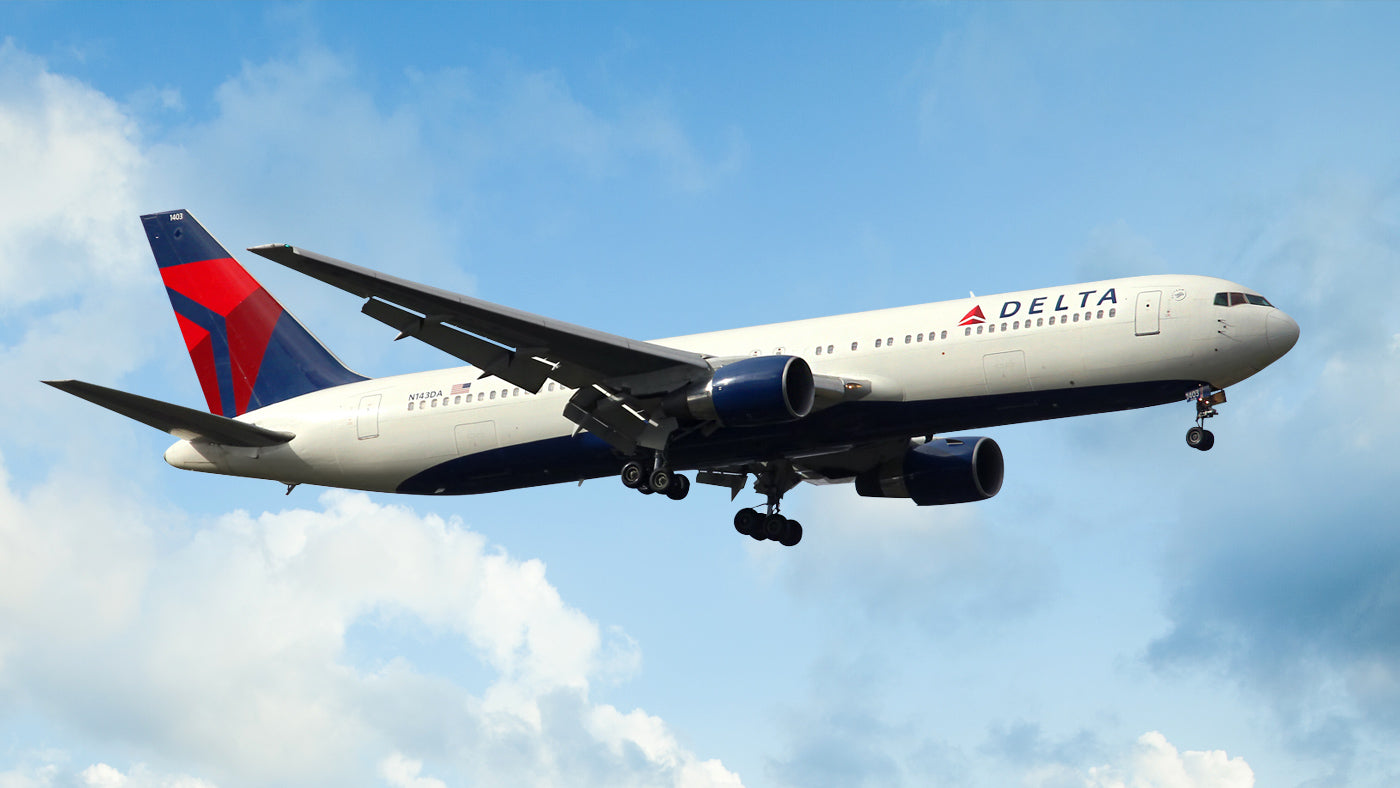
Join MotoArt in welcoming a worthy representative of the Delta Air Lines’ Boeing 767 fleet - meet N143DA, a 767-300 that flew its entire career with Delta.
Boeing 767-300

Delta Air Lines Boeing 767-300; N143DA@SLC;09.10.2011/621dd flickr photo by Aero Icarus shared under a Creative Commons (BY-SA) license
The 767 is a twin engine, wide-body aircraft, designed and built by Boeing. The -300 type has a longer fuselage than the 767-200 by 21.1 ft (6.43 m), accomplished by adding portions before and behind the wings for an overall length of 180.25 ft (54.9 m). The wings, engines, and most of the equipment on the 767-300 were virtually unmodified from the -200. It seated 269 passengers over a range of 3,900 NM. The added capacity of the 767-300 was put to use on high-density, long haul routes. It was 20 percent more fuel efficient and carried 25 percent more cargo than the 767-200.
On December 1, 1986, Delta Air Lines became the first U.S. carrier to fly a Boeing 767-300 in scheduled service. The inaugural flight was from Atlanta to Miami. Initially, the 767-300 was used for "intermediate and long-range runs that enjoy heavy demand” such as service from New England, New York and Montreal, Canada, to Florida and the Bahamas. Later, during the 1990s, Delta’s -300 frequently flew transcontinental and Hawaiian routes. By 2006, the -300 variant was operating medium to long transcontinental routes to Latin America, Puerto Rico and on the U.S. mainland between Atlanta and Florida.
Boeing 767-300 Specs

Specifications:
- Manufacturer: Boeing
- Tail #: N143da
- Crew: 2 Pilots, 6 Flight Attendants
- Seats: 226 Passengers
- Wing Span: 156 Ft 2 In
- Length: 180 Ft 1 In
- Height: 51 Ft 10 In
Performance:
- Range: 5,237 Nm
- Cruise Speed: 458 Kts
- Ceiling: 43,000 Ft
- Empty Weight: 189,751 Lb
- Max Takeoff Weight: 350,005 Lb
- Rate Of Climb: 2,500 Ft / Minute
- Engine: 2 X Pratt And Whitney Pw4000 Ser
Delta’s 767 Fleet
As of 2022, Delta Air Lines is the largest operator of the Boeing 767. Delta has operated every Boeing 767 model: -200, -300, and -400. According to Delta’s 767 Fleet List, they have operated 15 -200, 28 -300, 59 -300ER, and 21 -400. In 2006, the airline retired its 767-200 fleet. By 2019, Delta’s domestic -300 fleet were all retired.
Delta’s first 767 was ship 102, which holds a special place of honor with the airline and its employees. Delta employees purchased it in 1982 as a gift to the airline and named it The Spirit of Delta. It was one way of expressing their appreciation during a very uncertain time in the airline’s history. It was a symbol of Delta pride for over 23 years, until it retired in 2006 and became a permanent exhibit at the Delta Flight Museum in Atlanta, Georgia.
Remember this commercial?
N143DA

Delta Air Lines Boeing 767-300; N143DA@SLC;09.10.2011/621co flickr photo by Aero Icarus shared under a Creative Commons (BY-SA) license
Our 767, N143DA, was constructed as a -300 series (non-ER variant) and delivered to Delta in October 1998. N143DA flew exclusively for Delta for 19 years until retirement, then stored at KSBD in May 2017. MotoArt acquired the original skin material for this plane in 2022.
MotoArt’s Delta 767
Here are some photos from Dave Hall's collection.


Delta Air Lines 767-300 PlaneTags


The Delta 767-300 PlaneTags are numbered in a series of 7,500. They will initially be offered in these variants:
- White
- Delta Blue
- Delta Dark Red
- Delta Light Red
- Blue/White
- Red Combos
The Red Combos won’t last. Don’t miss out. Grab one for your PlaneTags collection and one for a friend. They are now available at planetags.com.
PlaneTags Benefit the Delta Care Fund

The Delta Employee and Retiree Care Fund, better known simply as the Delta Care Fund, was established to assist employees during a crisis. It receives funds from employee contributions and donations, which it uses to assist employees in need. Since its launch in 2007, it has provided support to thousands of employees and their families, putting food on the table, buying medical equipment, and helping families regain their lives after catastrophic events.
MotoArt was glad to donate a portion of the funds from Delta 767 PlaneTags - and all Delta branded PlaneTags - to the Delta Care Fund. Says MotoArt owner Dave Hall, “The Delta Care Fund is supported by Delta employees for Delta families. We are incredibly honored to donate a portion of the sales of each of our Delta PlaneTags to the Fund.”
Delta PlaneTags
MotoArt’s mission to catalog every aircraft is going strong with Delta Air Lines. They have graciously allowed us to create PlaneTags from several retired planes from their fleet. Make sure these are in your collection:

Delta’s Mad Dogs are a favorite of PlaneTags collectors, and travelers remember them fondly as well. The MD-88 and MD-90 PlaneTags are available. Read about them here: MD-88 and MD-90: Celebrating Delta's Mad Dogs.
Delta L-1011 TriStar PlaneTags made from N786DL are still available as of this writing. Get to know the L-1011 in our blog: Delta L1011: The Fuel Efficient Wide Ride Fleet

Add this to your collection - Delta Air Lines Boeing 757-200, made from N627DL, then read about N627DL here: Delta 757: The Backbone of the Fleet
Boeing 767 PlaneTags
Although our original Boeing 767 PlaneTags made from the famous Gimli Glider are sold out, we do have these gems for your collection.

Boeing 767 Air Do® JA98AD - Read about it in our blog: Air Do 767-300ER: Farewell to the Original Wings of Hokkaido
Boeing 767 ANA JA8568 - Read more about it: ANA’s 767: The $71 Million Dollar Plane
British Airways 767 G-BNWH - Get the scoop right here: British Airways - Flying With Pride for 100 Years

Share:
Corsair II: A Powerful and Advanced Attacker
F-4 Phantom: An Enduring Frontline Fighter