

- by Dianna Lopez
USS Midway History: Preserving the Materials of a Legendary Carrier
- by Dianna Lopez
A question? Visit our contact page
This site uses cookies for better user experience and analytics.
Working with a ship as historically significant as USS Midway carries a responsibility that goes beyond creation. Commissioned in 1945 and serving for nearly fifty years, Midway was not only a cornerstone of U.S. naval aviation, but a place shaped by daily work, movement, and life at sea.
This project, developed in partnership with the USS Midway Museum, is rooted in preservation first. The materials being used are not simply artifacts. They are elements that played essential roles in how the ship moved, operated, and sustained the people aboard her. Each piece tells a different part of Midway’s story, and together they offer a fuller picture of service aboard one of the most important aircraft carriers of the 20th century.
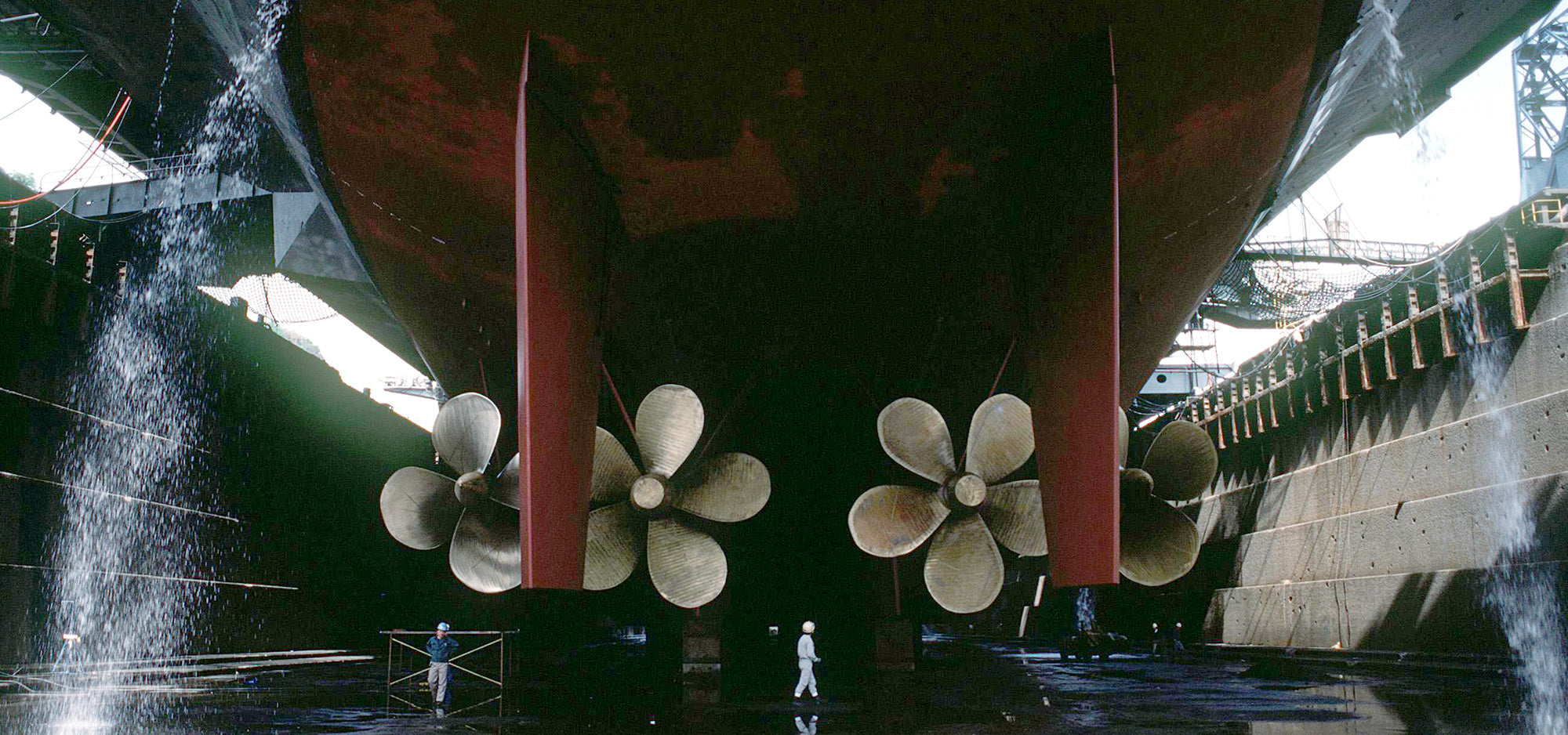
On a ship the size of USS Midway, it is more accurate to refer to the propellers as screws. Midway was fitted with four massive manganese-bronze screws, two to port and two to starboard, engineered to move one of the largest aircraft carriers of her era across the world’s oceans.

Public domain photo
The inboard screws featured five blades and measured more than seventeen feet in diameter, while the outboard screws were even larger, with four blades spanning over eighteen feet. Each weighed tens of tons and operated continuously throughout Midway’s nearly fifty years of service. These screws carried the ship through Cold War deployments, combat operations, humanitarian missions, and decades of global operations, bearing the physical burden of keeping Midway moving forward.
In recent years, while berthed as a museum, extreme low tides occasionally caused portions of the lower screw blades to contact the harbor floor. This created stress on the ship’s structure and required intervention to protect Midway’s long-term preservation. In 2023, the USS Midway Museum undertook careful engineering work, removing portions of several screw blades along with sections of the rudder. This reduction in weight allowed the ship to float safely clear of the bottom, even during extreme tidal conditions.
Material removed during this necessary preservation work is now being thoughtfully repurposed through an exclusive partnership with MotoArt. For the first time, parts of USS Midway made available through this process will be shared with the public, with all proceeds supporting the continued preservation of the ship for future generations.


Photo courtesy of USS Midway Museum
The flight deck was the most dynamic surface aboard USS Midway. It was a workplace defined by precision, coordination, and constant motion. Thousands of aircraft launches and recoveries took place here, each requiring trust among pilots, deck crews, and support teams working in close quarters under demanding conditions.

Photo courtesy of USS Midway Museum
As naval aviation evolved, so did the flight deck. It adapted to new aircraft, new technologies, and new operational realities, bearing the marks of decades of use. Every launch and landing left its impression, not only on the steel itself, but on the people who worked there. The flight deck reflects the intensity and teamwork that defined carrier aviation and made Midway a living, working ship around the clock.
Often unseen, the rudder played a critical role in guiding USS Midway safely through open seas and into complex operating environments. Steering a vessel of this size required precision and absolute trust in systems designed to respond quietly but decisively.

Photo courtesy of USS Midway Museum
The rudder represents control and direction. While flight operations and daily life unfolded above, this component ensured the ship could maneuver, adjust, and respond as needed. It serves as a reminder that not all vital systems are visible, yet each one is essential to the ship’s ability to operate safely and effectively.

Photo courtesy of USS Midway Museum
Beyond aviation and machinery, USS Midway was a working community at sea. One of the most important spaces aboard the ship was the mess hall, where thousands of sailors passed through daily between long shifts and demanding work.
On U.S. Navy aircraft carriers, interior spaces are formed by bulkheads, vertical steel walls designed to strengthen the ship and prevent flooding from spreading between compartments. These bulkheads shaped daily life aboard Midway, defining workspaces, passageways, and communal areas where sailors gathered to eat, rest, and reconnect.
As the USS Midway Museum continues to develop exhibits and improve visitor access, bulkhead material and occasional frame sections are carefully removed to open spaces and enhance storytelling. All material taken out during this work is documented and preserved to maintain historical integrity.

Through this project, select bulkhead material from areas such as the mess hall is being repurposed in partnership with MotoArt. These pieces represent the human side of life aboard Midway, the routines and shared moments that sustained the crew through decades of service. As with all materials in this project, proceeds directly support the ongoing preservation of USS Midway.

Each of these materials requires a thoughtful and deliberate approach to preservation. Different elements present different challenges, and each demands respect for its original purpose and context. The goal is not to erase the past, but to honor it by maintaining integrity and provenance throughout the process.
Careful handling, documentation, and craftsmanship guide every decision. These materials are treated not as raw components, but as pieces of a larger story that deserves to be preserved accurately and responsibly.

Taken individually, each material tells an important story. Together, they offer a broader understanding of USS Midway as both a warship and a living environment. The screws represent movement and endurance. The flight deck reflects aviation and teamwork. The rudder speaks to guidance and control. The bulkhead material from the mess hall reminds us of the people who lived and served aboard her.
These elements form a connected narrative, one that reflects how the ship functioned as a whole and how thousands of individuals contributed to her legacy.
In February 2026, CEO Dave Hall and Historian Rob Schneider visited the Museum team, Terry Kraft, Dave Koontz, Len Santiago and Brian Engleman, aboard the USS Midway. Enjoy this special podcast episode.


As part of this preservation effort, MotoArt has created a limited series of PlaneTags from manganese-bronze removed from USS Midway’s original propeller screws. Each tag is crafted from the authentic metal that once formed part of the carrier’s propulsion system, the engineering that powered Midway through nearly fifty years of service. Individually engraved and serialized, the tags preserve a small fragment of the ship’s mechanical history while supporting the USS Midway Museum’s ongoing mission to maintain and interpret this historic aircraft carrier for future generations.
As this project continues, we will share more about the historic materials being preserved, including elements from the screws, flight deck, rudder, and mess hall bulkheads, along with the stories of USS Midway, her crew, and the aircraft that served aboard her.
If you would like to follow along as this project unfolds and receive future updates, you are invited to join the USS Midway updates list.
Take a look at our other posts about this project.
USS Midway: A Legendary Aircraft Carrier and Its Lasting Legacy
USS Midway (CV-41): A Brief Historical View From the Flight Deck

MiG-15: Cold War History Built Behind the Iron Curtain
The MiG-15 was one of the most influential jet fighters of the early Cold War. With its swept wings, near-transonic speed, and devastating cannon armament, it changed aerial combat forever and became a feared adversary in the skies over Korea.
Now, MotoArt is preserving the legacy of this iconic Soviet fighter with authentic PlaneTags made from the skin of Polish-built SBLim-2 N2400X “Red 511.” This rare trainer variant served for decades before eventually making its way to the United States, where it was preserved in 2026 for aviation enthusiasts and collectors alike.

Two NASA T-38 Talons: Training the Pilots and Astronauts Who Pushed the Limits
Some aircraft make headlines. Others make history behind the scenes.
The Northrop T-38 Talon is one of the most important jets most people never think about. Introduced in the early 1960s, it became the world’s first supersonic trainer and has shaped generations of high-performance pilots.
At NASA, the T-38 still plays a critical role today. Long before launch, astronauts are in the cockpit of a Talon, building the precision and discipline required for spaceflight.
This release features two NASA T-38 Talons. Each followed a different path. Together, they represent the full scope of NASA flight.

Life Aboard USS Midway: The Doors That Held It All Together
The newest Midway PlaneTags are made from authentic USS Midway watertight doors, including doors such as 2-75-6.
Located below deck, these doors connected the spaces where sailors lived and worked. Layers of paint and wear reflect years of daily use.
Open. Closed. Passed through thousands of times.
Through MotoArt’s partnership with the USS Midway Museum, this material has been preserved and given a second life.
Share:
Flying United for Three Decades: Airbus A320 N404UA
Yakovlev Yak-3UA “Full Noise”: From Fighter to Reno Air Racing Competitor