

UH-46

The Boeing Vertol CH-46 Sea Knight was a tandem-rotor helicopter, which was ordered by the Marines in 1962. The first Sea Knights were delivered in June 1964, as U.S. operations were intensifying in South Vietnam. The first squadron of CH-46s arrived in theater in March 1966 and were immediately thrust into war. The CH-46As experienced problems with dust and sand entering the engine compressor and fuel systems, as well as structural failures that grounded them for a time. Eventually the much improved CH-46D, also known as the “Phrog” because of its appearance, became a central component of the Vietnam War.
The difference between the designations is that CH-46s are operated by the Marines and UH-46s are operated by the Navy.
They were used for many different missions over the course of the Vietnam War and for decades after. These versatile helicopters could be performing search and rescue operations, transporting dignitaries, personnel or cargo, mail delivery, medical evacuations (MedEvac), and daring evacuations such as the Marines’ final CH-46 flight in South Vietnam. On April 30, 1975, during the evacuation of Saigon, a Sea Knight extracted the last Marines from the American Embassy rooftop. The Marine Corps continued to use CH-46s through every major Marine conflict until they were retired in 2015.
The U.S. Navy used UH-46s in many different missions as well, supporting deployments first during the Vietnam War and afterwards, until retiring them from service in 2004. Helicopter Combat Support Squadrons operated on board support ships and transported necessary items of every type, including ordinance to troops to mail and more, during vertical replenishment missions. They also performed search and rescue missions and medical evacuations, minesweeping, and any and every imaginable mission. The CH-46 was replaced by the V-22 Osprey.
UH-46D Specs

Characteristics:
- Manufacturer: Boeing Rotorcraft Systems
- Tail #: 152491
- Crew: 3 crew, 17 troops or 15 litters and 2 attendants
- Payload Capacity: 7,000 lb
- Empty Weight: 13,065 lb
- Internal Cargo Capacity: 5,000 lb
- Cargo Hook Capacity: 10,000 lb
- Main rotor diameter: 2× 50 ft
- Main rotor area: 3,926.99 sq ft
- Length: 44 ft 7 in
- Height: 16 ft 8.5 in
Performance:
- Range: 206 nm
- Maximum Speed: 143 kn
- Cruise Speed: 135 kn
- Ceiling: 12,800 ft
- Rate of Climb: 8,440 ft/min
- Engine: 2 x GE T58-GE-10 shaft turbines
152491 History
HC-7 Seadevils

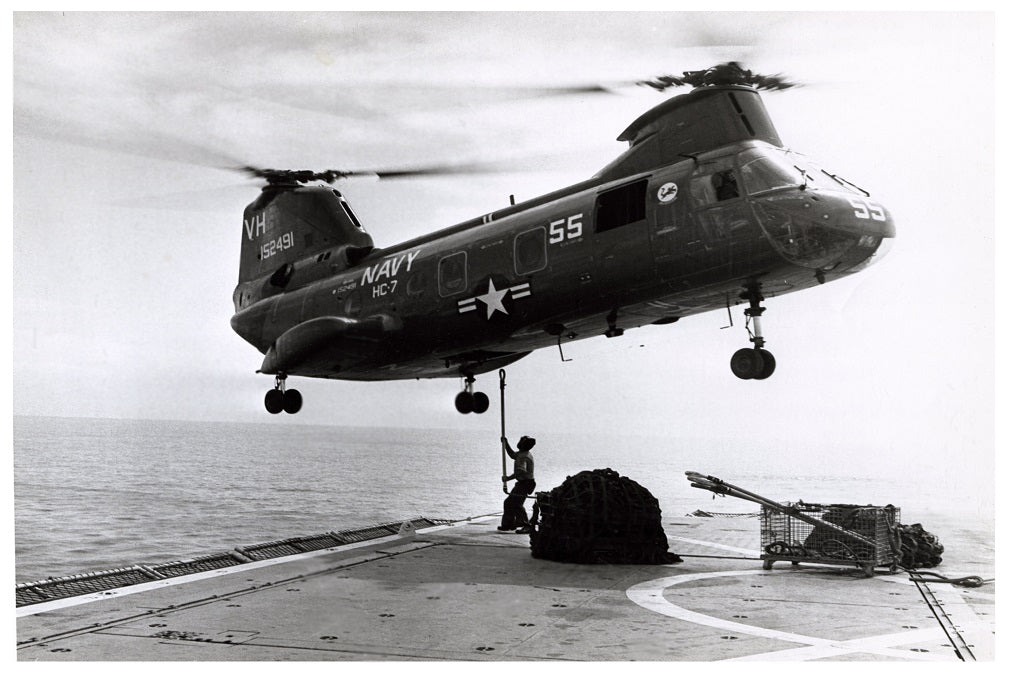
152491 was built in 1966, originally as a UH-46A, but later converted to a UH-46D. In 1969, in the midst of the Vietnam War, it was assigned to the Navy's Helicopter Combat Support Squadron Seven (HC-7). The HC-7 Seadevils were established on September 1, 1967 and were originally tasked with the following missions in support of the operations of the U.S. Seventh Fleet:
- Logistics
- Vertrep (vertical replenishment)
- Seventh Fleet Flagship
- Mine Countermeasure
- Home station SAR
- Combat Search and Rescue (CSAR)
At its founding, HC-7 was a general utility squadron based in Atsugi, Japan. By 1971, the Navy realized how critical the CSAR mission was and tasked all of the remaining missions to other squadrons. HC-7 became the Navy’s only active duty squadron dedicated to CSAR to ever exist. HC-7 had two detachments of H-46s for VERT REP - Det 102 and Det 112. #2491 was one of nine UH-46As in the squadron. Eventually, they consolidated their assets to an all H-3 force. The squadron was disestablished on June 30, 1975, after almost 8 years.
A Recollection from the HC-7 Historian Ron Milam
While researching this aircraft, MotoArt was able to find much information, mainly because of the dedication by Mr. Ron Milam to preserve this history. He has been collecting this history for 20 years. Mr. Milam, known as Lil Ron and the HC-7 Historian, was with HC-7 Det 113 Mine Sweepers aboard the USS Catskill, operating in Manila Bay. He has graciously shared some photos, data and an example of HC-7 VERTREP detachments.
This is Ron himself, hooking up cargo nets to #55.

HC-7 Historical Collection - Ron Milam Historian, contributed by Sam Clawson

HC-7 Historical Collection - Ron Milam Historian, contributed by Sam Clawson
Mr. Milam also shared some documents with us. Here are just a couple:
Take a look at some of the photos of both #55 and HC-7. Thank you to this amazing group and helicopter for bravery and service.

HC-7 Historical Collection - Ron Milam Historian, contributed by Dennis Neumann

HC-7 Historical Collection - Ron Milam Historian, contributed by Doug Akney

Det 102, USS Mars from HC-7 Historical Collection - Ron Milam Historian

HC-7 Historical Collection - Ron Milam Historian

HC-7 Historical Collection - Ron Milam Historian

HC-7 Historical Collection - Ron Milam Historian, contributed by Nick Sturzenegger

HC-7 Historical Collection - Ron Milam Historian, contributed by Roger Armstrong

HC-7 Historical Collection - Ron Milam Historian, contributed by Roger Armstrong

HC-7 Historical Collection - Ron Milam Historian
HC-11 Gunbearers

Photo by Scott Van Aken. Thank you Eric Bannwarth Chaika12
The Helicopter Combat Support Squadron Eleven (HC-11 Gunbearers) was established October 1, 1977 and was stationed at Naval Air Station North Island, San Diego, California. The squadron provided logistics support for the United States Pacific Fleet. #2491 joined the squadron in 1991. In April 2005, HC-11 was redesignated as Helicopter Sea Combat Squadron 21 (HSC-21 Blackjacks) and now flies the Sikorsky MH-60S Seahawk.

Photo by Sam Carnes - Stricken at HC-5 Anderson AFB, Guam in 2003. I assisted the SARDIP on her while TAD from 265.
NATTC Memphis
#2491 then went to the Naval Air Technical Training Center (NATTC Memphis) in Millington, Tennessee and Naval Air Technical Training Center, Chevalier Hall, NAS Pensacola, Florida. It was used as a ground trainer until it was struck off on April 2, 2003. After the end of its Naval career, it was registered to Columbia Helicopters and used for parts.
Scroggins Aviation Mockup & Effects
In 2017, it was given a new life. Parts of the airframe structure and cockpit were obtained by Scroggins Aviation Mockup & Effects. Scroggins Aviation is the leading supplier of aviation mockups and effects to the motion picture and television industry. They offer cockpit sections from helicopters, military aircraft and commercial airliners, cabin interiors, and fabrication and effects for custom builds. MotoArt has had the privilege of working with Scroggins Aviation for many years, and has obtained original aircraft material from a variety of planes, including #2491.
MotoArt’s UH-46D

MotoArt owner Dave Hall was thrilled to find original material from a Sea Knight right in his backyard. “The UH-46 was such an amazing helicopter,” says Hall. “And ours, 2491, really was an incredible workhorse for the Navy for many years. We felt such a privilege to honor her and the brave men who flew and worked with the Sea Knight by preserving what we could.”

UH-46 D Sea Knight PlaneTags

The newest PlaneTags are numbered to 2,000. The patina on these particular gray PlaneTags are not to be missed. They will make a very memorable gift for a veteran or collectible for any aviation enthusiast. Get a Boeing Vertol UH-46D Sea Knight PlaneTag in our shop.

Helicopter PlaneTags
Take a look at some of the other Helo PlaneTags offered by MotoArt.
Sikorsky H-34 Seabat PlaneTags
CH-47 Chinook Planetag #91-00234
Bell Huey UH-1F PlaneTags #: 66-1222
Sikorsky H-3 - PlaneTags TAIL #64-14234
Follow PlaneTags
Facebook | IG | Twitter
Share:
HZ-AB1: A Palace In The Sky
TWA DC-9: Bringing The Globe To The Heartland