

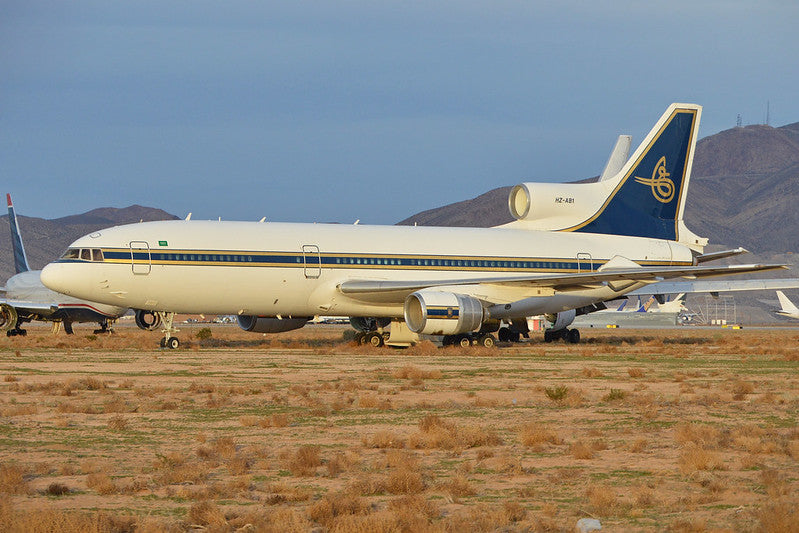
How does a globe-trotting Prince decorate his personal transport aircraft? With only the finest furnishings and decor - and with lots of gold. MotoArt was able to preserve a Lockheed L1011-500 TriStar that was once owned by a King and a Prince, and offer the first ever 23k Gold PlaneTag. Let’s read more about this plane, then grab one for your own collection.
What is the L-1011-500?

The Lockheed L-1011 TriStar 500 is a medium to long range, widebody trijet that flew onto the scene in 1978. It was a shortened version of the standard variants, by around 14 feet, which meant it carried less passengers, but it offered more fuel capacity, greater takeoff weight, and a maximum range of 6100 nautical miles (11,260km). It was Lockheed’s only commercial passenger jet. The L-1011 was celebrated for its many achievements including its reliability, ease of maintenance, profitability and being the quietest and most technologically advanced aircraft produced. Production for the -500 ended in 1983 after only 50 had been built.
L-1011-500 Specs

CHARACTERISTICS:
- MANUFACTURER: LOCKHEED
- TAIL: HZ-AB1
- CREW: 3
- SEATING: 240
- EMPTY WEIGHT: 245,400 LB
- WINGSPAN: 164 FT 4 IN
- LENGTH: 164 FT 2 IN
- HEIGHT: 55 FT 4 IN
PERFORMANCE:
- MAX TAKEOFF: 504,000 LB
- RANGE: 5,500 NM
- MAXIMUM SPEED: 518 KNOTS
- CRUISE SPEED: 483 KNOTS
- CEILING: 42,000 FT
- RATE OF CLIMB: 2,800 FT/MIN
- ENGINE: RB.211-524B (X3)
Our Plane’s History

According to Airfleets, our plane (MSN 1247) was constructed as an L-1011-500 in 1982 and took its first flight on March 11, 1983. It was 247 of 250 L-1011s that were built. It was delivered to Lockheed Corp on November 3, 1983 as N64854. It was then registered as JY-HKJ and was delivered to the Royal Jordanian Air Force in June 1984. In September 2001, it was registered as HZ-AB1 and delivered to Al Anwa Aviation for the private transportation of Prince Abdul Aziz Al-Ibrahim. It was withdrawn from use in 2013, and stored at Victorville, California until scrapping in 2021.
While that may not seem too exciting at first glance, a closer look at its history - from what we can find - and at the plane itself, this L-1011 certainly becomes much more interesting.
JY-HKJ: In Service of the Kingdom of Jordan

From the start, this TriStar was built to carry royalty. It was customized in a VIP configuration to be used for the Jordanian government, more specifically in service of the King of Jordan and the royal family. It’s not surprising that photos of the interior are difficult to find. However, it was spotted all over the world. It was painted in the colors of Jordan’s flag, with gold detailing in places such as the tail and fuselage.

HZ-AB1: Private Charter to A Prince

The plane was sold to Al Anwa Aviation, a business and private charter airline based out of King Khalid International Airport (RUH) in Riyadh, Saudi Arabia, for the purpose of serving as the private charter for Prince Abdul Aziz Al Ibrahim and the Royal Family. During that time, it was renovated inside and outside, in a manner befitting that of a globe-trotting Prince. Inside, it was decorated with the finest of materials - wood cabinetry, fine upholstery and linens, and gold - lots and lots of gold. Many items and fixtures were gold plated, including seat belts, ashtrays, signs and more. The exterior was painted white and royal blue, with genuine 23k gold leaf added in thick strips along the sides from nose to tail, engine cowlings, and on the empennage itself.
While it is difficult to find photos of the interior, the outside, perhaps the most exciting part of the plane in the end, has been photographed quite a bit. Many photos have been taken over the years as it sat at the Southern California Logistics Airport in Victorville, California. It was there where MotoArt owner Dave Hall first took notice of it.

MotoArt’s Gold L1011
“At first glance it was a beautiful plane,” says Hall. “When we noticed the gold paint and looked into the plane’s history we knew we needed this for our collection.” There was a challenge to overcome though - how to extract the gold without damaging it. Would it be worth it to purchase? Would MotoArt be able to offer an authentic gold PlaneTag? In the end, Hall knew his dedicated team was up for a challenge and he went for it.


This winter, the MotoArt team headed back up north to Victorville and began the process of cutting panels and windows from the plane before it was scrapped. It took several days for the crew to cut panels from the outside, as well as work from the inside to ensure they got all the material they needed.


Gold PlaneTags


Because the aircraft fuselage has the heaviest aluminum structure around the windows, the material from that section is much thicker than the rest of the fuselage. Hall and the team began devising a way to produce a very thick PlaneTag from that section. It could not be stamped out the way the others are.

Instead, the thickest ones were CNC machined, with a process that required 4 different tool changes on both sides. Each one took much longer but the result is an incredibly thick and beautiful 23k gold leaf PlaneTag.

The rest of the L1011 Collection, while not as thick, are just as stunning. They were cut and stamped the way most PlaneTags are created. Then cleaned and polished.

L-1011 PlaneTags

These stunning L-1011 PlaneTags are numbered to 10,000 and are available in blue, gold, white and color combinations. There are a limited number of thick 23k gold PlaneTags and it could be the first and last opportunity to buy them in the PlaneTags shop because of the excitement around them.

Lockheed PlaneTags

Lockheed Martin, formerly Lockheed, has designed some of the most amazing and iconic aircraft ever seen. MotoArt has had the privilege of preserving some of these planes, including the now sold out Lockheed SR-71 and Lockheed Martin Titan II PlaneTags. Round out your collection with our newest L-1011 and these Lockheed planes:
Lockheed C-130A Hercules PlaneTag

Share:
Beechcraft Starship: An Aircraft Ahead Of Its Time
UH-46 Sea Knight: Unique and Heroic Service