

- by Dave Hall
The Handley Page Victor: A V-Bomber That Delivered
- by Dave Hall
This site uses cookies for better user experience and analytics.
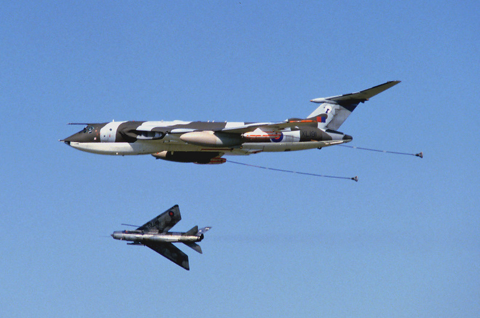
The Handley Page Victor, the last of the British V-Bombers, entered the Cold War fray during the ’50s and served with the RAF years beyond the lifetime of the manufacturer itself. One of them, XL191 RAF, faithfully flew with the 55 Squadron as an aerial fuel tanker. Read more about this dramatic, fantastic looking plane then add Handley Page Victor K2 PlaneTags to your collection.

Photo from Flickr user Irish251 On display at RAF St. Athan, September 1984.
Handley Page Ltd. was founded by Sir Frederick Handley Page in 1909 and grew to be Britain’s first publicly traded aerospace manufacturing company. They are known for their heavy bombers and other innovative airliners, and their role as pioneers in aviation history. Handley Page himself had experimented with monoplanes and biplanes before starting his company and building a factory in Great Britain over a century ago.
During the First World War, the Royal Navy required heavy bombers to fly runs over the German Zeppelin yards, with the intent on eventually reaching Berlin. Handley Page produced a series of aircraft which included the O/100, the O/400, and the V/1500. The V/1500 did have the range needed to reach Berlin but the war ended just as it entered service. Immediately after the war, some O/400s were converted to passenger use for the Handley Page Transport airline London to Paris run. Handley Page Transport merged with two other airlines to form Imperial Airways, UK’s first national airline service. They built the H.P.42 for routes to India and Africa, as well as other large airliners. Right before WWII, the RAF requested heavier, long-range aircraft. Handley Page produced a series of bomber designs including the Heyford, Hampden, and Halifax, as well as other aircraft, for the war effort.


After WWII, there was an immediate need for nuclear deterrents and bombers to carry them. Three of these were produced and were known as the V-Bombers. They were the Vickers Valiant, Avro Vulcan and the Handley Page Victor (HP.80). The Victor was a four-engine jet, with a unique crescent wing, designed by Godfrey Lee. It remained in service many years beyond Handley Page Ltd. itself, even after fatigue cracks were found following a nuclear mission. It was then repurposed as a strategic reconnaissance aircraft and modified with radars, sensors, and cameras. In 1968, the Royal Air Force converted the Victor once again, into an aerial refueling tanker.


Walter Soplata was the son of Czech immigrants, a husband and father of five, a union carpenter, and an aviation enthusiast who, together with his family, created an airplane sanctuary on his land in Ohio. His labor of love eventually amassed almost 20 incredibly rare airplanes, 50 different engines, and decades of history. All done without the cranes and machinery used today to dismantle an airplane. He disassembled each plane himself, with hand tools and the help of his children, and transported them to his collection. Read more about MotoArt’s Soplata Collection PlaneTags.


Last summer and fall, MotoArt owner Dave Hall and the team traveled to Ohio to see Walter Soplata’s collection in person. “Even months later,” recalls Hall, “The moment I first saw the Handley Page Victor is still so fresh in my mind. It was just sitting there, this hulking mass of machinery in disrepair, but I imagined being the bomb-aimer cramped inside that nose, and it took my breath away.”

The team was able to get in and out of Ohio before the snowfall and winter hit. They were able to get enough material for a small run of 1,000 PlaneTags. “No one likes to imagine an incredible plane like the Victor or the B-36 Peacemaker or any of the others in the Soplata Collection being cut up,” states Hall. “But no one likes to see them rot away either. I was glad we were able to preserve and share this piece of history with other enthusiasts.”

These PlaneTags feature a weathered patina in shades of grays, tans, and yellows. They are etched with the Victor’s image on one side, and the back is ready for custom information to be added. The colorful display card was designed specifically for PlaneTags and explains the origins of the plane, and displays the Soplata Collection logo. Like the others in the Soplata Collection, such as the B-36 Peacemaker and the Douglas DC-7, these are expected to sell out.

“My vision is to create an Encyclopedia of Aircraft,” says Hall, from his office at MotoArt Studios in Torrance, CA. “Instead of having a book, or a boneyard, full of planes, you’ll be able to hold them all in your hand. That’s my dream.” If that is your dream too, make sure you get one of these for your collection while it's possible.
With the 20th anniversary coming up next year, MotoArt has many exciting things in store for the months leading up to it. Many more vintage and commemorative planes will be added to the Encyclopedia of Aircraft, like the Handley Page Victor, interspersed with great commercial planes like the ANA 767 and an upcoming Thai Airways 747. MotoArt has also launched an American Airlines Mad Dog MD-80 line of furniture that is unlike any of past offerings. Read about the Mad Dog Wing Desk that kicked off the collection in January.
There are also more big surprises in store so make sure you are signed up for the PlaneTags and MotoArt newsletters.
Grumman OV-1D Mohawk: The U.S. Army's Battlefield Eye in the Sky
The Grumman OV-1 Mohawk was one of the most capable and technologically advanced reconnaissance aircraft operated by the U.S. Army during the Cold War. Designed to gather intelligence close to the front lines, the Mohawk combined short takeoff and landing performance with sophisticated sensor systems that allowed it to detect and monitor activity on the ground in nearly any weather conditions.
At a time when battlefield commanders increasingly relied on timely intelligence, the Mohawk provided information that could not always be obtained through traditional observation methods. Equipped with infrared sensors, cameras, and side-looking airborne radar systems, it helped military planners track troop movements, monitor supply routes, and identify potential threats day or night.
Over a service life that spanned more than three decades, the Mohawk flew missions in Vietnam, served with Army intelligence units in Europe during the height of the Cold War, and helped pioneer many of the airborne surveillance techniques that later became standard throughout the military.
Today, PlaneTags made from OV-1D Mohawk serial number 62-5902 preserve the legacy of an aircraft that played a critical role in military reconnaissance during a period of rapid technological change.
Built for Any Mission: The Lockheed C-130 Hercules
From Liftoff to Legacy: The Story of the Space Shuttle’s Solid Rocket Boosters
Share:
ANA’s 767: The $71 Million Dollar Plane
Thai Airways 747: Culture and Hospitality On Board