

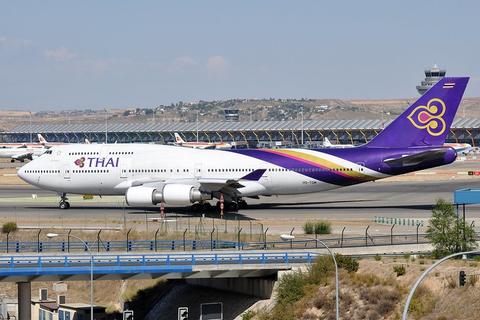
The rich purple and iconic symbolism of Thai Airways’ branding represents ideals the airline has been striving to portray since its inception in 1960 - a culture rich with history and unrivaled hospitality. Read more about the Star Alliance airline, the role of Boeing 747s in its expansion, and its future fleet, then get a Thai Airways Boeing 747 PlaneTag.

Thai Airways
Thai Airways International is the national flag carrier of the Kingdom of Thailand, based at Bangkok Suvarnabhumi International Airport. Since its beginning in 1960, it has developed a corporate vision to be a modern and innovative airline, while celebrating the culture and hospitality that Thailand is known for. Their motto is First Choice Carrier with Touches of Thai.
Brand & Livery
From its start, the airline was careful to brand itself in a manner that reflected Thailand’s most important values - culture and hospitality. Its original brand was the ‘dancing man’, a symbol created by HSH Prince Kraisingh Vudhijaya which represented a classical Thai dancer.

As the airline grew, it desired to project a more up-to-date, modern image that would be recognized internationally. In 1975, a new brand was adopted. The colorful symbol suggested a tropical orchid and was meant to evoke classical Thai design elements and the richness of Thai silk. In 2005, the airline changed the icon to give it an even more modern, three-dimensional appearance. Its livery was also changed to the current color scheme, with a predominant splash of purple on the tail of every passenger aircraft.
Thai Airways’ Boeing 747-400 History

During the 1980s the airline had classic 747 jumbo jets in the fleet, along with other older aircraft such as DC-10, DC-9, and A300. To replace them, they ordered two 747-400s on June 16, 1987. They then ordered 18 more 747-400s until 11/2002. Our plane was in this order.
The 747-400s flew on both long haul flights and short-distance routes. During this time period, it was the most universal aircraft for the airline and its use helped the airline grow. Within the next few years, all of these 747-400s will be retired.
The airline has received permission to purchase several new aircraft, which will allow them to compete with other airlines on routes where they are operating more fuel-efficient and more modern planes.
This has caused many to question whether the carrier can compete with other airlines, especially in business class, until the new planes can take over routes. Many have speculated that the airline will order variants of Airbus A350 and Boeing 787, both currently in the fleet.
HS-TGM

Our plane, HS-TGM, was added to the Thai Airways fleet in November 1992. She flew solely with the airline until she was withdrawn from service in December 2013.
The plane is named Chao Phraya, from Chao Phraya River. The Chao Phraya is the major river in Thailand, with its low alluvial plain forming the center of the country. It flows through Bangkok into the Gulf of Thai. Most Thai Airways planes are traditionally named after provinces, districts and landmarks.
MotoArt’s Thai Airways Plane

HS-TGM and other retired Thai Airways 747s were stored at the Mojave Air and Space Port for several years. The bright purple, magenta and gold colors caught the eye of MotoArt owner Dave Hall many times as he and the crew worked in the MotoArt Mojave boneyard location. “We were so excited to be able to preserve this plane,” said Hall. “We knew our customers would love these colors.”
The crew set to work cutting off panels of fuselage skin, as well as sections of windows. The materials were then transported to MotoArt Studios in Torrance, CA, in the South Bay area of Los Angeles. They were cut, polished, assembled by hand and the result is an array of PlaneTags in stunning colors fit for royalty.

Thai Airways PlaneTags

The Thai Airways 747 PlaneTags are available in several color variations, including purple, gold, magenta, white, and color combos of purple/gold and magenta/gold. As color combinations are limited, they will go quickly.
Thai Airways Airplane Windows

In addition to these beautiful PlaneTags, we are offering single and double Thai Airways Fuselage Mirrors. They are offered in purple and gold - and a special combo with pink. Only two are available in the color combo. A fuselage mirror or frame makes a striking decorative addition to any home or office. Show off your love of aviation.
747 PlaneTags
For fans of the Queen of the Skies, take a look at these other 747 PlaneTags we offer:
- Boeing 747 PlaneTag Tail# N818SA
- Boeing 747 PlaneTag Tail# N761SA
- Korean Air Boeing 747-400 HL7495
- United Airlines Boeing 747 N198UA
- Luxury Executive Metal Business Cards - 747 Plane
And don’t forget MotoArt’s Boeing 747 Conference Table
In case you missed it
Check out these related posts:
Share:
The Handley Page Victor: A V-Bomber That Delivered
MotoArt’s Military Planes: Saluting Our Mighty Defenders