


The Yakovlev Yak-3 is widely regarded as one of the most effective Soviet fighters of World War II. Compact, lightweight, and optimized for low-altitude combat, it earned a strong reputation among pilots on the Eastern Front for its maneuverability and climb performance.
The Yakovlev Yak-3UA known as Full Noise carries that legacy into the modern era. Built in 1993 using original Soviet tooling and engineering drawings, later powered by an American Allison V-1710 engine, and campaigned in the Unlimited class at the Reno Air Races, this aircraft represents a rare intersection of wartime design, post Cold War reconstruction, and modern competition.

Full Noise flickr photo by errolgc shared under a Creative Commons (BY-NC-ND 2.0) license
Yakovlev Yak: A Fighter Built for the Eastern Front

First flown in 1943, the Yak-3 was developed to meet the specific demands of low-altitude combat. The majority of air engagements on the Eastern Front occurred at relatively low heights, where acceleration, climb rate, and turning performance were critical.
The Yakovlev Design Bureau, led by Alexander Yakovlev, refined earlier fighters such as the Yak-1 and Yak-9 to create a smaller, lighter aircraft. Engineers reduced weight, simplified the structure, and shortened the wingspan to improve responsiveness and agility. When the Yak-3 entered frontline service in 1944, it flew alongside aircraft such as the Lavochkin La-5FN and La-7 and faced German fighters including the Messerschmitt Bf 109 and Focke-Wulf Fw 190.

A formation of Soviet Yakovlev Yak-3 fighter aircraft on an airfield during World War II. Photographer unknown.
In low-altitude engagements, the Yak-3 proved highly competitive and in many cases superior in maneuverability. It effectively replaced earlier Yak-1 variants in several units and represented the peak of Yakovlev’s piston-engine wartime development before jet aircraft such as the MiG-9 and MiG-15 began to dominate postwar air forces.
Continuation Construction in the 1990s
After the collapse of the Soviet Union, access to original Yakovlev factory tooling, dies, and engineering drawings made it possible to build continuation Yak-3 aircraft using authentic production methods. Rather than creating modern replicas, the goal was to construct aircraft as faithfully as possible to the original design.
Between 1991 and 2002, only ten Yak-3s were completed using this original tooling. ZK-VVS is number six of those ten. These aircraft are not reinterpretations of a historic fighter. They are continuation builds based directly on the original engineering. For warbird enthusiasts, that level of authenticity is distinctly significant.
The Yak-3UA Configuration and the Allison V-1710
The Yak-3UA designation reflects the installation of an Allison V-1710 engine in place of the original Soviet powerplant. Built in 1993, this aircraft was fitted with the liquid-cooled American V-12, an engine known for its service in aircraft such as the P-40 Warhawk and P-38 Lightning.
The Allison V-1710 offered practical advantages. It had established support within the Western warbird community, known maintenance practices, and available parts supply. For operators outside of Russia, this made sustained flight operations more feasible.
From a performance standpoint, the Allison paired well with the Yak-3’s compact and lightweight airframe. The combination preserved the aircraft’s strong low-altitude handling characteristics while providing reliable power delivery suited to competitive flying.
Yak-3UA At A Glance

Yak-3UA Specifications
Manufacturer: Yakovlev Design Bureau
Model: Yak-3UA
Registration: ZK-VVS
Crew: 1 (Pilot) + 1 Passenger capable
Wing Span: 30 ft 2 in
Length: 27 ft 11 in
Height: 8 ft 2 in
Yak-3UA Performance
Max Range: 550 mi
Max Speed: 360–410 mph (configuration dependent)
Service Ceiling: 34,100 ft
Empty Weight: 4,600 lb
Max Takeoff Weight: 5,850 lb
Rate of Climb: 3,500–4,000 ft/min
Engine: 1 x Highly Modified Allison V-1710 liquid-cooled V-12 piston engine
Full Noise: Reno Air Races and Competitive Flying
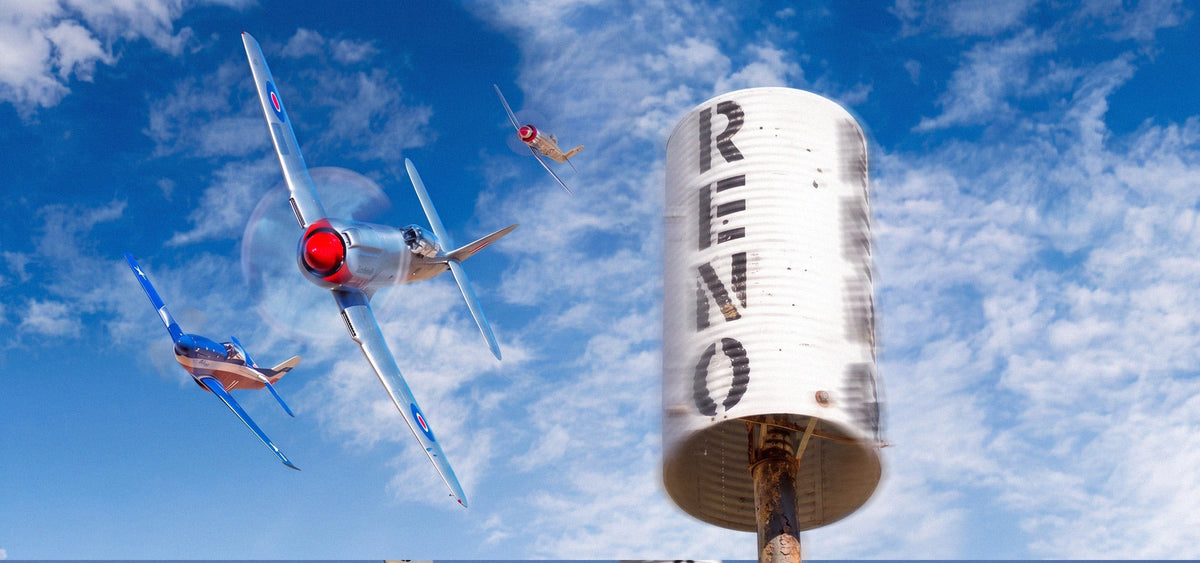
The Reno Air Races have long served as a proving ground for piston-engine fighters. In the Unlimited class, World War II era aircraft are flown at sustained high power settings around a tight pylon course at low altitude. Performance, reliability, and disciplined maintenance are essential.

This Yak-3 first competed at Reno in the 1990s. Its agility and low-altitude performance made it well suited to pylon racing. However, in 1999, the aircraft suffered a crash that ended its racing campaign at the time. Many aircraft do not return from such incidents. Restoration requires significant technical work, funding, and long-term commitment.
Restoration and Return to Flight
In 2004, the aircraft was purchased by Graeme Frew. The restoration process that followed focused on returning the aircraft to airworthy condition with attention to structural integrity, systems reliability, and competitive capability.

Yak 3 propeller vortices flickr photo by Seabird NZ shared under a Creative Commons (CC BY-ND 4.0) license
The Yak-3 returned to flight in 2012 under the name Full Noise. Based in New Zealand, the aircraft was dismantled, transported across the Pacific, and reassembled for competition in Reno. It became the only New Zealand based team to compete in the Unlimited class.
Reno 2017 and 2018 Results
The 2017 Reno Air Races marked a significant year for Full Noise. After completing an overnight engine change prior to competition, the aircraft started last in rookie Heat 1C and won the heat. It later won Unlimited Heat 3B and advanced to the Gold Final. These results demonstrated both the capability of the aircraft and the effectiveness of the team supporting it.

In 2018, Full Noise qualified sixth at 362.77 miles per hour. That speed placed it firmly among competitive Unlimited class aircraft and confirmed its consistency at a high level of performance.
A Continuing Legacy
As of 2026, Full Noise remains New Zealand’s only World War II fighter experience. It is not a static exhibit. It is a flying aircraft with a history of competition and restoration.

Full Noise pilots, Graeme Frew and Ryan Southam, from @fullnoise35 on Instagram
After competing at the Reno Air Races and qualifying at 362.77 miles per hour, the aircraft returned home to Marlborough. In May 2023, during a takeoff operation at Omaka Aerodrome, Full Noise experienced an overrun at the end of the runway and ran off into a fence. The pilot was not injured, and the aircraft sustained substantial damage. As of February 2026, Full Noise is flying again. Follow the story of Full Noise on Instagram and YouTube.
This aircraft connects multiple eras of aviation history. It represents World War II design carried forward through authentic continuation construction, fitted with a Western engine configuration, and campaigned at one of the most demanding competitive environments in aviation. Its rebuild and maintenance is a testament to the dedication of those committed to keeping aviation history in the air.
MotoArt Acquires a Yak
In 2023, during the final Reno Air Races at Reno-Stead Airport, Dave and the MotoArt team were on site for what would become the last year of this historic air racing event in Reno. 2023 marked the final Reno races after nearly six decades at the venue, a storied chapter in aviation history that drew pilots and enthusiasts from around the world.

While at the event, Dave was approached by Graeme Frew. Graeme was familiar with MotoArt’s work on PlaneTags and appreciated the way MotoArt honors aviation history through authentic material and thoughtful design. During their conversation, Graeme offered parts that had been replaced during the aircraft’s restoration, seeing a shared history and mutual respect in preserving real fighter aircraft.
Dave shared his perspective on the moment:
“I have always believed that preserving aviation history means connecting people directly with the machines that shaped it. When Graeme reached out with parts from Full Noise and the offer to work together, it was a rare chance to honor an aircraft that bridges World War II legacy, continuation craftsmanship, and a modern air racing identity. We are honored to carry forward that history with PlaneTags.”
From Racing Components to PlaneTags

The parts Graeme Frew sent were not decorative panels or cosmetic skins. They were authentic components removed during restoration. Each piece carried the marks of real flight, real stress, and real performance history.
When the materials arrived at MotoArt Studios, the process began the same way it does for every aircraft we work with. The team evaluates the structure, thickness, alloy composition, and surface condition of the metal. Because racing aircraft are maintained to exacting standards, the materials often show evidence of modification, reinforcement, and high-performance use.
Unlike aircraft retired after decades of airline service, racing components tell a different story. The wear patterns are different. The repairs are different. The structural integrity requirements are different. Every replaced panel or part reflects a decision made to improve performance, reliability, or safety under competitive conditions.
Once evaluated, the metal is carefully cleaned and stabilized while preserving as much of the original character as possible. The team maps out usable areas, avoiding structural stress points and honoring the integrity of the original component. From there, the material is precision cut into PlaneTags using MotoArt’s proprietary process.
Each PlaneTag is deburred, finished, stamped, and individually serialized. As always, no two tags are exactly alike. Variations in surface markings, rivet impressions, or subtle contour shifts reflect the aircraft’s operational history. In this case, that history includes World War II design lineage, 1990s continuation construction, modern restoration work, and competitive air racing at Reno.
The result is more than a collectible. It is a direct physical connection to an aircraft that has competed at full power, crossed the Pacific for racing, and carried a rare chapter of aviation history forward.
Other Reno Air Racers in the PlaneTags Collection
The Yak-3UA Full Noise is not the first Reno competitor to become part of the PlaneTags story.
Over the years, MotoArt has preserved material from several aircraft that competed in the Reno Air Races, each representing a different chapter in piston and jet racing history.
De Havilland Vampire
The de Havilland Vampire brought early jet technology to the Reno course. Originally developed as one of the world’s first operational jet fighters, the Vampire later found new life in air racing, where its compact twin-boom design and distinctive profile made it instantly recognizable.
Material from the Vampire connects the early jet era to the high-performance racing environment of Reno. Read more about it here.
Hawker Sea Fury “Dreadnought”
The Hawker Sea Fury is one of the most successful piston-engine racers in Reno history. Originally a British naval fighter, the Sea Fury’s powerful radial engine and strong airframe made it a natural competitor in the Unlimited class.
“Dreadnought” represents the refined end of piston fighter development and the evolution of military aircraft into dedicated racing machines. Sea Furies have consistently ranked among the fastest aircraft on the Reno course, and Dreadnought carries that legacy forward.
Hawker Sea Fury “Argonaut”
Like Dreadnought, Argonaut is a Hawker Sea Fury that transitioned from military service to competitive racing. In Reno trim, Sea Furies are often highly modified for speed and reliability, reflecting years of aerodynamic refinement and engine development.
Argonaut represents the technical progression of Unlimited air racing, where historic airframes are continually optimized to extract maximum performance. Read about both Sea Furys on our blog.
From early jets to radial-powered Unlimited champions and Soviet-designed racers, Reno aircraft represent a unique category in aviation history. They are not preserved only for static display. They are flown, tuned, and tested at the limits of their design.
Through PlaneTags, these racing aircraft continue their story in a new form, connecting collectors to one of the most demanding arenas in aviation.

Share:
Flying United for Three Decades: Airbus A320 N404UA
Sikorsky H-5 Dragonfly: The Navy’s First Fleet Helicopter