

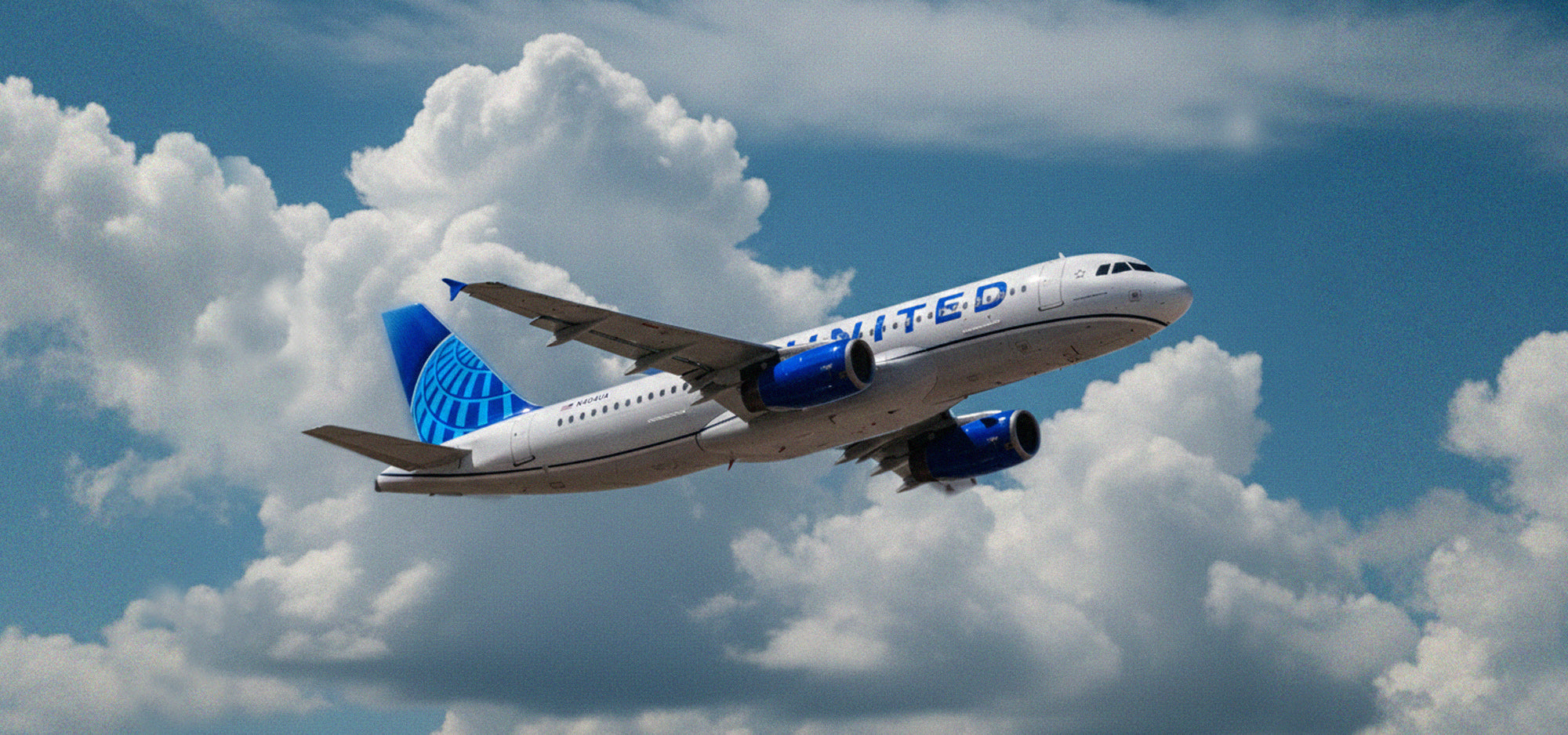
When the Airbus A320 entered service, it marked a turning point in commercial aviation. United Airlines’ A320 N404UA spent nearly three decades as part of that legacy, flying thousands of routes before its retirement and preservation through PlaneTags.
The Airbus A320: A Plane That Changed Aviation

United Airlines A320-232, N405UA flickr photo by usf1fan2 shared under a Creative Commons (BY 2.0) license
When Airbus introduced the A320, it did not just launch a new airplane. It changed the way commercial aircraft were designed and flown.
First flown in 1987, the Airbus A320 family introduced fully digital fly by wire flight controls to commercial aviation, replacing traditional mechanical systems with computers. The aircraft also debuted side stick controllers, a major departure from the conventional control yoke used on most airliners before it.

Airbus A320-232(WL) | HS-TXH | Thai Smile Airways flickr photo by Max Alpha X-Ray shared into the public domain using Creative Commons Public Domain Dedication (CC0)
These innovations improved efficiency, reduced pilot workload, and enhanced safety, setting a new standard for modern airline operations. The A320 was designed to replace older narrow body aircraft like the Boeing 727 and early generation 737s, offering better fuel efficiency, lower operating costs, and increased reliability.
The result was one of the most successful commercial aircraft families in history. It is an airplane that reshaped short and medium haul air travel around the world.

20110819_K7_P11463-p1.jpg flickr photo by In Memoriam: cclark395 shared under a Creative Commons (BY-NC 2.0) license
The Airbus A320 Family
The Airbus A320 family began in the late 1980s with a clear goal: to redefine narrow body air travel through efficiency, safety, and modern design. First flown in 1987, the original A320 introduced digital fly by wire flight controls and side stick technology, setting it apart from every commercial airliner that came before it. The family eventually grew to include the A318, A319, A320, and A321, offering airlines a range of capacities and performance options while maintaining common cockpit layouts and operating procedures.

A320 Family Production ramps up | Airbus photo
United’s A320s, including N404UA, represented the core of this family and served as versatile workhorses for short and medium haul routes. Today, the A320 legacy continues with the A320neo generation, which builds on the original design with more efficient engines, improved aerodynamics, and reduced emissions. More than three decades after the first flight, the A320 family remains a cornerstone of global airline fleets and one of the most successful aircraft programs in aviation history.
United Airlines A320 At A Glance

A320 Specifications:
- Manufacturer: Airbus
- Type: A320-232
- Tail #: N404UA
- Operator: United Airlines
- Crew: 5 (2 Pilots, 3 Flight Attendants)
- Passenger Capacity: 150 (96 Economy, 42 Economy Plus, 12 First Class)
- Wingspan: 111 ft 10 in
- Length: 123 ft 3 in
- Height: 38 ft 7 in
A320 Performance:
- Range: 3,797 mi
- Cruise Speed: Mach 0.78–0.80
- Service Ceiling: 39,100 ft
- Empty Weight: 93,000 lb
- Max Takeoff Weight: 169,750 lb
- Rate of Climb: 2,500–3,000 ft/min
- Engines: 2x IAE V2527-A5 turbofan s
United Airlines and the Airbus A320
In 1992, United Airlines placed a significant order for 50 Airbus A320 aircraft, with options for 50 more. It marked an important moment for the airline and introduced Airbus aircraft into a fleet long dominated by Boeing designs.
For United, the A320 became a core part of its domestic network. Operated from nearly all United hub airports, the aircraft primarily served short and medium haul routes with a typical capacity of around 150 passengers. It played a key role in connecting cities efficiently while supporting United’s growing route network.

Over time, advances in engine technology and aircraft design led United to transition toward newer narrow body aircraft, including the Boeing 737 Next Generation and 737 MAX families, which now form the backbone of United’s single aisle fleet. Today, United operates one of the largest and most modern fleets in the world, blending efficiency, range, and capacity across its narrow body and wide body aircraft.
Aircraft Spotlight: United A320 N404UA

N404UA flickr photo by Alec BHX/KKC shared under a Creative Commons (BY-SA 2.0) license
N404UA entered service in December 1993, just a year after United’s initial A320 order. Over the next 29.7 years, the aircraft became a familiar presence across United’s route map.
During its career, N404UA accumulated more than 90,000 flight hours and approximately 35,000 flight cycles, quietly carrying millions of passengers between cities across North America. Like many A320s, it spent decades doing exactly what it was designed to do. It operated reliably and efficiently day after day.
On July 15, 2023, N404UA completed its final revenue flight, from IAH to ORD. On July 18, 2023, N404UA landed at Tupelo Regional Airport and closed a nearly 30 year chapter in United Airlines history.
Preserving N404UA Before It Was Gone

As aircraft like N404UA reach the end of their service lives, most are dismantled and scrapped. Important chapters of aviation history disappear piece by piece. MotoArt had the opportunity to locate this Airbus A320 before it was lost forever. Our team carefully removed sections of the aircraft’s original skin, preserving authentic material from a jet that helped define modern airline travel.


Saving this aircraft was not about nostalgia alone. It was about honoring decades of service and giving aviation enthusiasts a tangible connection to that history. “Every PlaneTag starts with an aircraft that earned its place in history. N404UA flew for United for nearly 30 years, and preserving it was really about respecting the people, the routes, and the moments that airplane carried along the way," said Dave Hall, MotoArt PlaneTags Founder.


From Aircraft Skin to PlaneTags

Back at our facility, the aircraft skin was cleaned, cut, and transformed by hand into authentic PlaneTags. Each tag is made from the actual fuselage of N404UA and carries the wear, markings, and character earned through years of flight.


No two PlaneTags are exactly alike. Each one represents a small but genuine piece of a working airliner. It is an aircraft that once crossed the skies thousands of times.
A Growing United PlaneTags Collection
The United A320 PlaneTag joins a growing collection of authentic aircraft collectibles made from retired United jets. Each one has its own place in the airline’s history and tells a story with its unique registration and service record.
Here are some favorites already in the collection:
-
United Boeing 727 – N7630U. A classic 727 in the iconic Saul Bass livery, delivered in 1968 and serving United’s domestic network for more than two decades before retirement in 1992.
-
United Boeing 747 – N120UA. A Boeing 747-400 that carried passengers on international routes for nearly twenty years. Originally released as an employee-exclusive collectible, these tags are now available to the public
-
United Boeing 757 – N559UA. This 757-222 served United faithfully from the early 1990s through its retirement and represents the airline’s workhorse medium-haul fleet.
-
United Boeing 767 – N646UA. A long-haul favorite, the 767-332ER expanded United’s global reach for three decades before retirement and now lives on in collectible form.
-
Honorable Mention - United Boeing 747 – N198UA (now SOLD OUT) retired but found a second life when its cockpit and controls, engines, pylons, landing gear, actuators, electrical, hydraulics and fuel subsystems were incorporated into the Stratolaunch, the world’s largest aircraft by wingspan.
These tags celebrate the evolution of United’s fleet and make meaningful additions to any aviation collection.
Share:
F-84 Thunderjet: A Frontline Jet Preserved for History
Yakovlev Yak-3UA “Full Noise”: From Fighter to Reno Air Racing Competitor