

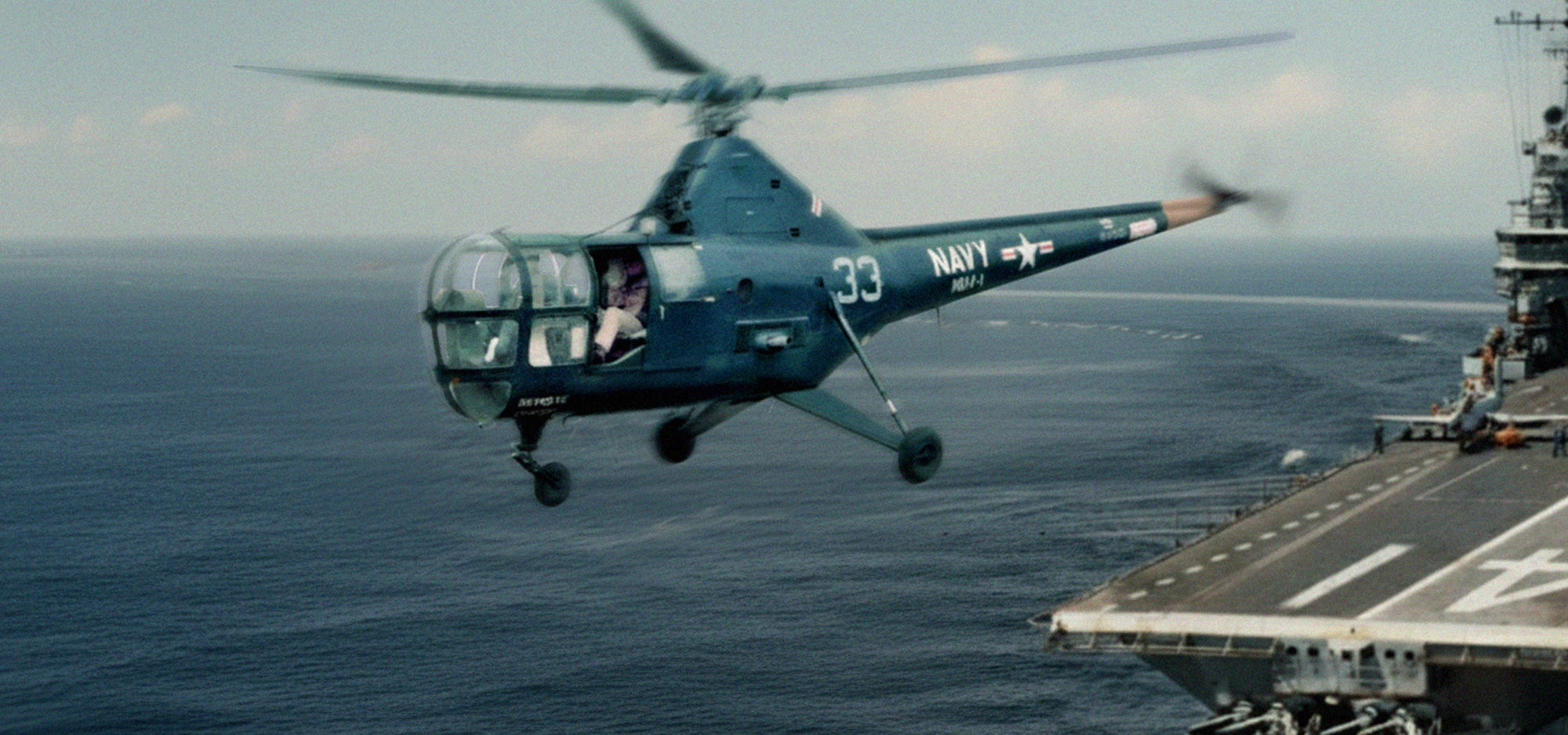
The Sikorsky H-5 Dragonfly, designated HO3S-1 in U.S. Navy service, was the helicopter that permanently changed naval aviation.
Introduced in the late 1940s, the H-5 became the first Navy helicopter to replace fixed-wing aircraft operating with the fleet. It established practical shipboard helicopter operations and laid the foundation for modern combat search and rescue doctrine.
Helicopters are now indispensable to naval operations worldwide. That integration began with the Dragonfly. Add a HO3S-1 to your collection.
Development and Design of the Sikorsky H-5 Dragonfly
From R-5 to HO3S-1
The H-5 evolved from Sikorsky’s earlier R-5 helicopter. Refinements led to the company designation S-51, which entered military service as the H-5 and became the HO3S-1 in Navy use.

By U.S. Navy - commons file, Public Domain, Link
Powered by a Pratt & Whitney R-985 radial engine producing approximately 450 horsepower, the helicopter featured a three-blade main rotor and lightweight tubular construction with fabric-covered skin. With a maximum speed of roughly 90 miles per hour and a range near 280 miles, the H-5 was modest in performance but revolutionary in application. Its true capability was vertical lift from confined spaces. That capability reshaped fleet operations.
Replacing the Floatplane
Before the HO3S-1, naval vessels relied on catapult-launched floatplanes for reconnaissance and rescue. These aircraft required launch rails, cranes for recovery, and relatively calm seas. In emergencies, small boats were often used to recover personnel, a process that was slow and weather dependent.
The H-5 eliminated those constraints. It could lift vertically from a small section of deck, hover precisely over survivors, and return directly to the ship without catapults or recovery gear. For the first time, ships had organic, on-demand vertical rescue capability.
The Dragonfly did not supplement fleet aviation. It replaced the floatplane in key operational roles and proved helicopters were essential, not experimental.
What Replaced the H-5 Dragonfly
As helicopter technology advanced in the early 1950s, fleet requirements expanded. Greater lift capacity, increased range, and broader mission capability were needed.
The Sikorsky H-19 Chickasaw introduced improved payload capacity and cabin space, making it suitable for transport and logistics in addition to rescue.
The Sikorsky H-34 further expanded naval capability with more power and endurance. It became a multi-role maritime platform supporting anti-submarine warfare, transport, and fleet utility missions.
These helicopters surpassed the H-5 in performance, but they were built upon its operational foundation. Deck procedures, maintenance standards, and shipboard doctrine had already been proven by the HO3S-1. The H-5 was replaced because it succeeded. It demonstrated that vertical lift was permanent in naval aviation.
The H-5 Dragonfly in the Korean War
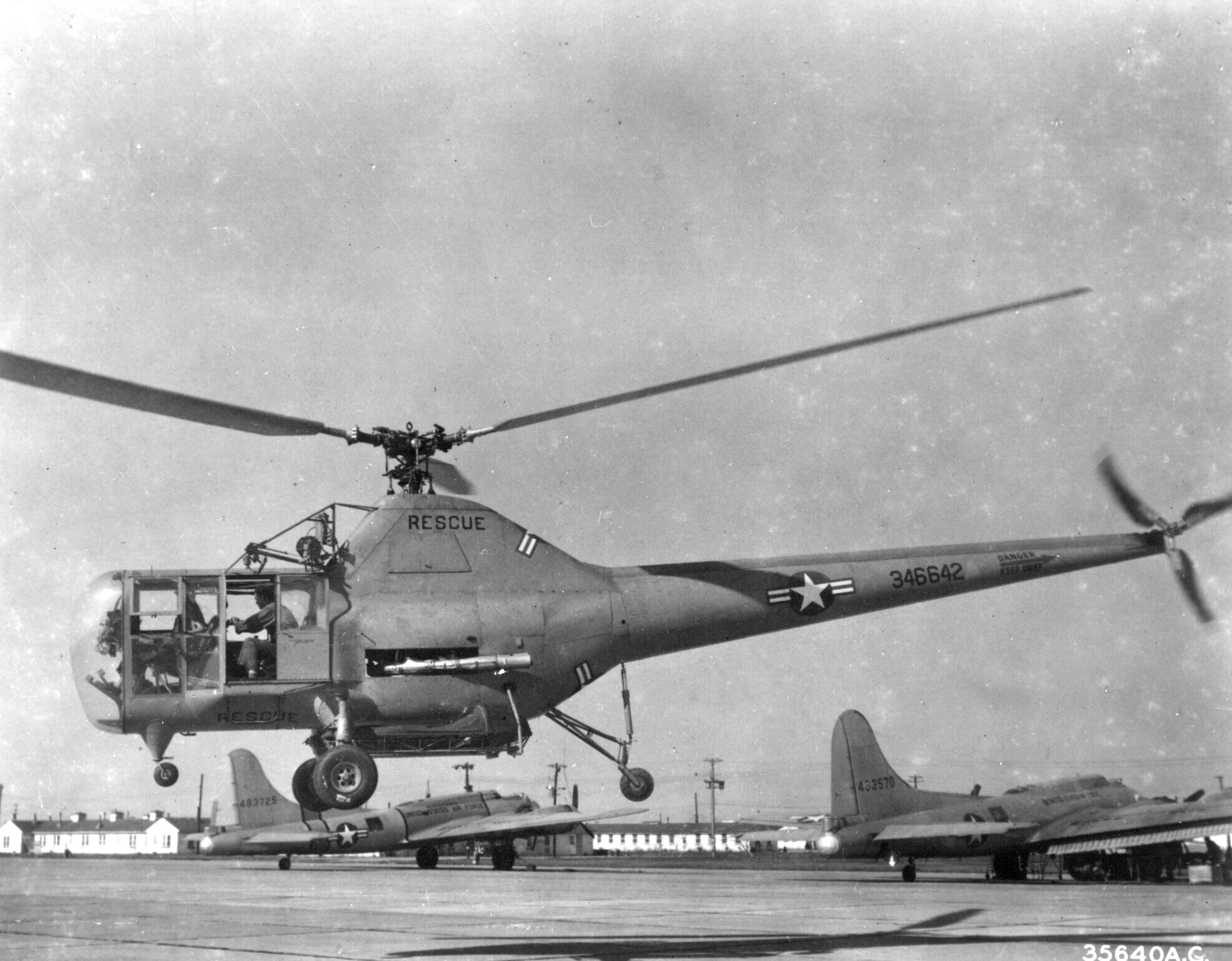
The Korean War provided the first large-scale test of helicopter utility in combat. HO3S-1 helicopters conducted some of the earliest combat search and rescue missions in modern military history. Operating from carriers and fleet vessels, they recovered downed United Nations pilots near hostile coastlines and mountainous terrain where fixed-wing aircraft could not land.

By Unknown, U.S. Air Force archived photograph - https://media.defense.gov/2004/Jan/20/2000595329/-1/-1/0/020903-O-9999B-054.JPG, Public Domain, Link
The helicopter’s ability to hover and land in confined areas made it invaluable despite its limited speed and lack of armor. It also supported short-range medical evacuation and fleet liaison operations.
These missions established the operational model for modern combat search and rescue. The concept of rapid helicopter extraction under combat conditions traces directly back to aircraft like the H-5.
Shipboard Aviation and Fleet Integration
The HO3S-1 normalized helicopter operations at sea. Beginning in 1946, Navy helicopters operated from aircraft carriers, cruisers, battleships, seaplane tenders, and polar expedition ships. The H-5 helped define deck handling procedures, maintenance practices, and coordinated ship-aircrew operations that remain standard today.

By U.S. Navy - U.S. DefenseImagery photo VIRIN: HN-SN-98-07148, Public Domain, Link
One of its most critical roles was plane guard duty. During carrier flight operations, helicopters hovered astern, ready to recover pilots who ditched during takeoff or landing. As jet aviation expanded in the early 1950s, this capability became essential.
By the mid-1950s, helicopters were no longer experimental additions. They were integrated fleet assets. That transition began with the Dragonfly.
BuNo 124352: A Late-Production Navy Helicopter
Bureau Number 124352 was accepted by the U.S. Navy in January 1950 and represents one of the final HO3S-1 helicopters produced for naval service.


Entering service during a period of rapid helicopter integration, BuNo 124352 would have supported fleet utility missions such as plane guard duty, search and rescue, liaison operations, and short-range transport. These roles were central to naval operations during the Korean War era.
The aircraft remained in Navy inventory until it was stricken in January 1960. While many early helicopters were scrapped as newer models emerged, BuNo 124352 survived. It was preserved by the U.S. Army Aviation Museum and later obtained by Scroggins Aviation, where it entered a new phase supporting motion picture and streaming productions.


In 2026, MotoArt preserved a limited portion of this historic airframe to create PlaneTags, ensuring that part of the Navy’s first fleet helicopter continues its story.
From Fleet Service to Film Industry Collaboration
MotoArt has partnered with Scroggins Aviation for several years. Scroggins is a leading supplier of aviation mockups, cockpit sections, helicopters, and effects fabrication to the motion picture and television industry. Their team builds and maintains full-scale rotorcraft and aircraft interiors for on-screen use.

When aircraft are restored, modified, or prepared for cinematic work, certain structural components may be replaced or removed. Through this long-standing collaboration, MotoArt responsibly acquires limited original material that would otherwise go unused.


BuNo 124352 followed that path. While the helicopter continues its next chapter supporting visual storytelling, a small portion has been preserved as PlaneTags. The aircraft now exists in two worlds: on screen and in the hands of collectors.
Sikorsky H-5 Dragonfly PlaneTags

A limited portion of original material from BuNo 124352 was carefully preserved and transformed into PlaneTags at MotoArt Studios. Each tag is cut from authentic aircraft aluminum, cleaned and refinished by hand, and individually engraved to create a lasting connection to the Navy’s first fleet helicopter. What once served aboard ships and supported rescue operations now continues its story as a tangible piece of aviation history.
Related Whirlybird Wednesday Releases
The H-5 Dragonfly marks the beginning of practical naval helicopter operations. Subsequent Whirlybird Wednesday releases show how rotary-wing design evolved across decades.
The Sikorsky S-60 Flying Crane demonstrated heavy-lift innovation.
The Boeing CH-47 Chinook expanded tandem-rotor transport capability.
The Sikorsky S-61 and its military H-3 variants became Cold War maritime icons.
The Boeing Vertol UH-46 Sea Knight advanced shipboard assault and logistics operations.
The Piasecki HUP-3 Retriever represents another early Navy rotorcraft that refined fleet procedures alongside the HO3S-1.
Together, they illustrate the evolution of naval helicopters from light rescue platforms to modern multi-role aircraft.
Preserving the Navy’s First Fleet Helicopter
The Sikorsky H-5 Dragonfly marked the moment helicopters became permanent fixtures in naval aviation. It replaced floatplanes, redefined shipboard rescue, and helped establish early combat search and rescue doctrine.
As one of the final HO3S-1 helicopters produced, BuNo 124352 represents the transition from experimentation to integration. Every naval helicopter that followed traces operational roots back to aircraft like the Dragonfly. That legacy endures.

_off_Korea_on_14_April_1953_(80-G-K-16320).jpg)

Share:
Yakovlev Yak-3UA “Full Noise”: From Fighter to Reno Air Racing Competitor
Bristol Beaufort A9-535: A Torpedo Bomber from the Pacific War