

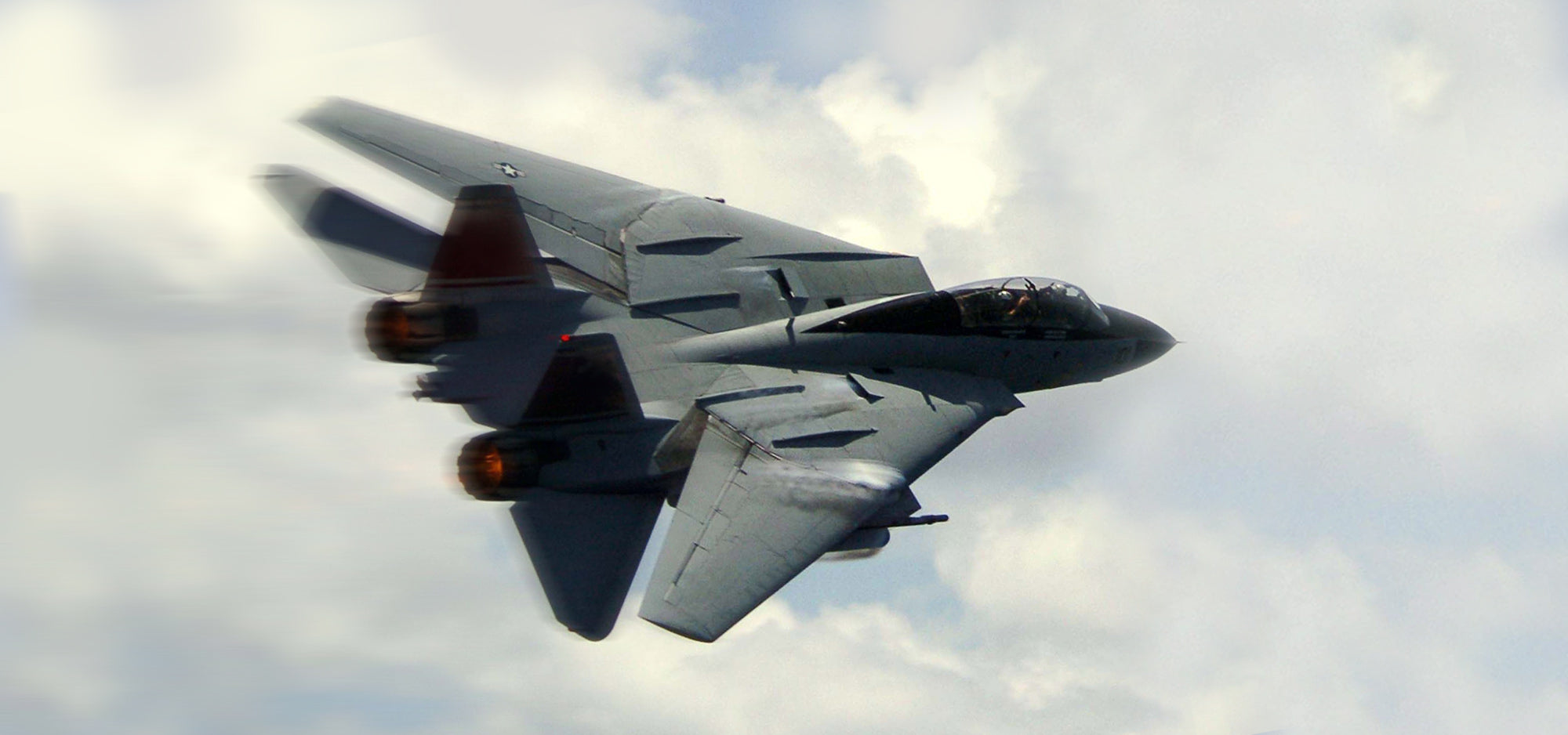
Crafted from real F-14 aircraft aluminum and released just in time for holiday entertaining
Few aircraft define an era quite like the Grumman F-14 Tomcat. Sleek, powerful, and unmistakably iconic, the Tomcat was the Navy’s premier fleet defense fighter for more than three decades. From Cold War missions to pop culture stardom, the F-14 remains one of the most recognizable and beloved aircraft ever built. Today, MotoArt is proud to introduce the F-14 Tomcat Coaster Set, created from authentic F-14 aircraft material.
The F-14 Tomcat: Origins, Purpose, and Design

F-14 Tomcat, wings folded and repositioning after landing. flickr photo by Gary Danvers shared under a Creative Commons (BY-NC-SA 2.0) license
The Grumman F-14 Tomcat was created at a pivotal moment in Cold War aviation. By the late 1960s, the U.S. Navy faced a growing threat from advanced Soviet bombers, cruise missiles, and long range maritime strike aircraft. Carrier groups needed a fighter that could intercept these threats at great distances, protect the fleet, and dominate both long range and close in engagements. Earlier aircraft were capable, but none offered the combination of radar power, maneuverability, and missile range needed for the changing landscape of aerial combat.
The Navy briefly pursued a joint fighter with the Air Force, the F-111B, but its weight and handling made it unsuitable for carrier operations. The program clarified what the Navy needed, and Grumman responded by developing a breakthrough aircraft that would set a new standard for naval aviation.
A Fighter Built for a Changing World
The F-14 made its first flight on December 21, 1970, and entered service in 1974. It quickly became the Navy’s premier fleet defense fighter, designed to counter long range Soviet threats during some of the most intense years of the Cold War. Throughout the 1970s and 1980s, Tomcats patrolled the oceans, intercepted Soviet aircraft, and stood watch over U.S. carriers around the world.

F-14, VF-101 (1) flickr photo by Ian E. Abbott shared under a Creative Commons (BY-NC-SA 2.0) license
As global conflicts shifted, the Tomcat shifted with them. It served in Desert Storm, Southern Watch, Enduring Freedom, and Iraqi Freedom, evolving from a pure interceptor into a capable multirole fighter with precision strike capability. For more than 30 years, it was one of the most respected and capable aircraft in the Navy. Read about BuNo 159611 here F:14 MotoArt Finds A Tomcat
Grumman F-14 At A Glance:

F-14 Specifications:
-
Manufacturer: Grumman Corporation
-
Crew: 2 (Pilot And Radar Intercept Officer)
-
Wing Span (Unswept): 64 Ft 1.5 In
-
Wing Span (Swept): 38 Ft 2.5 In
-
Length: 62 Ft 8 In
-
Height: 16 Ft 0 In
F-14 Performance:
-
Range: 1730 Nm
-
Cruise Speed: 550 Kts
-
Ceiling: 55,000 Ft
-
Empty Weight: 40,104 Lb
-
Max Takeoff Weight: 72,000 Lb
-
Rate Of Climb: 30,000 Ft / Minute
-
Engine: 2x Pratt & Whitney Tf-30-P-414a Turbofans, 20,900 Lb Static Thrust Each
What Made the F-14 Unique

F-14_19b flickr photo by AereiMilitari.org shared under a Creative Commons (BY-NC 2.0) license
Variable sweep wings
The wings could sweep forward for maneuverability or sweep back for high speed interception, allowing the Tomcat to operate at low speeds on the carrier deck and reach high speed at altitude.
Twin afterburning engines
Two powerful engines provided the thrust needed for demanding carrier operations and air superiority missions.
AN AWG 9 radar
One of the most advanced radars of its era, capable of tracking 24 targets at once and guiding up to six AIM 54 Phoenix missiles simultaneously.
AIM 54 Phoenix
A long range missile designed specifically to counter Soviet bombers, capable of engaging targets more than 100 miles away.
Two person crew
A pilot and a Radar Intercept Officer shared control of sensors, weapons, and threat management.
Carrier strength airframe
A rugged, durable structure designed for catapult launches, arrested landings, and the demanding life of carrier aviation.

F-14 USS Eisenhower flickr photo by Rob Schleiffert shared under a Creative Commons (BY-NC 2.0) license
Its Place Among the Fighters of Its Time
The F-14 served alongside and against some of the most influential fighters of its era, including the F-4 Phantom II, F-15 Eagle, F/A-18 Hornet, MiG-23, Su 27, Tornado F3, and the Mirage F1 and Mirage 2000. Each aircraft brought unique strengths to the evolving air combat landscape, but few matched the Tomcat’s combination of long range capability, powerful radar, and overall adaptability.
What Came Before and After

A Grumman F-14B ''Tomcat'' and a Boeing F/A-18E ''Super Hornet' flickr photo by aeroman3 shared into the public domain using Creative Commons Public Domain Dedication (CC0)
Before the F-14, the Navy relied on fighters such as the F-4 Phantom II and the F-8 Crusader. Both aircraft served well, but neither could meet the growing long range interception demands of the Cold War or provide the advanced radar and missile capability the Navy urgently needed. After the Tomcat’s long and successful career, it was eventually replaced by the F/A-18E/F Super Hornet, a modern multirole fighter with updated avionics and lower maintenance requirements. While the Super Hornet is practical for today’s fleet, many pilots and enthusiasts still regard the F-14 as unmatched in presence, performance, and long range air to air capability.
The F-14 Tomcat in Popular Culture
Beyond its combat record, the F 14 became a true cultural icon. Its dramatic silhouette, variable sweep wings, and twin tails made it one of the most recognizable fighters in the world. Its appearance in the 1986 film Top Gun turned the Tomcat into a symbol of naval aviation and inspired countless people to pursue careers in flying and aerospace. Thirty six years later, its triumphant return in Top Gun: Maverick proved that the F 14 remains just as beloved, captivating a new generation and reaffirming its place as one of the most memorable aircraft in popular culture.
Even after its retirement in 2006, the Tomcat continues to capture imaginations through documentaries, airshows, restored aircraft, books, and modern films. Its legacy endures as a symbol of American aviation and Cold War history. This lasting cultural impact makes preserving real F 14 material even more meaningful today.
Crafting the F-14 Coasters


For years, MotoArt has carefully preserved authentic material from several F-14 Tomcat airframes. These airframes were officially transferred to MotoArt with the requirement that they be destroyed, a process known as demilitarization. Rather than sending this historic material to a shredder, MotoArt chose to honor the aircraft by preserving what could be saved. The creation of the F-14 Coaster Set is the final step in that process. Once cut into coasters, the material cannot be used for any other purpose and is fully demilitarized.
The F-14 Coaster Set was created from that genuine aircraft material. Each coaster begins as original F-14 skin or structural material. At MotoArt Studios, the material is cut, shaped, polished, and finished by hand. The surface is then laser engraved with a clean Tomcat silhouette.


Because the material comes from various sections of original Tomcat airframes, each piece has its own grain, tone, and markings. No two sets are identical, and the variations are part of their story. Like our B-52 coasters, this collection does not trace back to one specific bureau number. Instead, it honors the broader heritage of the Tomcat fleet as a whole.


A Meaningful Gift for the Holidays
The holiday season is the perfect time to share gifts that carry history and purpose. The F-14 Tomcat Coaster Set blends authentic aircraft material with craftsmanship and everyday usefulness, making it a gift that resonates with aviation fans, veterans, pilots, and collectors.


Giving someone a set made from real F-14 material allows them to hold a piece of a legendary fighter. These coasters add character to any bar cart, office desk, coffee table, or hangar lounge. The limited nature of this release also makes it a thoughtful choice for collectors who appreciate rare and meaningful aviation pieces.
Bring the Legacy of the Tomcat Home
Crafted from genuine F-14 material and made in limited quantity. Shop the F-14 Coaster Set beginning December 4 at 12 PM Pacific.
Explore the Full Coaster Collection
Browse the Cold War Legends Collection

Share:
PR-AJB: The Story of an Azul Airbus A320 With a Global Journey
From Warbird to Water Bomber: The Epic Life of the Hawaii Mars