

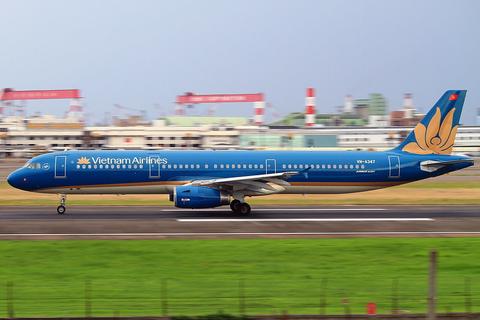
The newest plane in MotoArt’s fleet of commercial aircraft is a Vietnam Airlines Airbus A321-231, which took its first flight June 24, 2004. Its teal, cream and gold livery and distinctive golden lotus are symbolic of the airline’s commitment to remain true to traditional Vietnamese culture. The lotus flower represents beauty, perseverance and enlightenment. Read more about VN-A347 and then get one for your collection: Vietnam Airlines Airbus A321-200 PlaneTags

VN-A347 flickr photo by Alec BHX/KKC shared under a Creative Commons (BY-SA) license
Airbus
Airbus Industries was formed by a consortium of European aviation firms, as an effort to compete with U.S. companies such as Boeing, Lockheed, and McDonnell Douglas. This collaboration by airlines and manufacturers in the UK, Germany, and France was necessary to compete with the powerful lock on the aviation industry held by American companies since World War II. It was initially owned by Aérospatiale and Deutsche Airbus, with each company owning a 50% share. Though ownership and production would change over the years, it was a successful start. The A300 series was launched at the 1969 Paris Airshow, with the aim to create a smaller, lighter, and more economical commercial airplane than its three-engine American rivals.
Production work was divided up, with each company delivering its sections ready to fly and fully equipped.
Production work was initially split as follows:
- French owned Aérospatiale 36.5%
- West German owned Deutsche Airbus 36.5%
- UK owned Hawker Siddeley 20%
- Dutch owned Fokker-VFW 7%
Today Airbus is considered a pioneer in the aerospace industry. They continue to make great strides in design and manufacturing, and now boast 180 locations with aircraft and helicopter final assembly lines across Asia, Europe and the Americas. Their motto is “We make it fly” and their mission is a better-connected, safer and more prosperous world.

A321-231
The A321 is a short to medium range, narrow body, twin engine jet airliner. The A321-200 variant, developed in 1995, is heavier and has a longer, transcontinental range. It shares the commonality of its cockpit systems with all other A320 variants, which allows the A320 family - and even extending to the A330 and the A340 - to be flown by pilots without additional training. - The Airbus cross-crew qualification concept and mixed fleet flying allow airlines to quickly swap out Airbus aircraft and pilot crews to meet demands for capacity. “Fly-by-wire" refers to a purely electrically signaled control system. Not only is a FBW aircraft easier to handle and fly, it also is lighter in weight.
These and other features have made the A320 aircraft family one of the most successful and versatile series ever. According to Airbus, an A320 takes off or lands every 1.6 seconds. Continuing this family’s legacy are the A321neo, A321LR, and A321XLR (coming in 2023), which will extend its long-range capabilities and provide roomier flights with greater capacity for passengers and their luggage. Other enhancements include true long-haul full flat seating, new sidewall panels, new lavatory design, new window bezels, and innovative cabin lighting. Its fuel efficient engines and aerodynamic wing “Sharklets” provide better environmental performance as well. It will share common cockpit ergonomics as well.
Vietnam Airlines
Vietnam Airlines was founded in 1956, and later established as a state-owned airline in 1989. In 1996, the government formed the Vietnam Airlines Corporation, which included the airline and 20 service companies. This, along with better relations with the U.S. and Vietnam’s own economic and political changes, allowed the airline to modernize its fleet and improve its services. Today it is the flag carrier of Vietnam, a SkyTeam member, and offers flights on 94 routes to 22 domestic and 29 international destinations with an average of 400 flights per day. Skytrax, the world’s leading airline and airport ratings critic, ranked the airline as a 4 star airline for three consecutive years. The airline has also received several World Travel Awards and other recognition for their growth, quality of service, and brand. They pride themselves as a modern carrier characterized by Vietnamese traditional culture.

Golden Lotus
The Golden Lotus was introduced in 2002 and has since gained worldwide recognition for the brand. It was updated and relaunched in 2015, along with improvements to the airline itself. The blossoming golden lotus is a stylized version of Vietnam’s most important symbol of its heritage and represents beauty, perseverance, and enlightenment. Its petals reach out in a spirited and inviting gesture, and its silhouette resembles a star radiating energy and optimism. The branding, including the lotus and typography, defines the new Vietnam Airline identity and is a symbol of the airline’s commitment to its heritage.

VN-A347
Our plane was built in Hamburg, Germany and delivered to Vietnam Airlines in December 2004. It was one of 50 of the airlines’ fleet of A321-200s and flew from 2004 to January 2015. It was then leased to Jetstar Pacific Airlines for a short time before returning to Vietnam Airlines in August 2016. In 2019, this plane, along with four other A321-200s ,was offered for sale or lease. They have all been inactive since late August or early September 2019. VN-A347 was retired shortly after and stored from January 2020 at ROW. She was acquired by MotoArt later in 2020.

MotoArt’s A321

When MotoArt owner Dave Hall saw this beautiful plane waiting to be scrapped at Roswell Industrial Air Center Airport in Roswell, NM, he knew right away he wanted to preserve it as PlaneTags.

“What caught my eye was the golden lotus on the tail,” says Hall. “And the sunlight on this beautiful teal and gold livery. It was a bright flower in the desert.”

The MotoArt team went to Roswell and began the strenuous task of cutting each section by hand. “Sometimes people question whether PlaneTags truly are handcrafted. My team says absolutely they are. There’s no large machine to strip the skin off and cut it down into smaller pieces.”

Handcrafted Aviation Mementos


Once back at the MotoArt shop in Torrance, California, the smaller pieces are then hand stamped into the familiar oval shape, hand cleaned, hand polished, etched and assembled. There is no mass production - each is carefully crafted by MotoArt’s team of artisans.


The PlaneTags are made with authentic fuselage skin, with the same paint and finish that was worn on the aircraft. No additional paint or sealant or laminate or any other materials are added. If the aircraft had dents, scratches, pits, or paint abnormalities, the PlaneTags will also. This is part of the beauty of each individual piece.

Vietnam Airlines Airbus PlaneTags

Our Vietnam Airlines A321 PlaneTags are made from the original fuselage skin from this retired aircraft. They will be part of a series of 7,500 PlaneTags and will be available in Teal, Cream, Gold, and combos of Teal/Gold, Cream/Gold, Teal/Cream. They are attached to a colorful display card that features details about the plane and is suitable for displaying in a collection ,or to give as a gift. The combo-colored PlaneTags are always highly desired by collectors and will sell out quickly. Be sure to add one to your collection before they are gone.

Airbus PlaneTags
Check out some of the other PlaneTags from our Airbus collection:
- Airbus A320 PlaneTag Tail# N627AW - Used in the movie “Sully: Miracle on the Hudson”
- China Airlines A340-300 B-18801
- G-VEIL, the “Queen of the Skies" A340
- Varga Girl A340 PlaneTag

Share:
Sikorsky H-3: Search and Rescue At Its Best
Bell Huey UH-1F: Missile Site Support At Its Best