

Air Museums & PlaneTags

The entrance hall of the National Air and Space Museum in Washington, DC. Among the visible aircraft are The Spirit of St. Louis, the Apollo 11 command module, Space Ship One, and X-1. By Jawed Karim, CC BY-SA 3.0, Link
What is an aviation museum?
Aviation museums, also called air museums or air and space museums, preserve aviation history and the aircraft themselves for future generations. Without dedicated air museums many of the aircraft we see preserved today would be lost.
Museums preserve planes and aviation or space artifacts, allowing visitors to see and touch machinery that they would only be able to read about or see on photos, or video if available. Many museums also restore old planes as static models or to flying condition so that they can be appreciated in their former glory.
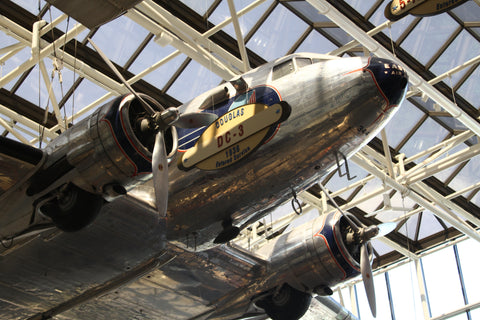
Former Eastern Douglas DC-3 hanging on the ceiling of the Smithsonian's National Air and Space Museum. By CamWow - Own work, CC BY 3.0
Aviation museums also carry much of the load for educating students about aircraft history. They offer tours, exhibits, programs, workshops, camps, STEM learning, and other educational outreach programs that make aviation come alive.
Museums like the ones listed below ensure that aviation history is not lost to neglect or decay, fading memories, or disinterest. They keep the aircraft, the pioneers, the technology, the insight and the history alive.
What do air museums and PlaneTags have in common?
Air museums and PlaneTags both:
- Preserve an aircraft so that its not lost forever
- Preserve the aircraft’s story so that it can be told by future generations
- Foster the love of aviation and participate in furthering its reach and knowledge
MotoArt is grateful for support it has received from air museums, foundations, organizations, and private owners. The museums below have begun offering PlaneTags in their gift shops, giving us another opportunity to share our fleet of planes with their visitors. Stop by to check them out sometime.
Smithsonian National Air and Space Museum
The Smithsonian National Air and Space Museum in Washington D.C. maintains the largest and most significant collection of aviation and space artifacts in the world. This collection houses exhibits pertaining to all aspects of human flight, related works of art, and archival materials. The museum welcomes more than eight million visitors every year, making it the most visited museum in the United States.

Pima Air and Space Museum
Pima Air and Space Museum in Tucson, AZ is one of the largest non-government funded aviation and space museums in the world, with around 400 historic aircraft. The museum opened its doors in 1976 and since then has grown to six indoor exhibit hangars on 80 acres.

Pima Air and Space Museum and MotoArt have a relationship that goes back many years. They have been a friend and ally of PlaneTags and have provided the original aircraft skin for several PlaneTags over the years (listed below).
- F86 Sabre
- P-40 Warhawk
- Titan II Missile
- PBY Catalina
Yanks Air Museum

Yanks Air Museum is dedicated to the restoration and preservation of American aircraft and artifacts. It houses one of the largest aircraft collections, including one of a kind vintage aircraft which have been painstakingly restored to airworthy status. Yanks Air Museum has been a big supporter and has partnered with MotoArt to turn the original aircraft skin removed during restorations into PlaneTags (see below).
- A-4 Skyhawk
- H-3 Jolly Green Giant
Palm Springs Air Museum
The Palm Springs Air Museum is home to one of the largest collections of static and flyable aircraft in the world. Their exhibits feature planes from WWII through the War on Terror, which are housed in air conditioned hangars, with no ropes to prevent you from fully interacting with the exhibits.

Military Aviation Museum
The Military Aviation Museum in Virginia Beach, Virginia is home to one of the world’s largest private collections of World War I and World War II era military aircraft. Each plane has been restored to its prior military condition, and most are airworthy. All of the aircraft are one of a kind, and some are the last flight-ready aircraft of their time.

Aerospace Museum of California
The Aerospace Museum of California in McClellan, California was founded in 1982 as the McClellan Aviation Museum, located near the McClellan AFB. After the base closed it was renamed to the Aerospace Museum of California and expanded its mission to display commercial, private, and military aircraft from all branches of the Armed Forces. With the motto “More than a museum”, they also focus on providing inspiration and STEM learning opportunities for students of all backgrounds.
Museum of Flight
The Museum of Flight in Seattle, Washington is the largest independent, non-profit air and space museum in the world. It houses over 175 aircraft and spacecraft, many exhibits and experiences, as well as tens of thousands of artifacts and millions of rare photographs which bring mankind's incredible history of flight to life.
Visit MotoArt PlaneTags

Our brick and mortar shop for PlaneTags and aviation gifts is located in Torrance, California, just minutes from LAX and LGB. Stop in and handpick your own PlaneTags from our showroom wall.

Aviation Museums - MotoArt Wants To Work With You
For museums and restoration projects who want to partner with MotoArt, either by offering PlaneTags in their shop or with original aircraft skin material, please contact us. We would love to work with you.
PlaneTags Store Locator
Want to buy PlaneTags near you? You can always buy PlaneTags on the PlaneTags app and on planetags.com but it's nice to be able to pick your own in person. Check out our store locator to find the nearest PlaneTags store near you.
Store Locator is loading from Storemapper store locator software...

Share:
BAC 1 11: British Aircraft Corporations Successful Twin Jet
SB2C Helldiver: The Navy's Last Dive Bomber