

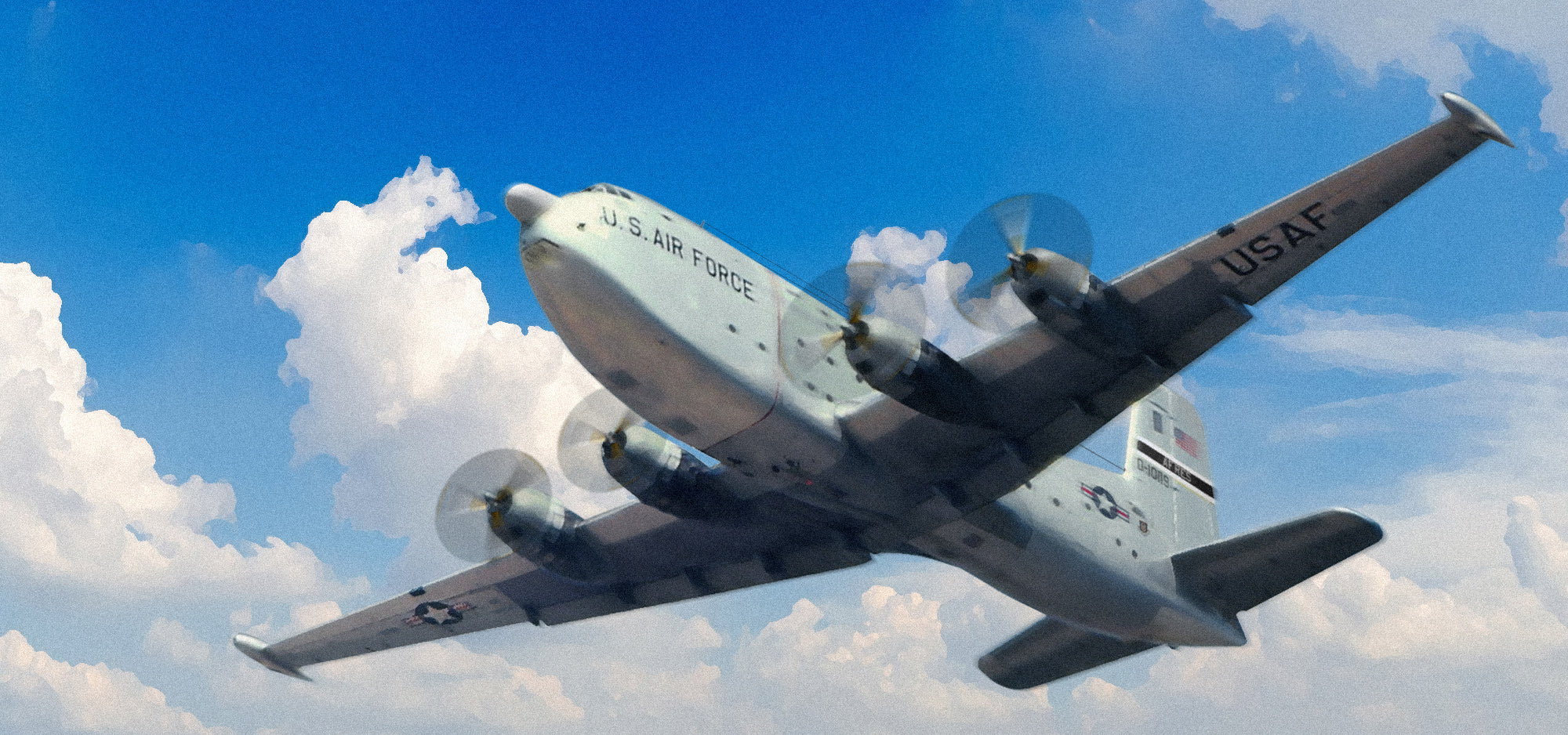
The Douglas C-124 Globemaster II was a true workhorse of military aviation. Known as "Old Shaky," this massive cargo plane played a critical role in airlifting troops, equipment, and supplies across the globe during the Cold War era. One particular C-124, #51-119, has a unique and tragic history—one that led it to be salvaged by aviation preservationist Walter Soplata before MotoArt gave it new life.
In this blog, we’ll explore the fascinating story of the C-124, its development, operational history, and how MotoArt continues to honor its legacy through PlaneTags. Get your C-124 PlaneTags now.

By User:Kitplane01 - Own work by the original uploader, CC0, Link
The Development of the C-124 Globemaster II
The Douglas Aircraft Company designed the C-124 Globemaster II as a solution to the growing need for heavy-lift air transport in the U.S. Air Force. Derived from the earlier C-74 Globemaster, the C-124 featured a stretched fuselage, larger cargo doors, and an innovative clamshell nose design that allowed it to transport massive payloads, including tanks, vehicles, and troops.
With its first flight in 1949, the C-124 quickly became the backbone of military airlift operations. Production continued through the 1950s, with 448 aircraft built before it was phased out in favor of more advanced transport aircraft.
Key Features & Capabilities of the C-124

C-124 Moves SNARK flickr photo by RyanCrierie shared under a Creative Commons (BY) license
The C-124 was engineered for versatility and strength, making it a reliable transport aircraft for decades. Some of its key features included:
-
Massive cargo bay: Capable of carrying up to 200 troops or 74,000 lbs of cargo.
-
Clamshell nose doors: Allowed for easy loading of oversized equipment.
-
Twin-deck configuration: Provided additional space for personnel or gear.
-
Pratt & Whitney R-4360 radial engines: Four powerful engines delivering a combined 14,000 horsepower.
-
Range and endurance: Capable of long-haul missions without refueling.
These features made the C-124 invaluable for large-scale logistics, military deployments, and humanitarian missions.
Douglas C-124 Globemaster II At A Glance
C-124C Specifications:
- Manufacturer: Douglas
- Model: C-124C Globemaster II
- S/N: 51-0119
- Crew: 7 (2x Pilots, 1x Navigator, 1x Flight Engineer, 1x Radio Operator, 2x Loadmasters)
- Wing Span: 174 ft 1 in
- Length: 130 ft 0 in
- Height: 48 ft 4 in
C-124C Performance:
- Range: 4,030 mi
- Cruise Speed: 230 mph
- Ceiling: 21,800 ft
- Empty Weight: 101,165 lb
- Max Takeoff Weight: 194,500 lb
- Rate Of Climb: 760 ft/min
- Engine: 4x Pratt & Whitney R-4360 Wasp
Operational History: From the Korean War to Global Airlift Operations

C-124 Globemaster 0-20980 at Biggin Hill 1963 flickr photo by Harry Clampers shared under a Creative Commons (BY) license
The C-124 entered service with the U.S. Air Force in 1950, just in time for the Korean War. It played a crucial role in transporting supplies and troops to the front lines. Throughout the 1950s and 1960s, the Globemaster II continued to serve in strategic airlift missions, including Arctic resupply operations, Cold War military movements, and aid delivery during crises.

Douglas C-124C Globemaster II '0-10089' flickr photo by HawkeyeUK shared under a Creative Commons (BY-SA) license
By the early 1970s, the C-124 was gradually replaced by the more modern C-141 Starlifter and C-5 Galaxy, which offered jet propulsion and greater speed. Despite its retirement, the C-124 left a lasting impact on military air transport, shaping the future of heavy cargo aircraft.
C-124: The Story of 51-119

Photo of 51-119, courtesy of American Aviation Historical Society

Public domain photo, U.S. Army soldiers debark from a U.S. Air Force Douglas C-124A-DL Globemaster II (s/n 51-119) in Korea on 1 November 1952 after were returning from a five-day rest leave in Japan.
51-119 was one of the many C-124s that served faithfully in the U.S. Air Force. After being retired from active service, it was placed at the New England Air Museum (formerly the Bradley Air Museum) in Windsor Locks, CT, where it became a part of aviation history. Unfortunately, disaster struck on October 3, 1979, when a powerful tornado tore through the museum, destroying 51-119 beyond repair.

In just a few minutes, it was all over. Of the 30 aircraft in the outdoor display, only 4 escaped serious damage. Of the remainder, 16 were destroyed, and 10 were deemed damaged but salvageable. The roof of the display hangar was torn to pieces, with numerous aircraft inside also substantially damaged.
Photo and excerpt from Bradley Air Museum and the 1979 Windsor Locks Tornado

Aviation preservationist Walter Soplata stepped in to save parts of the wreckage. His dedication to preserving aircraft led to 51-119 finding a place in his legendary aviation collection.
Preserving Aviation History: MotoArt & the Soplata Collection
MotoArt has had the privilege of working with the Soplata family on multiple occasions to recover and repurpose rare aircraft materials. Walter Soplata was known for saving historic aircraft from the scrapyard, amassing one of the most remarkable private collections of aviation relics. What was left of 51-119 was uncovered by the MotoArt team in August and September 2024, in a painstaking process of unearthing it from its decades-old resting place amongst piles of debris and vegetation.


MotoArt has sourced materials from several aircraft in the Soplata collection, including:
-
F-84 Thunderjet – The subject of PTO: F-84B a documentary by award winning filmmaker Monty Miranda.
-
B-36 Peacemaker – The largest piston-engine aircraft ever built.
-
DC-7 – A classic Douglas propliner.
-
P2V Neptune – A Cold War-era maritime patrol aircraft.
-
Other rare aircraft from Soplata’s extensive collection.
By transforming pieces of these aircraft into PlaneTags, MotoArt ensures that their legacy lives on for aviation enthusiasts and collectors around the world.


Douglas C-124 Globemaster II PlaneTags

C-124 PlaneTags are made from the original aircraft skin of 51-119. They will be introduced on February 20, 2025 at 12 PM Pacific on planetags.com. Sign up for our newsletter and texts, and follow us on social media so you'll never miss a new PlaneTags release.


Honoring the Legacy of the C-124
The Douglas C-124 Globemaster II was a groundbreaking aircraft that revolutionized military cargo transport. 51-119 may have met an unfortunate fate, but thanks to the efforts of Walter Soplata and MotoArt, its history continues to be preserved and celebrated.
MotoArt remains committed to honoring aviation history by transforming pieces of legendary aircraft into collectible PlaneTags, allowing enthusiasts to own a piece of the past. Stay tuned for more incredible aircraft stories and PlaneTags releases! Join the MotoArt PlaneTags Collections Facebook group to share your collection, discuss PlaneTags and buy/sell/trade.

Share:
Celebrating the Boeing 727 and 747 Anniversaries: A Legacy of Innovation in Commercial Aviation
Celebrating 60 Years of the Douglas DC-9: A Legacy That Endures