

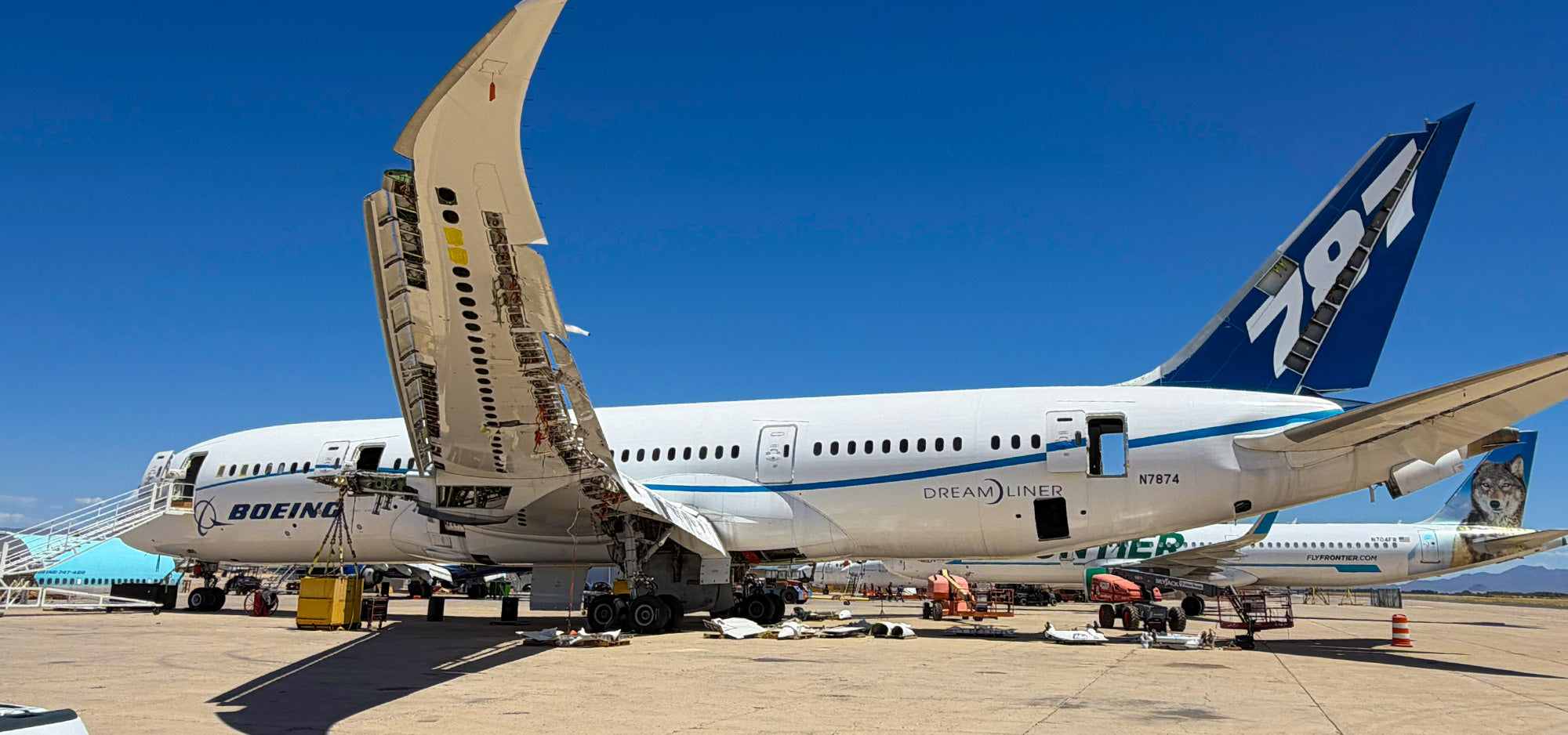
On August 26, 2011, the Boeing 787 Dreamliner received type certification from the Federal Aviation Administration and European Aviation Safety Agency, clearing the way for an entirely new generation of commercial aircraft to enter service.
Fifteen years later, on August 26, 2026, PlaneTags will mark that anniversary with a first of our own: the release of our first Boeing 787 Dreamliner PlaneTags.
The aircraft behind them isn't just any Dreamliner. Known throughout its life as ZA004, and registered N7874, this aircraft was the fourth 787 built and one of the original airplanes created for Boeing's Dreamliner flight-test program. For nearly 16 years, it helped engineers test, prove and continue developing the technologies behind the 787.
Its story begins before the first 787 ever carried a paying passenger.
Building a Different Kind of Airliner
The 787 began as a clean-sheet approach to Boeing's next generation of widebody aircraft. Originally introduced as the 7E7, the program was designed around efficiency, range and passenger comfort. But one of the biggest departures from conventional commercial aircraft design was the airplane itself.

Boeing 787 Dreamliners on the final assembly line at Boeing South Carolina in North Charleston. Photo: Boeing
The 787 uses carbon-fiber composites extensively throughout its structure. Approximately 50 percent of the airframe by weight is composite material, including major structural components. Combined with advanced aerodynamics, more efficient engines and more-electric systems, the lighter structure helped give the Dreamliner greater range and route flexibility while reducing fuel use compared with the aircraft it was designed to replace.
The use of composites also helped Boeing rethink the passenger cabin. The 787 could maintain a lower cabin altitude and higher humidity, while its design incorporated larger electronically dimmable windows, improved air quality and technology intended to provide a smoother ride.
Before airlines could put any of those innovations into regular passenger service, however, Boeing had to prove the new airplane. That meant building airplanes whose job wasn't to carry passengers; their job was to test the Dreamliner.
Boeing 787 Dreamliner At A Glance

Boeing 787-8 Characteristics
- Manufacturer: Boeing
- Type: Boeing 787-8 Dreamliner (ZA004 Flight Test Aircraft)
- Tail #: N7874
- Operator: Boeing
- MSN: 40693
- Passengers: Test/Prototype Aircraft
- Wingspan: 197 ft 3 in
- Length: 186 ft 1 in
- Height: 55 ft 6 in
Performance
- Range: 9,206 mi
- Max Operating Speed: Mach 0.90
- Service Ceiling: 43,100 ft
- Empty Weight: 264,500 l*
- Max Takeoff Weight: 502,500 lb
- Rate of Climb: Varies by weight/altitude
- Engines: 2× Rolls-Royce Trent 1000 turbofan engines
Built to Test the Dreamliner
ZA004 wasn't an airline aircraft that later became a test plane. It was built for the job. Registered N7874, ZA004 was the fourth 787 built and part of the original Dreamliner flight-test fleet.

Boeing Co N7874 flickr photo by Drewski2112 shared under a Creative Commons (BY-NC 2.0) license
Flight-test aircraft lead very different lives from the airplanes passengers eventually board. They are filled with instrumentation and flown through carefully planned tests so engineers can collect data about how a new aircraft and its systems perform. ZA004 would become an important part of that process.
Its assignments included work involving aerodynamics, high-speed performance, propulsion, structural flight loads, noise and extended operations. ZA004 was built to help engineers answer some of the fundamental questions that had to be answered before the Dreamliner could enter airline service.
ZA004 Takes Flight
With Captains Heather Ross and Craig Bomben at the controls, ZA004 made its first flight on February 24, 2010 and joined the 787 flight-test program. That flight began a testing career that would eventually stretch far beyond the original certification program.

Boeing’s ZA004 Joins 787 Flight-Test Program. Photo: Boeing
The aircraft traveled wherever engineers needed it. ZA004 was used for testing under different environmental and operating conditions and for gathering the enormous amount of data necessary to understand how the new aircraft behaved throughout its operating envelope.
In May 2010, it went to Mesa, Arizona, for hot-weather testing at low elevation before traveling to Colorado Springs for high-field-elevation testing. Later, much of its flight-load survey work was conducted at Victorville, California, where engineers measured pressure distribution across the aircraft structure through different phases and configurations of flight.
Then came one of the most challenging periods of the original 787 test program. Following an electrical incident aboard another test aircraft, ZA002, in November 2010, 787 flight testing was temporarily suspended.
Engineers conducted laboratory, simulator, integration and ground testing as modifications were developed for the airplane's power-distribution system. When 787 flight testing resumed, ZA004 flew the first flight used to validate upgrades to the power-distribution-system software following the interruption to the test program.
The Road to August 26, 2011
After years of engineering and an extensive flight-test campaign, the Dreamliner approached one of the most important milestones in any new commercial aircraft program: certification.

Boeing Co N7874 flickr photo by Drewski2112 shared under a Creative Commons (BY-NC 2.0) license
The 787 presented regulators and engineers with an aircraft incorporating a combination of new technologies, including extensive composite construction, advanced aerodynamics, new propulsion technology and more-electric systems. The work of ZA004 and the rest of the test fleet helped provide the data necessary to demonstrate that the new airplane met applicable airworthiness requirements.
On August 26, 2011, the Boeing 787 Dreamliner received type certification from both the FAA and EASA. The Dreamliner was ready to move from development into commercial service.
For many test airplanes, that milestone might have marked the beginning of the end of their careers. For ZA004, it was nowhere close.
The Test Airplane That Kept Testing
ZA004 remained a working Boeing test aircraft long after the original 787 certification program was completed. In 2011, it performed the 1,000th flight of the 787 program.
And as the Dreamliner continued to evolve, ZA004 continued to contribute. The aircraft supported certification of Rolls-Royce engine variants for the 787, eventually including the Trent 1000 XE in 2025, nearly 15 years after ZA004's first flight. But one of the most interesting chapters in its career came in 2014.
A Flying Laboratory
In 2014, ZA004 became Boeing's second ecoDemonstrator aircraft. The ecoDemonstrator program uses flying test beds to take promising technologies out of the laboratory and evaluate them in an operational environment. The goal is to determine which ideas might improve areas such as efficiency, safety and environmental performance before they are considered for wider use.

Boeing ecoDemonstrator 787 tests innovations for more efficient air travel (2014). Photo: Boeing
ZA004 was used to test more than 25 technologies during its time as an ecoDemonstrator, a fitting second act for an aircraft that had been built specifically to experiment, measure and learn.
One Final Flight
By early 2026, ZA004 was approaching maintenance thresholds that Boeing determined were no longer cost-effective given the maturity of both the 787 test program and the operational fleet.
On February 11, 2026, almost exactly 16 years after its first flight, ZA004 departed Boeing Field in Seattle for the final time. Captains Heather Ross and Craig Bomben, who had flown together on ZA004's first flight in 2010, returned to the cockpit for its last. They were joined by Capt. Chris Caps, who had served as an engineering systems operator on that first flight and later became a Boeing test pilot.

N7874 B787-8, Boeing, Pinal Airpark 03-01-26 flickr photo by CaptainN1435S shared under a Creative Commons (CC BY 4.0) license
For its final journey, the aircraft once again used its original flight-test call sign: Boeing 004. Its destination was Pinal Airpark in Marana, Arizona. However, even retirement wouldn't completely end ZA004's usefulness. Boeing has said portions of the aircraft will continue supporting learning and development for the 787. Some components will be used for training and research, while others may become replacement parts or spares.
And another part of the airplane's story is being preserved in a very different way.
From Test Aircraft to PlaneTags

For PlaneTags founder Dave Hall, aircraft like ZA004 represent exactly the kind of aviation history worth preserving.
"We always look for more than an airplane. We look for the story behind it. ZA004 helped prove what the 787 could do, and that's what makes being able to preserve material from this aircraft so special." - Dave Hall


ZA004 presented the PlaneTags team with a very different kind of material story. PlaneTags has worked with composite aircraft before, but the 787 represents a major milestone in the use of carbon-fiber composites in commercial aviation. Approximately half of the Dreamliner airframe by weight is composite material, with carbon-fiber composites used extensively throughout its primary structure.

The Beginning of a New Collection
The Boeing 787 Dreamliner ZA004 marks another first for PlaneTags: the first release from our official collaboration with Boeing. For nearly a decade, PlaneTags has preserved aircraft and the stories they carry. Working directly with Boeing gives us new opportunities to continue that mission, bringing collectors authentic material from noteworthy aircraft across Boeing's history.

ZA004 is where this next chapter begins. We look forward to sharing what comes next.
Fifteen Years Later
There is something fitting about August 26. On August 26, 2011, years of engineering, testing and certification culminated in approval of the Boeing 787 Dreamliner.
On August 26, 2026, exactly 15 years later, material from one of the airplanes that helped make that certification possible becomes something aviation enthusiasts can hold in their hands.
ZA004 never carried passengers across the Atlantic or Pacific as part of an airline fleet, but it helped make those flights possible. And now a small piece of the airplane that helped certify a dream can continue telling that story. The Boeing 787 Dreamliner PlaneTags will be available August 26 at 12 PM Pacific at PlaneTags.com.

Share:
The Gulfstream That Helped Preserve Walt Disney's Airplane
From the Racing Line: Preserving Reno’s Outer #4 Pylon