

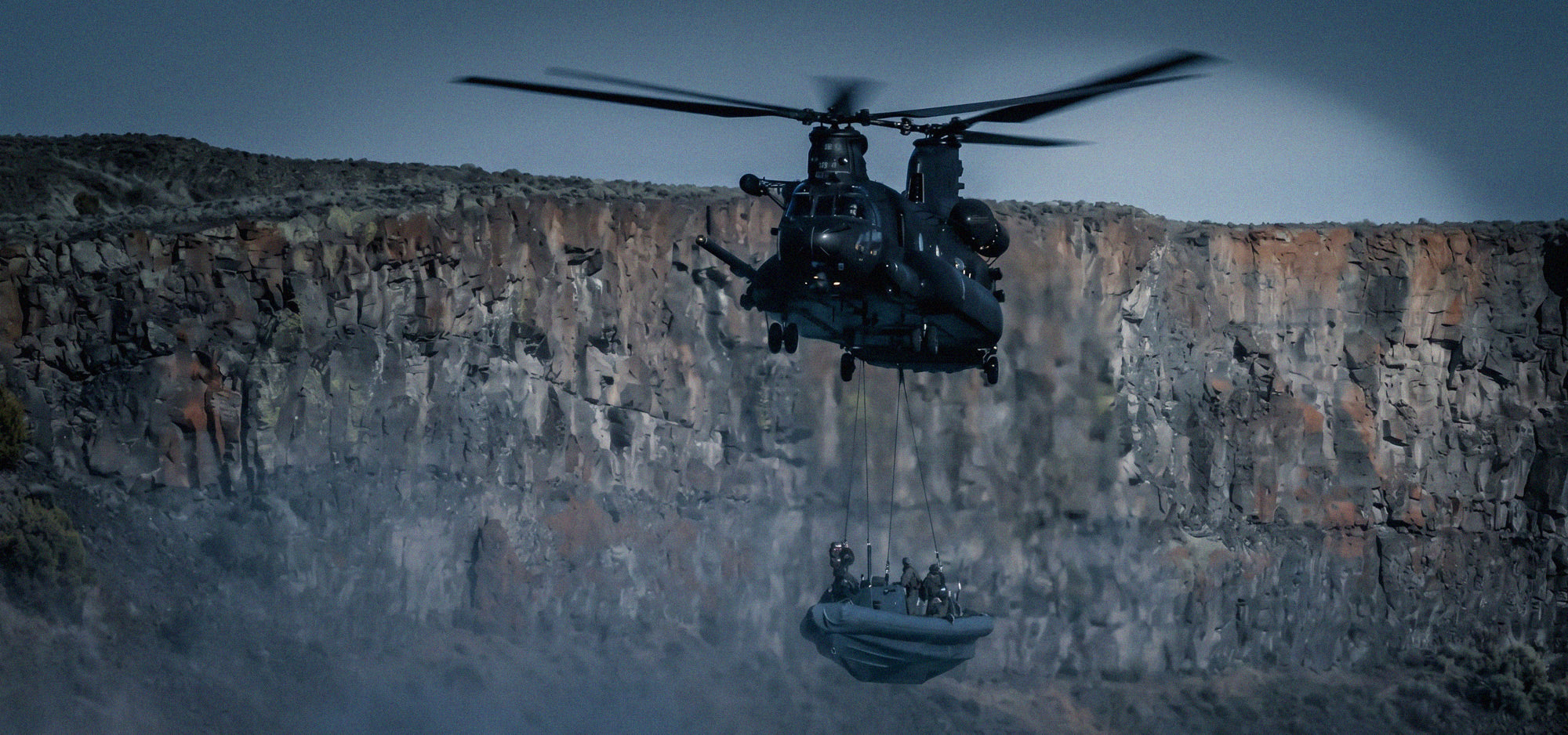
Some aircraft serve a single role throughout their careers. Others evolve with the times.
05-03761, a MH-47G Chinook, is one of the rare aircraft that spent decades transforming alongside the U.S. Army itself. What began life as a CH-47A Chinook during the Vietnam era would later be rebuilt into a CH-47D before ultimately becoming an MH-47G, one of the world's most capable special operations helicopters. Get yours here: MH-47G PlaneTags
Its story spans nearly sixty years of Army aviation history, from the Cold War to modern special operations missions. Along the way, it served as part of a helicopter family that has transported troops, lifted artillery, delivered supplies, supported humanitarian relief efforts, and carried elite operators into some of the most demanding environments on Earth.
Assigned in its final form to the famed Night Stalkers of the 160th Special Operations Aviation Regiment (SOAR), 05-03761 represents the remarkable adaptability of both the Chinook platform and the crews who flew and maintained it.

Today, this aircraft's legacy lives on through PlaneTags, preserving a piece of a helicopter whose service history reflects generations of innovation, sacrifice, and service.
The Helicopter That Changed Army Aviation
The story of 05-03761 begins long before the aircraft itself was built.
In the late 1950s, the U.S. Army sought a replacement for the piston-powered Sikorsky CH-37 Mojave. The Army needed a helicopter capable of carrying heavier loads, flying farther, and operating more efficiently than existing transport helicopters. Boeing Vertol answered the challenge with a revolutionary design that would become one of the most recognizable military helicopters ever built.
Unlike conventional helicopters, the new aircraft used tandem rotors mounted at the front and rear of the fuselage. This design eliminated the need for a tail rotor, allowing more engine power to be devoted to lifting people, vehicles, artillery, and supplies. The result was the CH-47 Chinook.
The Chinook first flew in 1961 and entered Army service soon afterward. What began as a heavy-lift transport helicopter quickly proved itself capable of far more. Over the decades, Chinooks have supported combat operations, humanitarian relief efforts, disaster response missions, and military exercises around the world.
More than sixty years later, the Chinook remains in active service, making it one of the longest-serving military aircraft designs in U.S. history.
Born During the Vietnam Era
The aircraft that would eventually become 05-03761 began life as CH-47A serial number 66-19043. Built during the height of the Vietnam War, it entered service at a time when the Chinook was proving indispensable to Army operations in Southeast Asia. The helicopter's ability to move large loads across difficult terrain made it one of the most valuable aircraft in the Army's inventory.

Vietnam 1969 flickr photo by Judge Rock shared under a Creative Commons (BY-NC 2.0) license
In Vietnam, Chinooks transported troops to remote locations, delivered supplies to forward operating bases, carried artillery into position, recovered damaged aircraft, and evacuated wounded personnel. Their distinctive tandem-rotor silhouette became a familiar sight throughout the conflict.
While the specific details of 66-19043's early service remain unknown, it belonged to a generation of Chinooks that demonstrated the helicopter's versatility and reliability under some of the most demanding conditions imaginable. The success of these early aircraft helped establish the Chinook as a cornerstone of Army aviation, a role it continues to fill today.
A Second Life as a CH-47D
Many military aircraft are retired after a few decades of service. This Chinook's story was only beginning.
Rather than replace its fleet entirely, the U.S. Army invested in extensive modernization programs designed to keep proven airframes flying for decades. Through these efforts, older Chinooks were rebuilt with upgraded systems, engines, and avionics that dramatically improved their capabilities.
As part of this process, 66-19043 was remanufactured into a CH-47D and redesignated as serial number 82-23767.

D-666 CH-47D 298Sqn RNLAF flickr photo by Denmen Aviation Photography shared under a Creative Commons (BY-NC-ND 2.0) license
The upgraded CH-47D featured more powerful engines, increased lifting capability, improved reliability, and modernized flight systems. The transformation extended the aircraft's service life while allowing it to meet the demands of an evolving battlefield. For the crews who operated them, the CH-47D represented a significant leap forward. Yet even this would not be the aircraft's final evolution. Another transformation still lay ahead.
Joining the Night Stalkers
The next chapter in this Chinook's story began with one of the most consequential moments in modern U.S. military history.

In April 1980, Operation Eagle Claw, the mission to rescue American hostages in Iran, ended in tragedy after a series of equipment failures and unforeseen challenges forced the operation to be aborted. The mission exposed a critical need for aviation units specifically trained to support special operations forces under the most demanding conditions.
In response, the U.S. Army established what would become the 160th Special Operations Aviation Regiment (Airborne), better known as the Night Stalkers.

160719-N-BL637-111 flickr photo by U.S. Pacific Fleet shared under a Creative Commons (BY-NC 2.0) license
The regiment was built around a simple but demanding mission: fly where others could not, at times when others would not. Night Stalker crews became experts in low-level flight, operating in darkness, navigating difficult terrain, and supporting special operations forces around the world. Their aircraft and training evolved to meet missions that often required extraordinary precision, endurance, and adaptability.
At some point during its long service life, this Chinook was selected for conversion into the most advanced special operations variant ever built: the MH-47G. Redesignated as serial number 05-03761, the aircraft joined a select fleet tasked with supporting some of the military's most sensitive and demanding operations. For an aircraft that began life during the Vietnam era, it was a remarkable transformation, one that carried it into an entirely new generation of warfare.
What Makes an MH-47G Different?
At first glance, the MH-47G looks similar to other Chinooks. Look closer, however, and the differences become clear.

121009-N-FH966-079 flickr photo by U.S. Pacific Fleet shared under a Creative Commons (BY-NC 2.0) license
Designed specifically for special operations missions, the MH-47G incorporates advanced technology that allows it to operate farther, longer, and in more challenging conditions than standard transport helicopters.
One of its most recognizable features is the in-flight refueling probe mounted on the nose. This capability allows the aircraft to receive fuel while airborne, dramatically extending its range and enabling missions that would otherwise be impossible.

160th SOAR(A) Mid-air Refueling. Photo courtesy of dvids.com
The MH-47G also features advanced navigation systems, specialized communications equipment, terrain-following capabilities, and mission-specific avionics designed to support operations in low-visibility environments.
These upgrades allow crews to fly long distances at low altitude, often at night, while carrying personnel, vehicles, equipment, and supplies into areas where conventional aircraft may be unable to operate.
The result is one of the most capable heavy-lift helicopters ever developed, combining the proven strength of the Chinook platform with technologies tailored for special operations missions. For the Night Stalkers who fly and maintain them, the MH-47G is more than a transport helicopter. It is a critical tool that enables missions around the globe.
MH-47G At A Glance

MH-47G Specifications:
- Manufacturer: Boeing
- Model: MH-47G Chinook
- S/N: 05-03761
- Crew: 5 (2 pilots, 3 crew chiefs/aerial gunners)
- Rotor Diameter: 60 ft 0 in
- Length (fuselage): 51 ft 2 in
- Height: 18 ft 8 in
- Mission: Special operations heavy assault support, long-range infiltration/exfiltration, heavy lift, resupply, personnel recovery, and direct-action support
- Sensors: FLIR/EO sensor, multimode terrain-following/terrain-avoidance/weather radar, CAAS glass cockpit, NVG-compatible cockpit, and defensive aids suite
- Armament: Crew-served 7.62mm weapons, typically M134 Miniguns and/or M240 machine guns; exact loadout varies
MH-47G Performance:
- Range: 575 mi
- Max Speed: 196 mph
- Ceiling: 20,000 ft
- Empty Weight: 24,578 lb
- Maximum Takeoff Weight: 54,000 lb
- Rate of Climb: 2,000+ ft per minute
- Engine: 2x Honeywell T55-GA-714A turboshaft engines
- Fuel Capacity: 2,067 gal with extended-range fuel system and aerial refueling capability
The Missions We'll Never Know
Unlike many historic aircraft, much of 05-03761's operational history may never be fully known. That uncertainty is part of what makes this aircraft unique.
The 160th Special Operations Aviation Regiment routinely supports missions whose details remain classified long after they are completed. While specific information about this aircraft's service is limited, the role of the MH-47G within the regiment is well understood. Read about just one special forces mission we do know about.
These helicopters are used to infiltrate and extract personnel, deliver equipment and supplies, support special operations forces, and operate in environments where precision and discretion are essential. Their crews train extensively to fly in darkness, adverse weather, and complex terrain.
The aircraft often receives little public attention, yet its missions can have an outsized impact. Success is frequently measured not by headlines, but by the fact that a mission is completed without anyone ever hearing about it.
For that reason, the story of 05-03761 is not defined by a single operation. Instead, it represents the thousands of hours flown, the countless maintenance actions performed, and the dedication of the crews who ensured the aircraft was ready whenever it was needed. Some stories remain classified. The service and sacrifice behind them should never be forgotten.
Three Identities. One Aircraft.
Few aircraft experience a transformation as dramatic as this one.
Over the course of nearly six decades, the helicopter carried three different identities as Army aviation evolved around it.
1966
CH-47A 66-19043 enters service as part of a new generation of turbine-powered heavy-lift helicopters.

Photo courtesy of chinook-helicopter.com
1980s
The aircraft is remanufactured and redesignated CH-47D 82-23767, receiving upgraded systems and extending its service life.
2000s
It undergoes another transformation, becoming MH-47G 05-03761 and joining the ranks of the elite Night Stalkers.
2026
After decades of service, the aircraft begins its final mission: preserving its history through PlaneTags.

Each redesignation reflected a new chapter in the aircraft's life, allowing it to remain relevant across multiple generations of military aviation. Few helicopters can claim such a remarkable journey from the Vietnam era to modern special operations service.
Discovering a Night Stalker

When PlaneTags founder Dave Hall located 05-03761 in Delaware, he knew he had found a rare aircraft with an extraordinary story. The helicopter's service life had spanned decades, multiple redesignations, and assignment to one of the most respected aviation units in the world. To preserve it, the aircraft first had to be relocated to a facility where it could be carefully dismantled and prepared for its next chapter.


It was during that process that the team made an unexpected discovery. As sections of the helicopter were examined, bullet holes became visible in portions of the airframe. The markings offered a sobering reminder that this aircraft's history extended far beyond serial numbers and specifications. While the circumstances surrounding the damage remain unknown, the evidence served as a physical connection to the demanding environments in which special operations aircraft often operate.


For the PlaneTags team, moments like these are among the most powerful parts of aircraft preservation. Every scratch, repair, modification, and mark tells part of a story. Some stories can be documented. Others remain known only to the crews who flew and maintained the aircraft.

The bullet holes found in 05-03761 may never reveal their full story, but they stand as a reminder that this helicopter was more than a machine. It was a working aircraft that served real missions with real people aboard.


Preserving a Night Stalker Legacy
By the time 05-03761 reached retirement, it had spent nearly sixty years adapting to the changing needs of Army aviation. From its beginnings as a Vietnam-era CH-47A to its final years as a special operations MH-47G, the aircraft represented generations of innovation, service, and dedication.
Its story is also the story of the people behind it: the pilots who flew it, the crew chiefs who trusted it, the maintainers who kept it mission-ready, and the soldiers who depended on it.

Boeing MH-47D Chinook - U.S. Army Special Operations Command's 160th Special Operations Aviation Regiment (Airborne) (SOAR(A)) "Night Stalkers"; at KEFD flickr photo by AV8PIX Christopher Ebdon shared under a Creative Commons (BY-NC-SA 2.0) license
Today, pieces of 05-03761 live on as PlaneTags. Each tag preserves a small part of a helicopter that evolved across three generations of service and supported one of the most respected aviation units in the world. For collectors, veterans, aviation enthusiasts, and historians alike, it represents far more than a piece of aluminum.


It is a tangible connection to the legacy of the Chinook, the Night Stalkers, and the countless individuals who answered the call whenever and wherever they were needed.
Night Stalkers Don't Quit. Neither does their legacy.


Explore More Vietnam-Era Aircraft
Although 05-03761 spent its final years serving with the Night Stalkers, its story began during the Vietnam era as CH-47A 66-19043. That connection places this aircraft among a remarkable generation of military aircraft that shaped aviation history during one of the most transformative periods of the twentieth century.
From the battlefield reconnaissance of the OV-1D Mohawk and the heavy-lift capabilities of the Chinook to iconic fighters such as the F-4 Phantom II, F-100 Super Sabre, A-4 Skyhawk, A-7 Corsair II, F-5 Freedom Fighter, and MiG-21, these aircraft played critical roles in the conflicts and technological advances of the era.
Today, PlaneTags preserves pieces of many of these historic aircraft, allowing collectors to own a tangible connection to the pilots, crews, maintainers, and missions that defined a generation.
Explore our Vietnam Era Collection to discover more aircraft stories and preserve a piece of aviation history for your own collection.

Share:
Grumman OV-1D Mohawk: The U.S. Army's Battlefield Eye in the Sky
The Airbus A330 That Helped Take Azul Beyond Brazil