

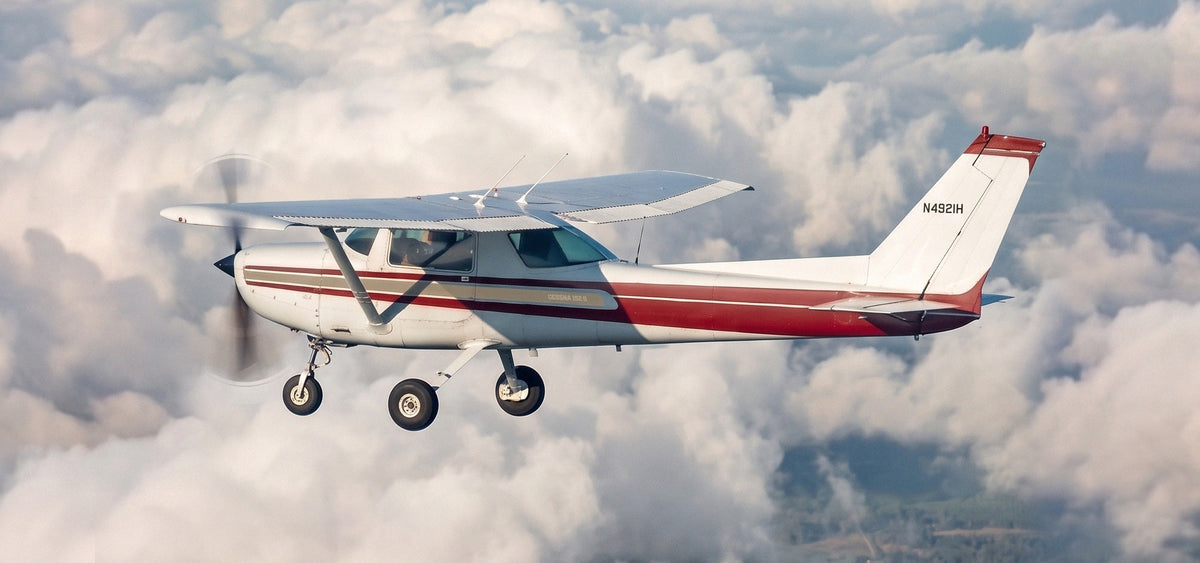
For generations of aviators, the journey to the skies began in a small, two-seat airplane. The Cessna 152 helped turn the dream of flying into reality, one lesson at a time.
Every pilot remembers their first flight. The anticipation before takeoff, the unfamiliar feeling of controlling an airplane, and the moment the wheels leave the runway. For many, those memories are connected to the Cessna 152.
Small, dependable, and designed with the student pilot in mind, the Cessna 152 became one of the most recognizable training aircraft in general aviation. It wasn't the fastest or most powerful airplane in the sky, but it served an important purpose: helping people learn to fly.
Today, MotoArt PlaneTags is preserving a piece of that history with the introduction of PlaneTags made from a 1979 Cessna 152, registration N4921H.
Building on a Proven Design
The Cessna 152 grew out of one of general aviation's most successful training aircraft, the Cessna 150. Introduced for the 1978 model year, the 152 retained the familiar high-wing configuration and two-seat cockpit while incorporating improvements intended to make it a more capable and practical trainer.

Cessna 152 II flickr photo by Armchair Aviator shared under a Creative Commons (BY 2.0) license
One of the most significant changes was the introduction of the Lycoming O-235 engine, producing 110 horsepower compared with the earlier Cessna 150's 100-horsepower Continental engine. The updated airplane also featured a slightly wider cabin, a revised electrical system, and an increased maximum gross weight of 1,670 pounds.
These refinements helped the Cessna 152 establish its own identity while preserving the straightforward flying characteristics that made its predecessor so popular.
More than 7,500 examples were produced before manufacturing ended in 1985, establishing the Cessna 152 as a lasting presence in flight training.
An Airplane Built for Learning
Learning to fly requires more than understanding instruments and memorizing procedures. It means developing the ability to recognize what an airplane is doing and respond confidently. The Cessna 152 provided an excellent environment for developing those skills.
Its high-mounted wings offered good visibility toward the ground, while its relatively simple cockpit allowed students to concentrate on the fundamentals of flight. Fixed tricycle landing gear eliminated the additional complexity of retractable gear, and its predictable handling made it suitable for repeated takeoffs, landings, and training maneuvers.

By BestOnLifeform - Own work, CC BY-SA 4.0, Link
With an instructor seated beside them, student pilots could practice everything from straight-and-level flight and coordinated turns to stalls, emergency procedures, and cross-country navigation.
Eventually came one of aviation's great milestones: the first solo flight. For a student pilot, flying alone for the first time is an unforgettable achievement. And for generations of aviators, the Cessna 152 was the airplane that made that moment possible.
Cessna 152 At A Glance

Cessna 152 Characteristics
- Manufacturer: Cessna Aircraft Company
- Type: Cessna 152 II (1980 Model)
- Tail #: N4921H
- Serial #: 152-84021
- Crew: 1 Pilot (2 Seats)
- Wingspan: 33 ft 4 in
- Length: 24 ft 1 in
- Height: 8 ft 6 in
Cessna 152 Performance
- Range: 415 nm
- Cruise Speed: 107 kts
- Ceiling: 14,700 ft
- Empty Weight: 1,142 lb
- Max Takeoff Weight: 1,670 lb
- Rate of Climb: 715 ft/min
- Engine: 1x Lycoming O-235-L2C, 110 hp, with a two-blade McCauley fixed-pitch propeller
Memories from the Cockpit
For generations of pilots, the Cessna 152 was more than a training aircraft. It was where they experienced their first takeoff, learned from their mistakes, and discovered the freedom of flight.
We asked three members of the PlaneTags community to share what flying the Cessna 152 meant to them. From a first solo at Fullerton Airport to unforgettable flights through the mountains of Alaska, their stories reveal why this little airplane continues to hold such a special place in aviation.
Husam Bazzi: A First Solo to Remember
For PlaneTags collector and pilot Husam Bazzi, the Cessna 152 holds a special place in his aviation journey. It's the aircraft in which he earned his private pilot license and experienced one of aviation's most unforgettable milestones: his first solo flight.
Husam began his training in the Cessna 152, practicing maneuvers in the Long Beach, California practice area before returning to Fullerton Airport for landing practice. He remembers the aircraft as an ideal trainer because of its forgiving handling, nimble performance, and economical fuel consumption.
But one flight stands above the rest.
During what seemed like a routine lesson practicing takeoffs and landings, Husam's instructor made an unexpected announcement to Fullerton Tower. They were returning to parking so his student could make his first solo flight.
"I looked at him shocked and was excited and nervous at the same time," Husam recalled.
His instructor stepped out of the airplane with a few memorable words of encouragement:
"He said, Fly good don't suck and remember that I can always go around."
That first solo remains Husam's favorite memory from his aviation journey.
And what would owning a Cessna 152 PlaneTag mean to him?
"Owning a 152 PlaneTag would mean the world to me. I have so many hours in one that it's basically my baby."


Paul Davies: An Airplane That Opened Up the World of Aviation
For Paul Davies, creator and head moderator of the Facebook fan group MotoArt PlaneTags Collections and owner of Final Approach Fabrication, the Cessna 152 represents the beginning of a lifelong connection to aviation.
As both a pilot and a dedicated PlaneTags enthusiast, Paul remembers the Cessna 152 for its forgiving handling, excellent stall characteristics, and versatility as a training aircraft. But it's the memories made along the way that mean the most.
"Owning a Cessna tag brings back all the memories of flight training; all the emotions of my first landing, my first solo, first cross country, first stall, and all the times I messed up and learned how to improve my flying skills."
For Paul, every lesson, including the mistakes, became part of the journey.
"I'm so grateful to those birds for opening up the world of aviation to me."


Rob Schneider: From First Flight to the Mountains of Alaska
For MotoArt historian and Operations Manager Rob Schneider, the Cessna 152 brings back memories of where his aviation journey began, from his very first flight lesson to unforgettable adventures through the mountains of Alaska.
Rob remembers the 152 as an ideal training aircraft, with simple systems, forgiving handling, and a reliable engine. He especially appreciated its high-wing design, which provided excellent visibility of the ground for visual navigation.
But what he remembers most is the excitement of those early days.
"I still remember that first walkaround with my flight instructor, carefully examining the aircraft, checking the flight controls, and finally climbing into the cockpit to start the engine for my very first flight as a student pilot. That feeling of excitement and anticipation is something I'll never forget."
His experiences in the Cessna 152 eventually took him into the Alaskan mountains, creating memories that remain among his favorites.
"I made so many incredible memories flying the Cessna 152 through the mountains of Alaska. Those flights were some of the best experiences of my life."
Although N4921H isn't the aircraft Rob flew, owning a PlaneTag made from another Cessna 152 holds a special meaning.
"It's more than just a collectible to me. It's a reminder of where my love for aviation began and the experiences that made flying so special."
Different pilots, different experiences, but one shared connection to an airplane that helped shape their love of aviation. For Husam, Paul, and Rob, a Cessna 152 PlaneTag is more than a piece of aircraft metal. It's a tangible reminder of the flights, lessons, and memories that began in the cockpit of a little two-seat Cessna.
The Story of N4921H
Manufactured in 1979, Cessna 152 N4921H carried serial number 152-84021. Over its years of operation, the airplane accumulated more than 6,455 hours of recorded service, reflecting the extensive use that made the Cessna 152 such a familiar sight at airports and flight schools.
N4921H was a Cessna 152 II, an upgraded equipment version of the popular two-seat trainer. The 152 II offered enhanced avionics and interior appointments while retaining the same basic airframe, engine, and forgiving flying characteristics that made the Cessna 152 a flight-school favorite.
Its documented history includes an accident on August 18, 1993, at Hardwick Field in Cleveland, Tennessee. According to the National Transportation Safety Board, N4921H was taxiing for takeoff during an instructional flight when the student pilot reported losing brake pressure. The flight instructor assumed control, but the airplane continued off the run-up pad and down an embankment, where it came to rest inverted.
Both the instructor and student escaped without injury. The airplane sustained substantial damage. Although the subsequent examination did not identify a mechanical problem with the braking system, the accident marked a significant event in the aircraft's documented history.
Decades later, material from N4921H found a new purpose.


When MotoArt recovered material from N4921H, the aircraft still carried its distinctive red, white, and dark striping, along with decades of weathering. The recovery process involved carefully removing sections of the original aircraft skin, preserving material that would otherwise remain part of a retired airframe. That material is now being given a new purpose as Cessna 152 PlaneTags, each carrying a tangible connection to the aircraft's history.


Preserving a Piece of Flight Training History
In 2026, MotoArt PlaneTags transformed authentic material from N4921H into collectible aviation keepsakes.


Each PlaneTag preserves a physical connection to an aircraft type that introduced generations of pilots to the freedom of flight. For someone who learned to fly in a Cessna 152, it may bring back memories of an instructor's voice, a first successful landing, or the moment they took to the skies alone.
For aviation enthusiasts and collectors, it represents something equally meaningful: a piece of the aircraft that helped make flying accessible to so many people.
The Cessna 152 may be small, but its place in aviation history is anything but.
Cessna 152 N4921H PlaneTags launch Thursday, October 22, 2026, at 12 PM Pacific.
Explore More Cessna PlaneTags
From general aviation trainers to regional commuter aircraft and military jets, Cessna's history spans generations of pilots and passengers. MotoArt PlaneTags has preserved material from several aircraft representing that legacy.
Cape Air Cessna 402C Utiliner N1361G
A twin-engine regional commuter that served Cape Air's network of short-haul destinations, representing an important part of regional passenger aviation.
Cessna 402C Businessliner N526FA
Part of Cessna's versatile 402 family, the Businessliner was designed for practical passenger and business transportation.
A twin-engine jet trainer that helped prepare generations of U.S. Air Force pilots for more advanced military aircraft.
One of general aviation's most recognizable aircraft, the Cessna 172 has introduced countless people to flying. Our N6922A PlaneTags are sold out, but remain part of our collection's history.
Explore more Cessna PlaneTags and discover the aircraft that helped shape aviation history.
Share:
Dassault Falcon 2000 N250DL: A Business Jet with a Casamigos Connection